 Michael Liebreich
Host of Cleaning Up.
Michael Liebreich
Host of Cleaning Up.
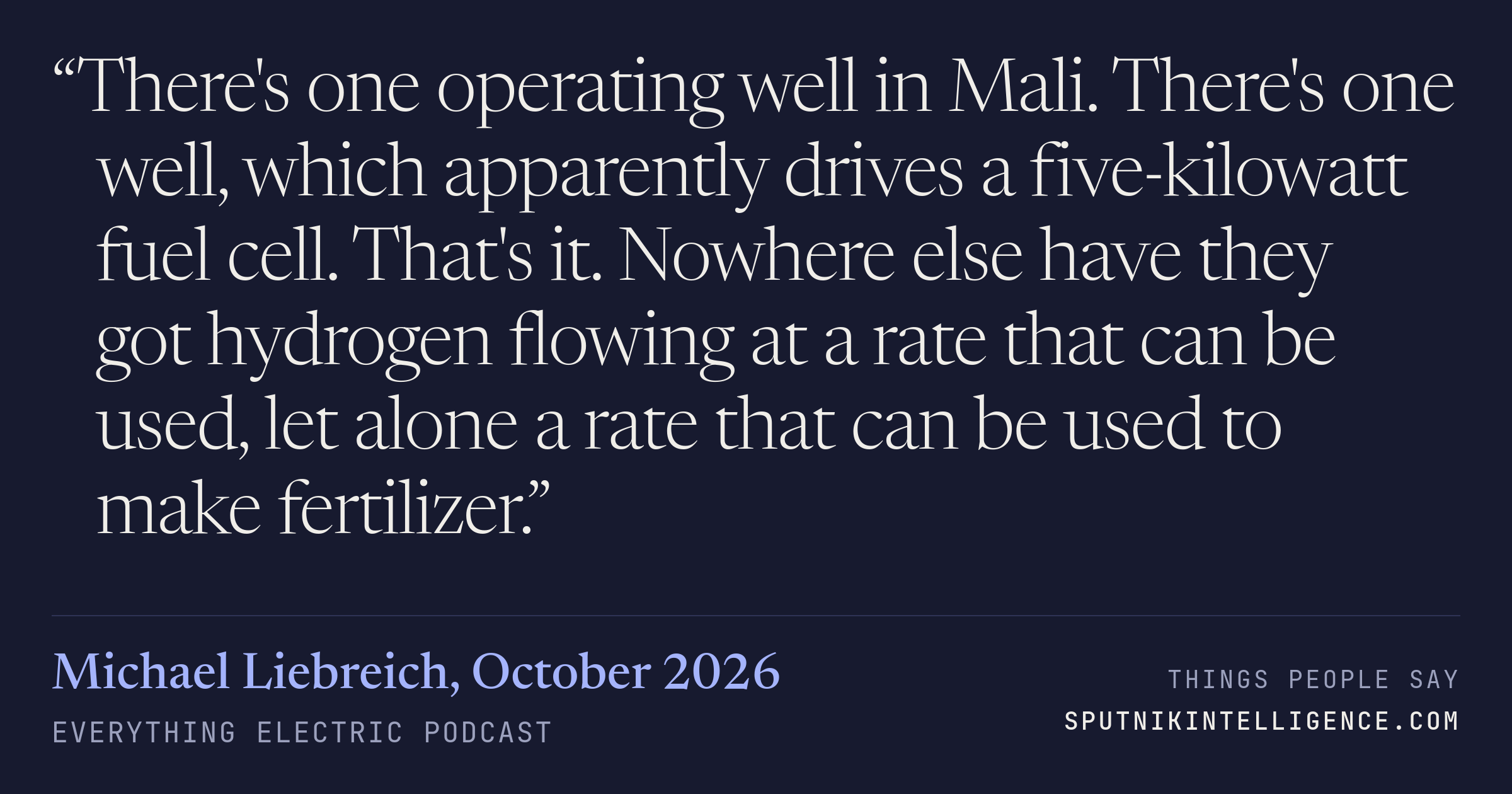
“There's one operating well in Mali. There's one well, which apparently drives a five-kilowatt fuel cell. That's it. Nowhere else have they got hydrogen flowing at a rate that can be used, let alone a rate that can be used to make fertilizer.”
Everything Electric Podcast · Climate & Energy · October 2026
Liebreich on the recent excitement about geological hydrogen, sometimes called white hydrogen, found underground. He said the reported finds are mostly dissolved in water and don't come out when you drill.
Transcript
You know, I haven't forgotten. I'm talking to the first time we met, you said that the ocean is a great big heat pump. It's a thermodynamic system and it's being powered by the energy flows, and that enormously appealed. So you are a really proper thermodynamicist, which is great. Because, you know, fundamentally, when you talk about something like ESAF, right? It is sustainable aviation fuel made from electricity, using electricity from taking water, splitting it, get the hydrogen, take air, separate out the CO2, combine them, then refine them, create the right molecules, et cetera, et cetera. What you're really doing is reversing combustion. You've taken some fuel, you've burnt it, you've got water and CO2, and now you're reversing that. And guess what, thermodynamicist? Burning stuff is an irreversible process. It is, in other words, you have to put in work to reverse it, lots of work. And so, yes, it's just inherently incredibly expensive. But there's more than that. There's also the physical properties of hydrogen. So it's not just that it's really hard to make the hydrogen, or in the case of the fuel, to make the fuel, but well, in the case of hydrogen, it's transporting it, it's storing it, it's distributing it, it's keeping it safe. It's all of the value chain. It's just incredibly expensive. And frustratingly, because I would love if I would love it, it would be so wonderful if it was just kind of cheap and easy. And if you didn't have to put in lots of work and so on. But unfortunately, it's just a horrible, horrible process, horribly expensive process right the way through the value chain.
I kind of find it fascinating in the really big picture, and this is very, very big picture because the universe is something like 74% hydrogen. So if you were to come from some other universe and arrive in our universe and say, how are you going to get things done? You go, oh, there's all this hydrogen. Everything's made of hydrogen, right? Except on Earth, where actually there's not that much hydrogen, and where there is, it's bound up with other things. It becomes very hard to use. So
you'll know the answer to this probably where I don't. How much of that 74% in the universe is not bound to another atom? How much of it is free? Because on Earth, you know, there is a bit of free hydrogen. And that's the other thing in the last few years, everybody's gone crazy about geological hydrogen, white hydrogen, they call it. And, you know, and you get all these, you know, breathless stories. They found 98% proof, 90% proof hydrogen through some borehole. It's like, yes, but it's actually all of it dissolved in water. And none of it comes gushing out when you punch a hole in the ground. There's one operating well in Mali. There's one well, which apparently drives a five-kilowatt fuel cell. That's it. Nowhere else have they got hydrogen flowing at a rate that can be used, let alone a rate that can be used to make fertilizer, let alone the rate that would be needed if you actually wanted to put it in a pipeline to a place where they actually make fertilizers. So, I mean, hydrogen, yeah, there's a lot of it, but it's kind of doing other things, right?
So to answer your question, I think most of the hydrogen in the universe is in stars, and that probably means it's in a plasma form. So it's not, it's, it's in neither case. It's not, it's, it's, it's the two atoms that make up H2 will be floating around because it's so hot they can't stay bound together. So I'm not absolutely certain of my uh planetary stages, but I'm pretty sure most of the hydrogen in the universe will be inside a star and will therefore be plasma. Well, if we just stick
to the solar system, we know that's true, right? Because the sun weighs a lot more than the earth and it's all hydrogen. Okay, good. So we've got a lot of hydrogen. Fine. I don't know how you can. But it's in the sun.
I mean, that's the point. It's in the sun doing undergoing nuclear fusion in the sun. That's the right place for hydrogen. It's very good at that. I mean, stars are actually very inefficient, but you know, they're very big, so it's fine. So I had a lot of
More from Everything Electric Podcast