← Things People Say on Podcasts

Crypto & Web3 · August 2026

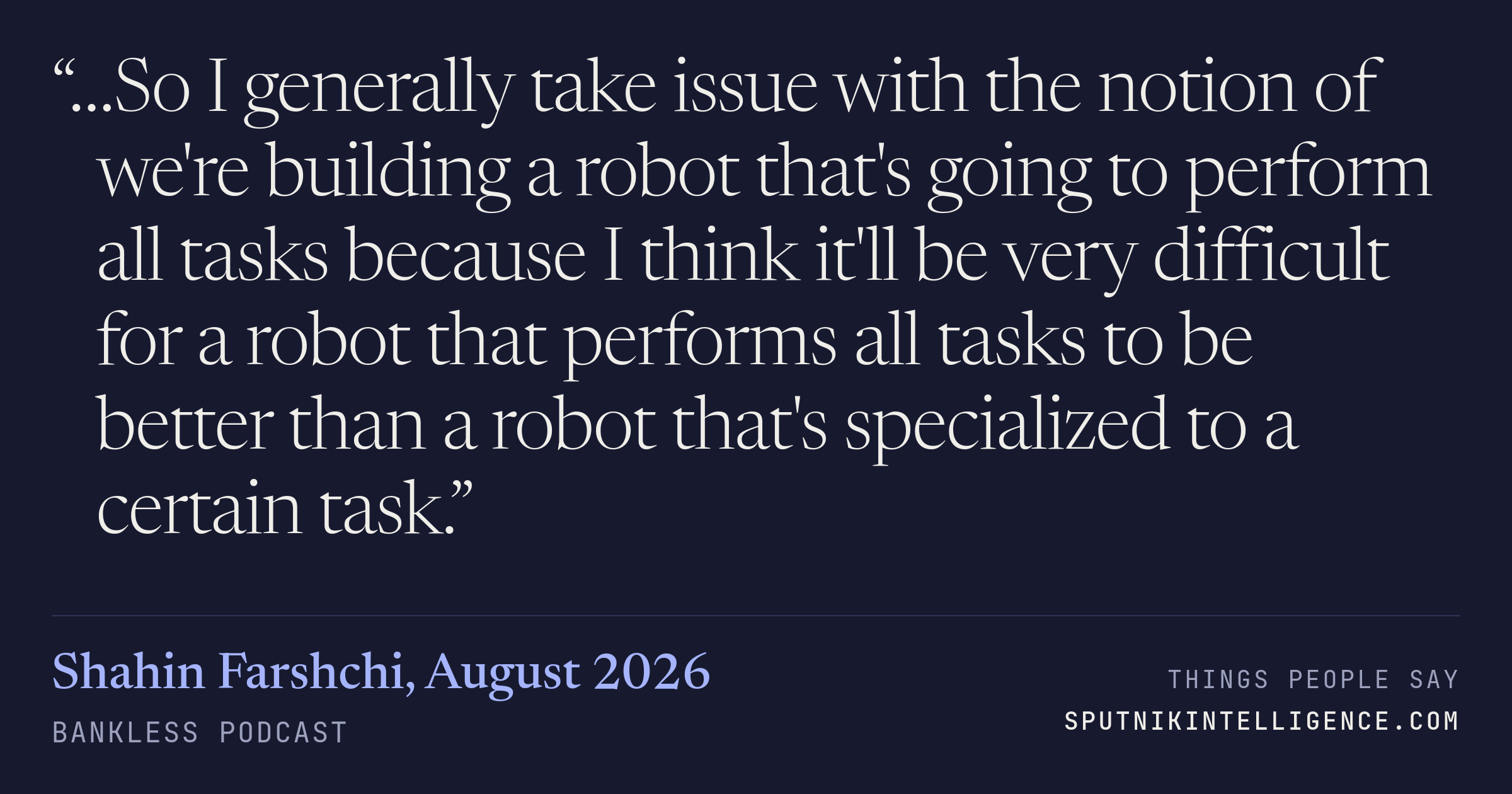
“…So I generally take issue with the notion of we're building a robot that's going to perform all tasks because I think it'll be very difficult for a robot that performs all tasks to be better than a robot that's specialized to a certain task.” — Shahin Farshchi, Bankless

Farshchi had been arguing that robots share components the way phones and laptops share processors and screens: common parts, very different machines. He used that to reject the general-purpose humanoid premise outright — a machine built to do everything loses to one built for the job. He then pointed out that specialised robots are the only ones that have actually proliferated, on industrial lines like Ford's.

Transcript

Bankless Around 16:49 into the episode
Shahin Farshchi

I would say, yes, broadly. There are components that go into these robots that will be consistent across use cases. The cameras, the force sensors, the reduction gear sets, the encoders, the power management systems, the actual arms. The

David Hoffman

building blocks. The building blocks.

Shahin Farshchi

For example, if you look at a smartphone, it may have little resemblance with, for example, a laptop, a small, inexpensive laptop. The use case for the cell phone may be very different from the use case, let's say, for example, for an iPad. Yet a lot of the technology that goes into the phone, the ARM-based processor, the memory, the Wi-Fi interface, the video driver, even the L C D screen itself, there are different form factors. They have different specifications, but they share the same basic technological architecture. Even their operating systems may share many, many thousands of lines of code, but they're used for very different use cases with a similar technology basis. So when you see a robotic arm that is doing welding, it may have the same motors, encoders, force sensors, cameras as the robot that's doing the riveting, but the robot that's doing the riveting may have a larger, for example, range of motion. It has a different end effector attached to it. And so it is engineered for that use case, yet that use case is very broad, but not as broad as doing everything for everybody. So I generally take issue with the notion of we're building a robot that's going to perform all tasks because I think it'll be very difficult for a robot that performs all tasks to be better than a robot that's specialized to a certain task. And why would someone not use a robot that's specialized to that certain task?

David Hoffman

And so on the specialization end of the spectrum, the specialization to generalization spectrum, I guess the bottleneck is if we indeed do have all of the raw ingredients that it takes to make a robot, we have the power, we have the actuators, the ball bearings. Really, the constraint is the ability to put them in the right package according to the actual task at hand. Is that the current constraint? Is great, we have the pieces, but we need to put them in the right shapes. And that part can be more difficult. because there's more possible shapes to order all the pieces in than could, you know, there's so many possible shapes to order all the pieces that it's a little bit hard to bear. Is that a fair assessment?

Shahin Farshchi

And that's why you've only seen robotics proliferate in these larger industrial settings. Ford has tens of millions of dollars that it can deploy to companies who specialize in this, companies like Honeywell, Dematic, Symbotic, Winrite, these companies who specialize in engineering robotic solutions for a particular use case. In Ford's case, it would be an assembly line. So the robots that, for example, put a sheet of aluminum into a stamp, the robots that take those sheets of aluminum, the stamped aluminum out of the stamp, put into another stamp. And then the robot that has a camera at the end that inspects the stamped part to make sure there's no defects. And then the robot that puts two pieces of stamp metal together and the other robot, a third robot, doing the weld between those pieces of sheet metal, those stamped pieces of sheet metal. And then robots doing the riveting and the gluing and then lowering it into a bath of acid. And the robots that are doing the painting. So there are many tasks that need to be automated that need to be engineered by the integrator, which is extremely expensive. And there are few companies today that can afford to do that with the legacy technology that was available to us until today. And my enthusiasm is rooted to the earlier part of the conversation. And these robots becoming less expensive and the engineering that goes into making them useful becoming far more accessible, just like how anybody can now speak to a computer and generate code. I see a future where someone can speak to an interface powered by AI that will then program the robot to do a specific task rather than you having to hire an engineer to do that for you. And we'll see the more rapid adoption of automation in more and more settings that until now didn't have that access. So you're right. It is taking the individual components and building all the software and the tools that you need to actually make that system that you build for your use case useful.

David Hoffman

It feels like kind of building a developer platform of sorts in that we just, we have all the basic ingredients and we need to be able to allow people to tinker with, play with, you know, combine all of the pieces in order to suit their needs. And making this more and more accessible is going to find, allow the market to place automation in deeper, more niche, more specific parts of the market. So long as we can just figure out how to open up robotics and be more accessible. That's kind of what it feels like.

Speaker names from our own diarization · position estimated from where the line sits in the episode