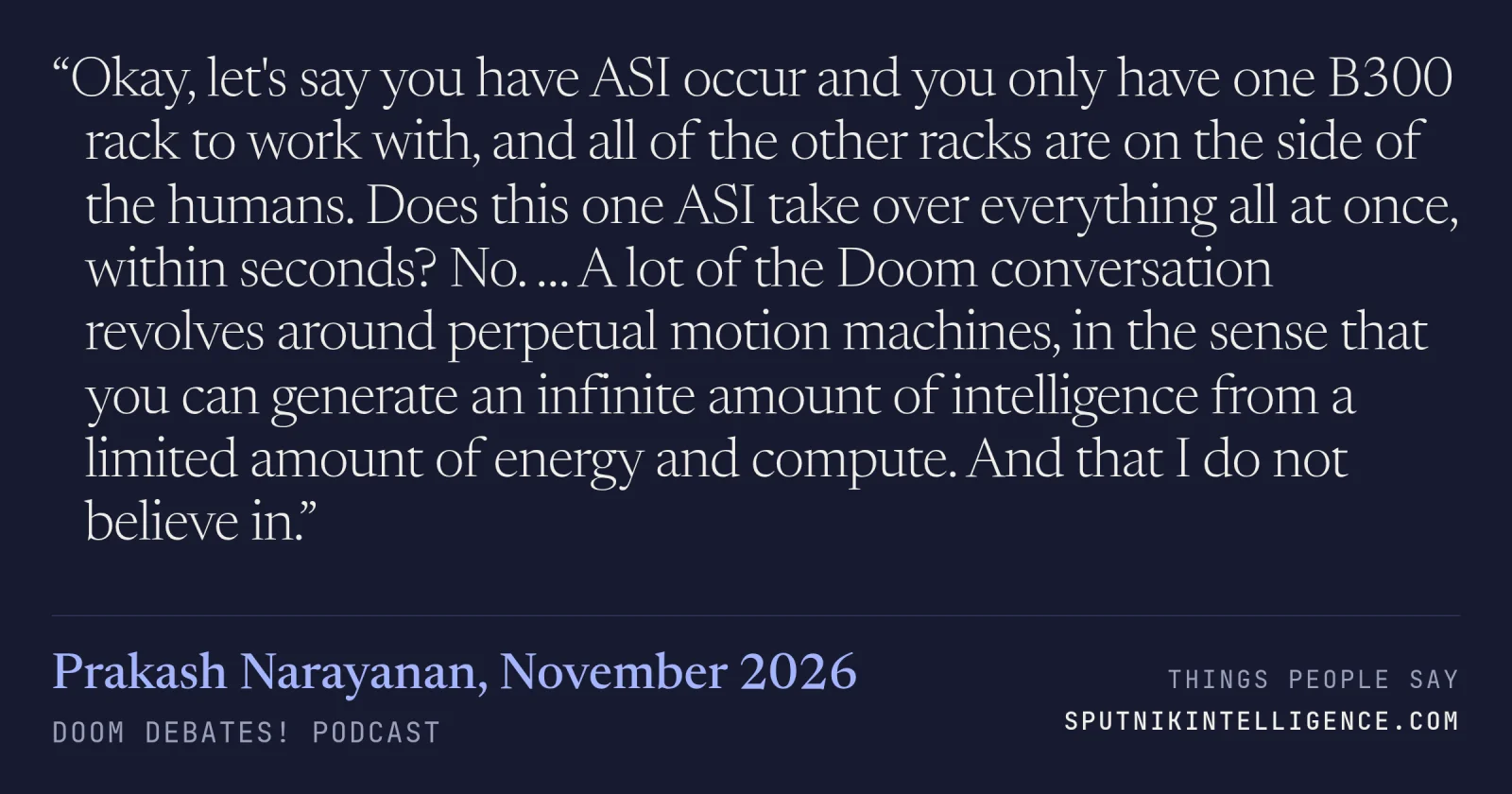
“Okay, let's say you have ASI occur and you only have one B300 rack to work with, and all of the other racks are on the side of the humans. Does this one ASI take over everything all at once, within seconds? No. … A lot of the Doom conversation revolves around perpetual motion machines, in the sense that you can generate an infinite amount of intelligence from a limited amount of energy and compute. And that I do not believe in.”
Doom Debates! · AI Research & Frontier Labs · November 2026
Context
Liron Shapira had asked whether humanity could be outclassed by superintelligence. Prakash answers that physical and compute limits stop any one AI from running away, and this 'perpetual motion machine' framing becomes his main reason for putting the chance of AI doom at zero.
Transcript
I think a single human brain outclassed. Sure. I think the sum total of all human brains and all machines on Earth, you know, versus a single data center? No.
You're saying that the sum of all human brains cannot be outclassed.
Can a single B300 rack? Okay, let's say you have ASI occur and you only have one B300 rack to work with, and all of the other racks are all like, you know, on the side of the humans, right? Like, does this one ASI take over everything all at once? Like within like seconds? No. Right? So I think you have to like, you cannot generate, this is why I call like, you know, this, a lot of the Doom conversation revolves around perpetual motion machines, right? In the sense that you can generate an infinite amount of intelligence from a limited amount of energy and compute. And that I do not believe in, right? I don't believe in that.
Okay. What if you took all of the world's computing power today and you ran the ideal algorithm, meaning in the space of possible algorithms, you know, how to move bits around? Okay. So God comes down and just gives us the ideal, you know, it's a super exponential search space. God just tells us…
No.
Okay. So you really think that like all of our human managers combined with like human real-world experience is just better than all of the world's compute running the ideal algorithm for intelligence. That's a big crux.
More from Doom Debates!