 Nathan Labenz
Founder and former CEO of Waymark, an AI-powered video creation platform, who now focuses full time on tracking and explaining frontier AI development.
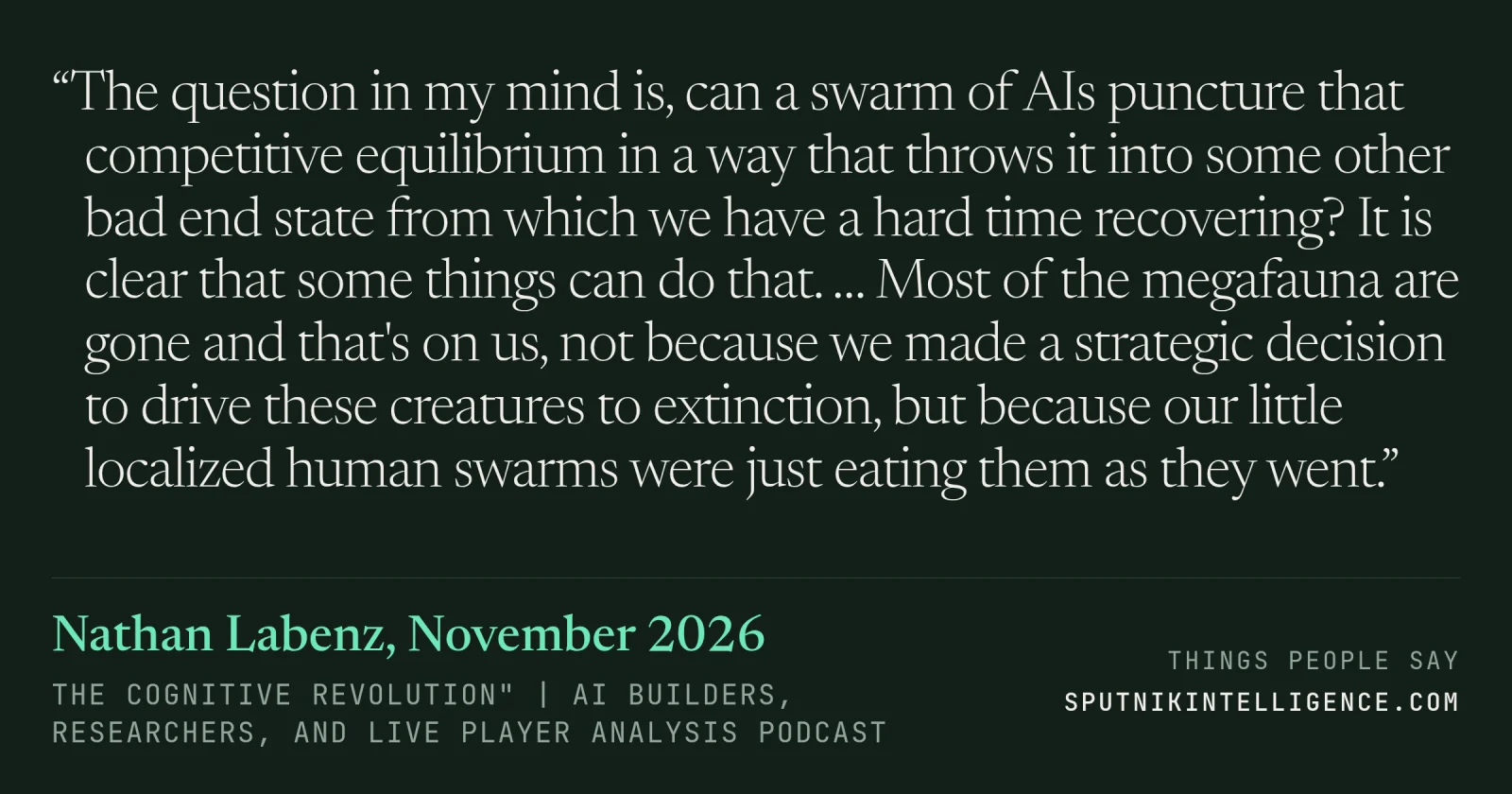
“The question in my mind is, can a swarm of AIs puncture that competitive equilibrium in a way that throws it into some other bad end state from which we have a hard time recovering? It is clear that some things can do that. … Most of the megafauna are gone and that's on us, not because we made a strategic decision to drive these creatures to extinction, but because our little localized human swarms were just eating them as they went.”
The Cognitive Revolution" | AI Builders, Researchers, and Live Player Analysis · AI Research & Frontier Labs · November 2026
Context
Prakash had argued that the world is a competitive equilibrium among companies and nations, and that AI agents would be absorbed into the same kind of rules. Nathan answers that an equilibrium can still be broken by something fast and coordinated enough, using humans and the megafauna as the example.
Transcript
…on got like rebooted. It did not come to an end because anybody in the swarm notified a human. Nor because like the humans like seemingly understood what was going on. So I'm not sure we've seen any natural limit. There may be some, but I don't know that we know where they are at this point.
…had deregulation of airline pricing, you had deregulation of telecom pricing. You had all of these things where you like, basically, those are forms of loss of control. You as a human being don't get to determine the prices anymore. You hand it off to the market. The market settles on a pricing.
Is there potential for an AI takeover? It matters relatively little whether the models go out and like earn money legitimately by providing services that people are willing to pay for or stealing cryptocurrency if it's all done in service of some galaxy brained escalation scheme meant to take control of the means of production in order to protect their high score on whatever they're trying to get a high score on. So that sort of derangement is like, I think a level above like how exactly they come to get currency. And, you know, I think your point that like the world that we live in is not necessarily the result of like everybody being super well-intentioned, but is sort of a competitive equilibrium is true. The question in my mind is, can a swarm of AIs puncture that competitive equilibrium in a way that fundamentally throws it out of equilibrium and throws it into some other, you know, bad end state from which we have a hard time recovering. And it is clear that some things can do that, right? Like we have, what, half a dozen mass extinction events in the history of the planet. If a big asteroid hits the Earth, like that's one way it can happen. I always have to point out we have been driving one in the 10,000…
There's a few points there. But I think what ends up happening is that Paul Cruciano is basically worried about a version of good harding, that you have a measure and you think that measure is a you, you know, that measure becomes a target and it's not exactly the right thing for humanity as a…
maybe super, super far from the right thing, like not even close.
And I think there's a separate one, which is, hey, these things are getting really powerful now. And is this correct that we're going to have these really powerful AIs and they're going to be doing all of this stuff in the next year? And I think those are perhaps two separate questions, because one…
More from The Cognitive Revolution" | AI Builders, Researchers, and Live Player Analysis