 Michael Kofman
Defense analyst
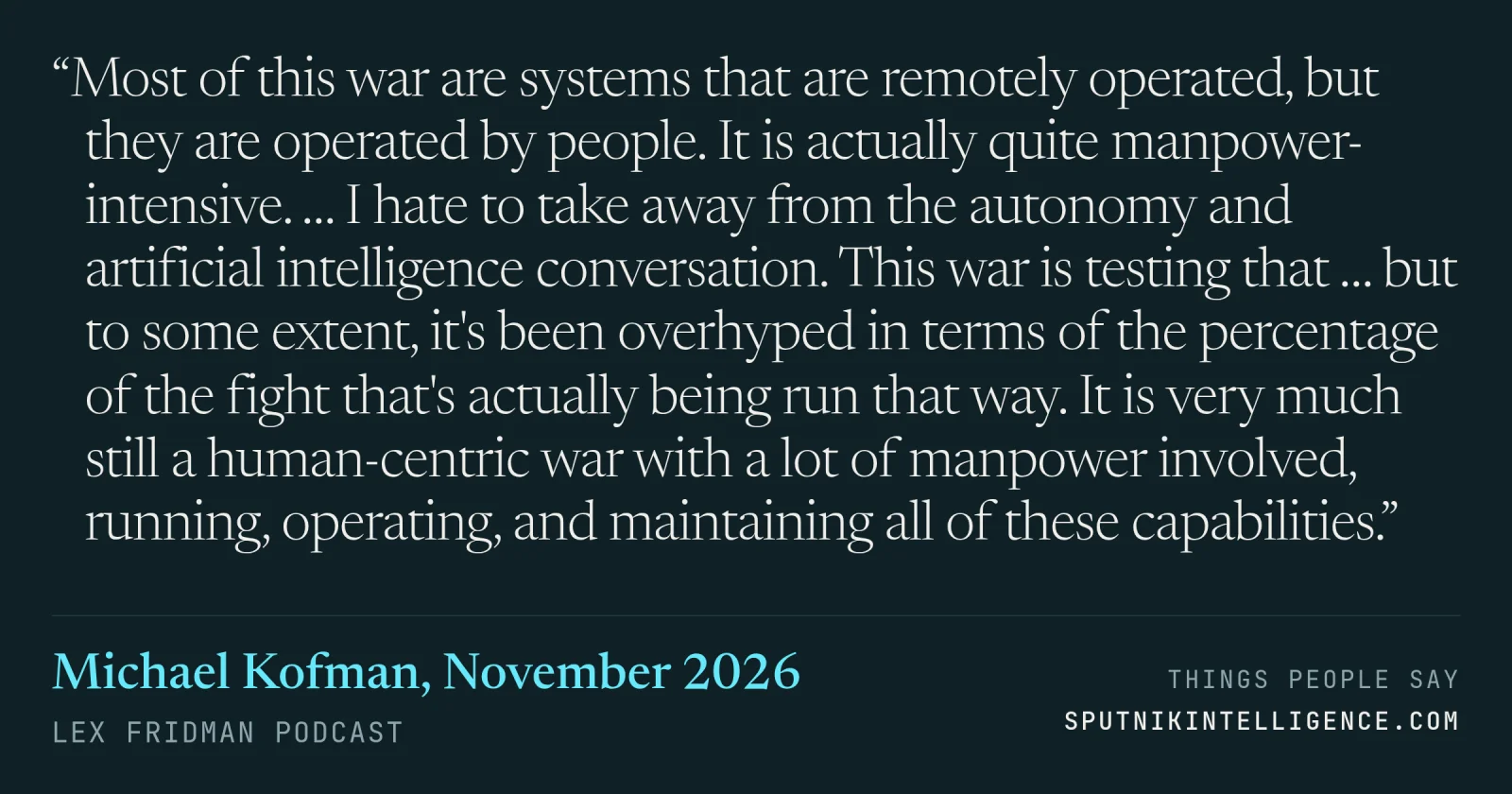
“Most of this war are systems that are remotely operated, but they are operated by people. It is actually quite manpower-intensive. … I hate to take away from the autonomy and artificial intelligence conversation. This war is testing that … but to some extent, it's been overhyped in terms of the percentage of the fight that's actually being run that way. It is very much still a human-centric war with a lot of manpower involved, running, operating, and maintaining all of these capabilities.”
Lex Fridman Podcast · Ideas & Essays · November 2026
Context
Lex Fridman asked whether autonomy is being used on FPV drones in Ukraine, as news coverage suggests. Kofman, a military analyst, says there is only a thin layer of terminal guidance and nearly everything is piloted by human crews, a useful check on AI-in-warfare hype.
Transcript
…not including other types of tactical drones. And that would be for one side of the war. So, to give you a sense that these are hundreds of thousands of these being employed per month, these tried capabilities exceed all the numbers of personnel and equipment on the battlefield by very substantial.
And just to clarify, behind every FPV drone, there's a human being operating it. So, there's also from the news or something, there's a sense that autonomy is being utilized. It is not. So, this is something you guys talked about. There's usually humans behind the drones.
So, I'll be frank. Most of this war are systems that are remotely operated, but they are operated by people. It is actually quite manpower-intensive. And in fact, it's in many cases, if you look at both Russian-Ukrainian military, they had to build out substantial numbers of drone units and channel manpower into the drone component of the fight. It's not even a ratio of one to one, sort of one person to one drone. A typical drone team might require two or three people. You have a pilot, you have a co-pilot navigator. This is exhausting…
So, one of the other novel aspects of this war is so much of it is televised so that you could see videos from the drone perspective on both sides of that drone killing another human being. It takes one drone to accomplish that task, and it actually takes a lot more. Can you speak to that in terms…
Yeah, eliminate a target might be a cold way of saying that. We're in an interesting place where there's a lot of propaganda value in footage for anybody using it in any military right now in a way that we didn't have access to even just a few years ago. So, there's a lot of interest in being able…
So we should be imagining a very large number of FPV drones just hunting humans and tanks and technology.
More from Lex Fridman Podcast