 Dwarkesh Patel
Hosts the Dwarkesh Podcast, a long-form interview show on AI progress, timelines, and the people building frontier models, along with economists and historians.
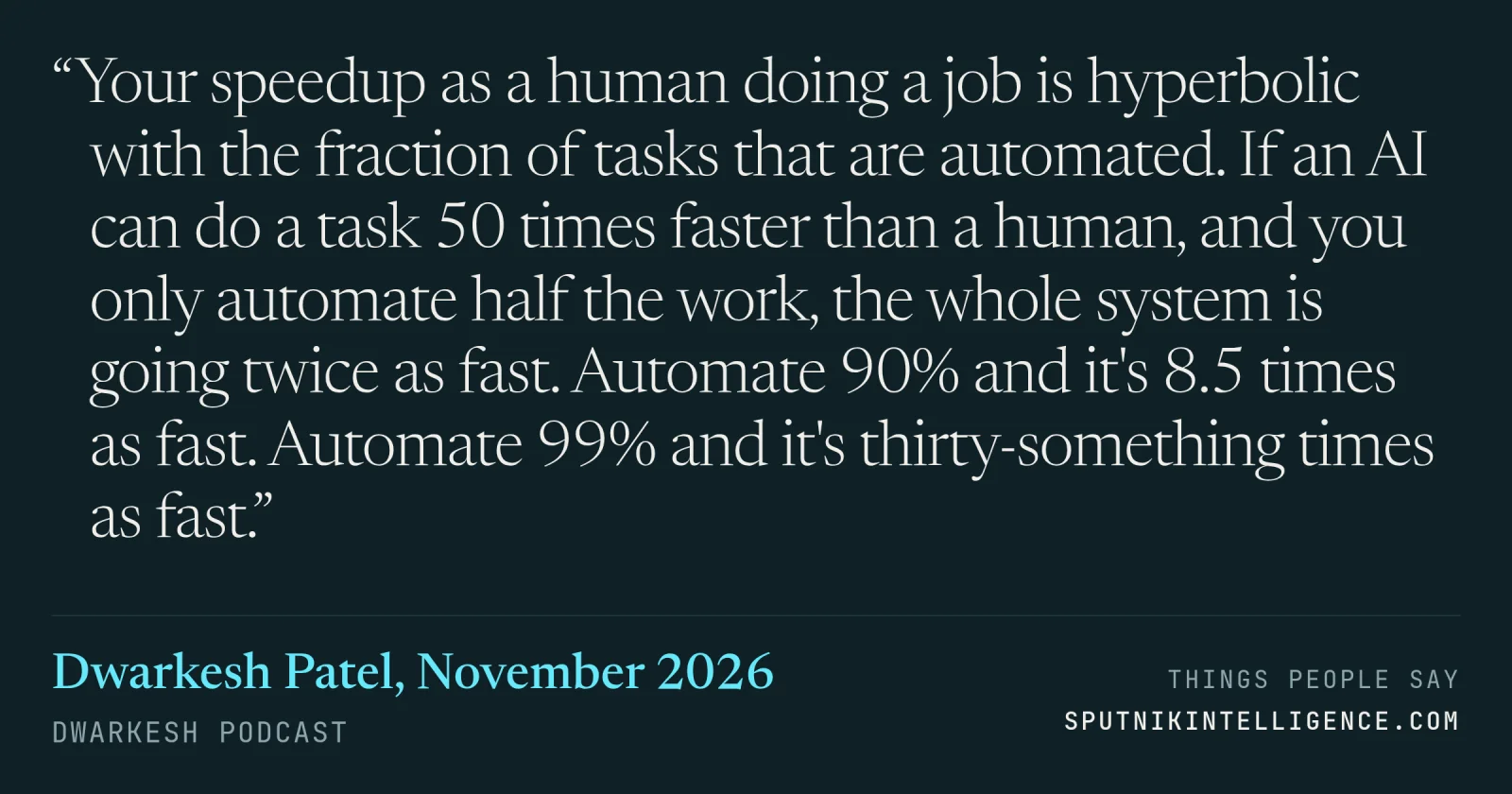
“Your speedup as a human doing a job is hyperbolic with the fraction of tasks that are automated. If an AI can do a task 50 times faster than a human, and you only automate half the work, the whole system is going twice as fast. Automate 90% and it's 8.5 times as fast. Automate 99% and it's thirty-something times as fast.”
Dwarkesh Podcast · AI Research & Frontier Labs · November 2026
Context
A critic argued that if any part of the AI-research loop still needs a human, there is no real recursive self-improvement. Dwarkesh answers with an Amdahl's-law-style argument that partial automation can still produce very large speedups.
Transcript
it makes me feel good. Okay, so I'll come back to the point. So
…like this. Even if I grant that AI use dramatically accelerates progress, that still does not imply recursive improvement. If even one piece of the feedback loop needs a human, then you definitionally don't have recursion. That's a high bar to pass when dealing with general frontier advancements.
So I think that's correct. And that is one of the main reasons that I think it's quite. Possible that we're looking into the 2030s before we get full automation of AI research and subsequently super intelligence, right? At the same time, the research that you have automated so far is speeding you up in the things that you have not yet automated. Now, an important thing to keep in mind is that your uplift or your speedup as a human that is doing a job is hyperbolic with the fraction of tasks that are automated. Let me explain what I mean. In computer science and in systems, there's this concept of Amdahl's law, which basically says that when you paralyze a system or when something goes faster, you're bottlenecked by the slowest moving part. However, I think that is worth appreciating is that as the fraction that is going really fast increases, the amount faster the whole system is going is not even exponential, it's hyperbolic. So, if an AI system can do the same task right now 50 times faster than a human can or can get 50 times more work done in a week than a human can, and suppose you only automate…
And so your claim is like you can still see a lot of uplift and a ton of acceleration, even if it's not definitionally fully recursive right now. It's like you might expect that slope into it at some point. And then eventually you do hit the full 50x, whatever that like multiplier is, and then…
I mean, I buy that the relative uplift might not be as big. Paul Cruciano, who used to be a computational complexity theorist, said that in his field, it feels like the last month of AI progress, or even the single day of math proofs that AI dumped, sorry, and OpenAI dumped in October, if that had…
Okay, another objection comes from Henry Dowling on Twitter. The canonical argument here is something of the sort of AI research will be bottlenecked on expensive GPUs. Jorkesh in his essay proposes as a counterpoint: don't worry, guys, we will have access to a ton more compute in the future.…
More from Dwarkesh Podcast