 Jordan Schneider
ChinaTalk Founder and EIC
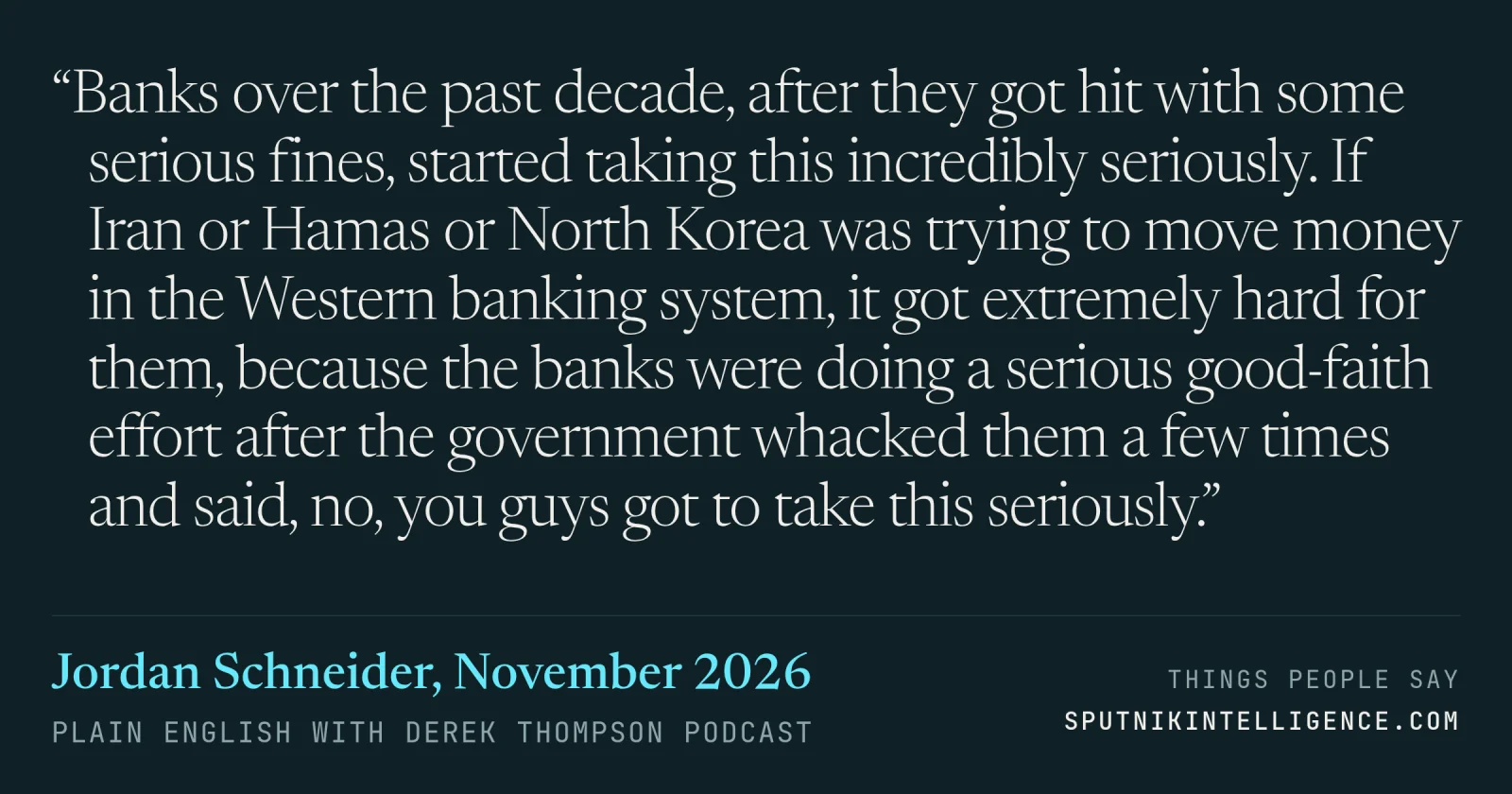
“Banks over the past decade, after they got hit with some serious fines, started taking this incredibly seriously. If Iran or Hamas or North Korea was trying to move money in the Western banking system, it got extremely hard for them, because the banks were doing a serious good-faith effort after the government whacked them a few times and said, no, you guys got to take this seriously.”
Plain English with Derek Thompson · US Politics · November 2026
Context
Jordan argues Nvidia must have known where its chips were ending up. He compares chip export compliance with the anti-money-laundering rules banks only took seriously after big fines.
Transcript
…that are also the policy choices that let China play the AI game at all. China cannot make chips in any kind of appreciable number. Their chips are not very good. And all of this, the reason it matters so much is this is what's keeping China in the game. And we don't have to allow this to happen.
…want to add. And as you talk, I'm going to be putting on my NVIDIA hat and getting ready to play defense attorney for the company to tell you both why you're wrong about China and the danger of exporting chips. But why don't you go ahead and finish the answer there before I start to play NVIDIA?
I think Ben did it. Basically, look, there are two things that Megaspeed and all these other companies were doing. They were setting up data centers in Malaysia to help Alibaba, Tencent, ByteDance, DeepSeek get chips. And they were also shipping these chips into China because they are marginally more useful for these companies if they can be used on domestic workloads than international workloads. So we've seen both happen. One, the actual transshipment is the illegal part. The data centers in Malaysia is the sketchy part that Ben and I both think is really dumb, but is not necessarily something that's illegal. And the problem for Jensen and NVIDIA is that he had to, given all the reporting, it is, you know, I have like a 99% degree confidence that NVIDIA knew what was going on. I mean, they were, I'm pre-butting you, NVIDIA terrorists. They were screaming for years and years. There's no such thing as illegal shipments. There's some, you know, Jensen at one point, he said, these things are two tons. How could anyone ever potentially smuggle them? And it's just not true. And this isn't even using the intelligence community. There's all this public evidence that has…
This episode is brought to you by J.P. Morgan Chase. In today's unpredictable world, geopolitics isn't just a backdrop. It's shaping markets, business strategy, and risk. The J.P. Morgan Chase Center for Geopolitics brings together former senior policymakers and seasoned practitioners to translate…
This is the kind of question that I think Congress needs to investigate. Because in my experience in the government, any kind of enforcement investigation was unbelievably firewalled, as it should be. And it is worth dwelling on this for one second. The Department of Commerce, especially this part…
Jordan, briefly to you, how do you feel about NVIDIA placing a friendly call to commerce as they're investigating NVIDIA's relationship to MegaSpeed?
More from Plain English with Derek Thompson