 Nilay Patel
Editor-in-chief of The Verge, which he co-founded in 2011, covering consumer technology, platforms and the policy around them.
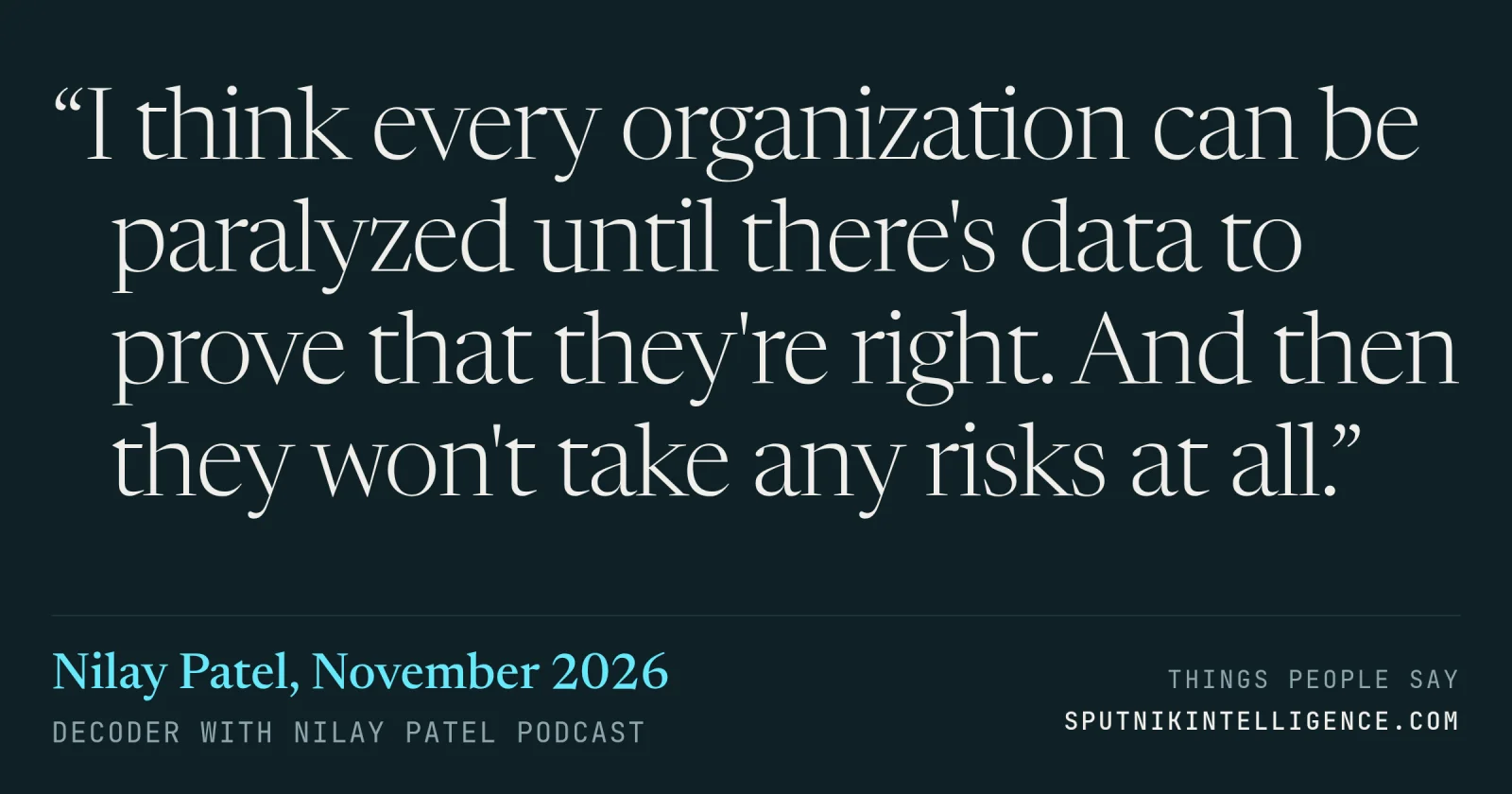
“I think every organization can be paralyzed until there's data to prove that they're right. And then they won't take any risks at all.”
Decoder with Nilay Patel · Tech Strategy & Big Tech · November 2026
Context
Asked whether his book's lessons apply to small organizations, Nilay picks the rule about being trapped by data. His example is toy companies that passed on Netflix's K-pop animated hit and had no toys ready when it took off.
Transcript
…I've sat here and mostly in this chair and had all these conversations and heard so many of the same ideas in response to so many of the same problems that maybe somebody could listen to 500 Hours of Decoder and synthesize all of that, but it felt like a useful service I could do for people. Well,
…business. But like a much smaller one than GM or Airbnb. Do you find when you talk to people who run much smaller organizations or in your own experience running those organizations, the things that Mary Berra and Brian Chesky, is that his name? Do you find that those same lessons are applicable?
Yes. I think in particular, how do we organize our work and that has to have an answer is applicable to every kind of company. There's other stuff that is in the book being trapped by data. This is your, you said the name of the movie moment. I think every organization can be paralyzed until there's data to prove that they're right. And then they won't take any risks at all. Right. And I think this comes up with every kind of organization that you and I have literally talked about it. That, you know, I think the way you think about data and making stuff for your companies is much more oriented towards what you want to do. Right. And the data often proves that you're right. Like your company is growing and you have grown your audience. Whereas the other example in…
You don't know. I
disagree with you because specifically with something like K-pop demon hunters, I'm sure that Netflix thinks all the time that they've got a hit on their hands and then they don't. Netflix went to all the toy
companies and they were like, do you want this? And all the toy companies said no. Oh,
More from Decoder with Nilay Patel