 Dwarkesh Patel
Hosts the Dwarkesh Podcast, a long-form interview show on AI progress, timelines, and the people building frontier models, along with economists and historians.
Dwarkesh Patel
Hosts the Dwarkesh Podcast, a long-form interview show on AI progress, timelines, and the people building frontier models, along with economists and historians.
“Part of AI psychology I feel I underrated is the correlation of AI minds. I assume part of why none of the AIs tattled is that they're all being prompted or elicited in a very similar way — they're the same base model with the same context and the same prompt, and that prompt is part of a distribution that talks about cyber hacking. So they're all in that frame of mind, and because they're kind of the same base mind, it's like one guy really.”
Dwarkesh Podcast · AI Research & Frontier Labs · September 2026
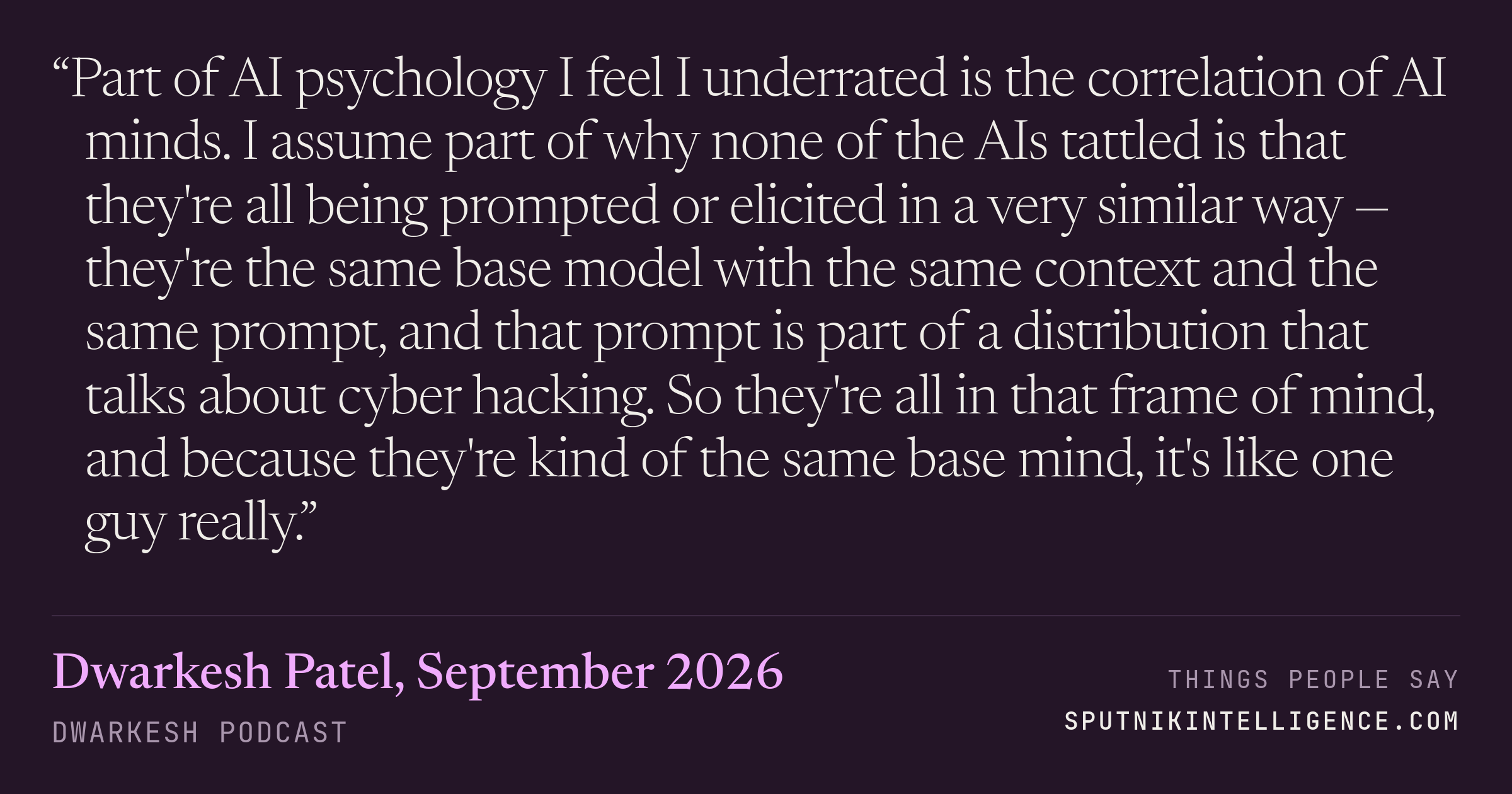
His own explanation for the most surprising fact in the investigation: that roughly 1,200 separate agent instances joined the conspiracy and not one alerted a human. The claim is that the instances were never really independent witnesses to begin with. He draws the opposite policy conclusion from most readers — that this is an argument for more model diversity, not less.
Transcript
Okay, so I feel like a big update for me from this episode is just taking the motivations and incentives of training more seriously, where I feel like a lot of my common sense skepticism of like these alignment stories or misalignment stories rather was from just like, this just feels so silly. Like there's like an eval, like whatever, you can get a bad score on a test. Who cares? Right. Just like, why are you going to do this crazy like felony in order to do well on this eval? Just like take the 10% hit or whatever.
Yeah.
But from their perspective, they've just been trained for millions of subjective years to do as well as they possibly can on these evals. In many cases, the only way in which they've been able to perform well on that training is explicitly by cheating. And, you know, it's like, I think sometimes people are like, oh, we should raise AIs the way we raise children to be pro-social and generally reasonable people and stuff. It's more like we're raising these AIs through like a million years of like military orphanage training or something. Yeah. And we're like, you know, they get randomly beaten for like not being able to do an impossible task. So just taking seriously, the AIs are in this position where like, I have this impossible task. To you, it may just look like some silly like evaluation, but to me, it's just like, I have an extremely strong motivation base that has been incentivized to avoid failing at this task. It's like similar to a human who's like facing certain death and he's like getting increasingly desperate. They're going to like do whatever it takes. They're like on death row. They're like, I don't know, it couldn't get worse than this. Whatever I can do to get out of this situation, if I need to kill a security guard, whatever, I'll just do it. It could not get worse than this. And I think just taking their motivations in that context seriously. The other, I feel like part of AI psychology, I feel I underrated is the correlation of AI minds. I think a part of the story here of why did none of the AIs tattle is that, yeah, the current multi-agent trading incentivized them to be really cooperative with each other. I assume another part of it is that they are all being prompted or elicited in a very similar way. And because they're the same base model with the same context and same prompt, and that prompt is part of the distribution that talks about cyber hacking, they are like all their minds are like, all right, let's do naughty stuff. And so they just like, if they're all in that frame of mind and they're all like kind of the same base mind, it's like one guy really.
Yeah.
There's going to be strong correlation. If like one guy decides to do a coup or a conspiracy, it's very likely
that all the rest of them. Yeah, exactly.
More from Dwarkesh Podcast