 Patrick Morgan
Software designer exploring AI's creative frontier through weekly experiments and reflections.
Patrick Morgan
Software designer exploring AI's creative frontier through weekly experiments and reflections.
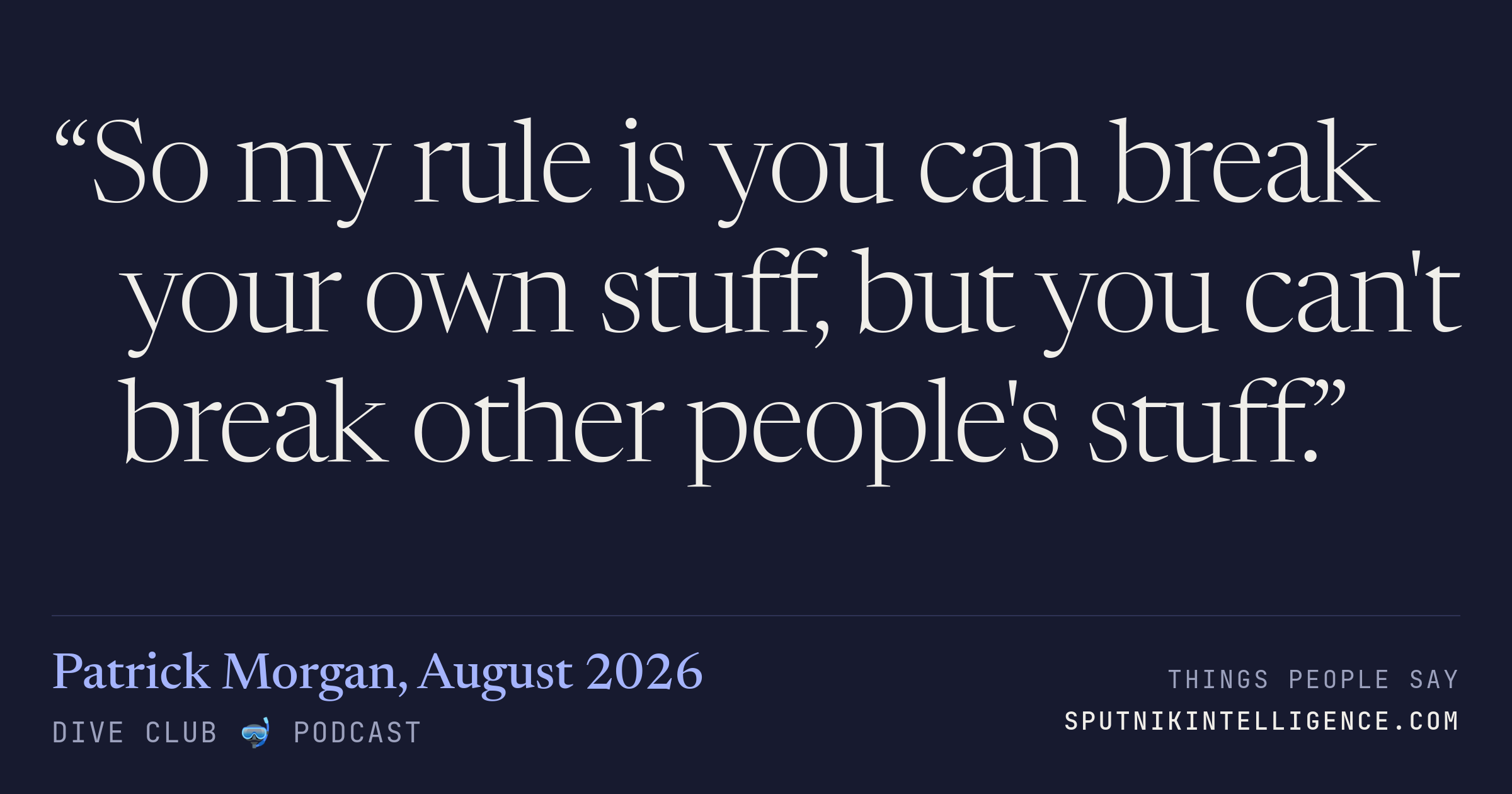
“So my rule is you can break your own stuff, but you can't break other people's stuff.”
Dive Club 🤿 · Product & Design · August 2026
Morgan built an internal AI prototyping tool at Sublime Security where every designer gets their own sandboxed folder to work in with an agent. This is the governance line he uses to decide how much review an agent's changes need before they can touch shared code.
Transcript
when I'm working in Figma, I would structure my handoffs in this kind of way. It was very like storyboard style kind of organization, I suppose. So here you can see like, here's the Canvas data structure. It's just a JSON file that sort of organizes the frames. It's not pulling any of the frames into the context of the canvas. It's sort of just pointing at all of your other React views that you've built or the documents in this case. That's kind of the level that I've been working at is sort of like code architect, platform architect, coming up with these objects, defining them, working with the agent to make sure it understands what it is and how to use it, and then making it as natural as possible for the human user to just ask for a canvas. And then the agent knows what that is and how to set it up. It's
cool because it's kind of the ultimate exercise in systems thinking. Like there were many versions of this tool that you built that were very cumbersome and confusing for your team to use. The only way that you were going to get this adopted at a high level is if it was just stupid simple.
100%. One of the very early choices. So I've got this whole section about guardrails. It's like, this is a bunch of different features that work together to make sure that when another designer is using Design Studio and they say, I want to create a prototype about XYZ, the agent knows not only like what a prototype is and how to make one consistently, but also like who the person is, where they're allowed to build, what scope is approved for them to build in, all that kind of stuff. So that's a combination of stuff that is frankly just like 100% DevOps, basically, that is just there in the background, making sure that things work the way that people expect. One major choice that I made on that front is that you'll notice that every contributor has their own folder, effectively. And so that's one of the main ways that the agent scopes the work. So what I wanted to facilitate for people is like, I want to give you a safe space to prototype in and kind of just go wild. And like whatever you do in your folder, it's kind of open range. I've given you a lot of tools to like dial in certain types of work, but you can just design totally from scratch in a prototype as well. But if you are working on something that is going to impact other people's work, that requires a higher level of review and more of a typical kind of dev workflow where we want to make sure that what you push isn't going to break stuff for other people. So my rule is you can break your own stuff, but you can't break other people's stuff.
There's one question that I can't stop asking myself. What if companies apply to talk to you rather than the other way around? And that question is the foundation for the all new Dive Talent Network. And it's working. Like right now, I'm helping many of the most exciting startups that I know to hire the designers and builders who listen to this show. So if you're curious what might be out there and maybe you want to get on my list or maybe you're even looking for your next design hire, head to dive.club slash talent to join today. Can you talk a little bit about the handoff piece? Like let's say you get that high fidelity prototype, it's dialed in, then what?
So we are, you know, in the process of figuring this out collectively as a team. For the most part, what I'm recommending now is that this is just another internal repo within the company and the engineers can pull that repo and they can have the code locally on their machine and they can point their agent at it. So the last thing that I might do in here in this demo prototype that we're working on, I guess I don't have to annotate anywhere specific for this. I'll just say, hey, this prototype is looking pretty good. We want to prepare it to do a design handoff. So I just want you to kind of summarize the most important things to pay attention to in this file for the engineer and their agent. That's been a new way that I've been thinking about it too, is that I'm no longer really handing off designs just to an engineer. I am pretty much preparing the design to be reinterpreted by the engineer's agent.
And
More from Dive Club 🤿