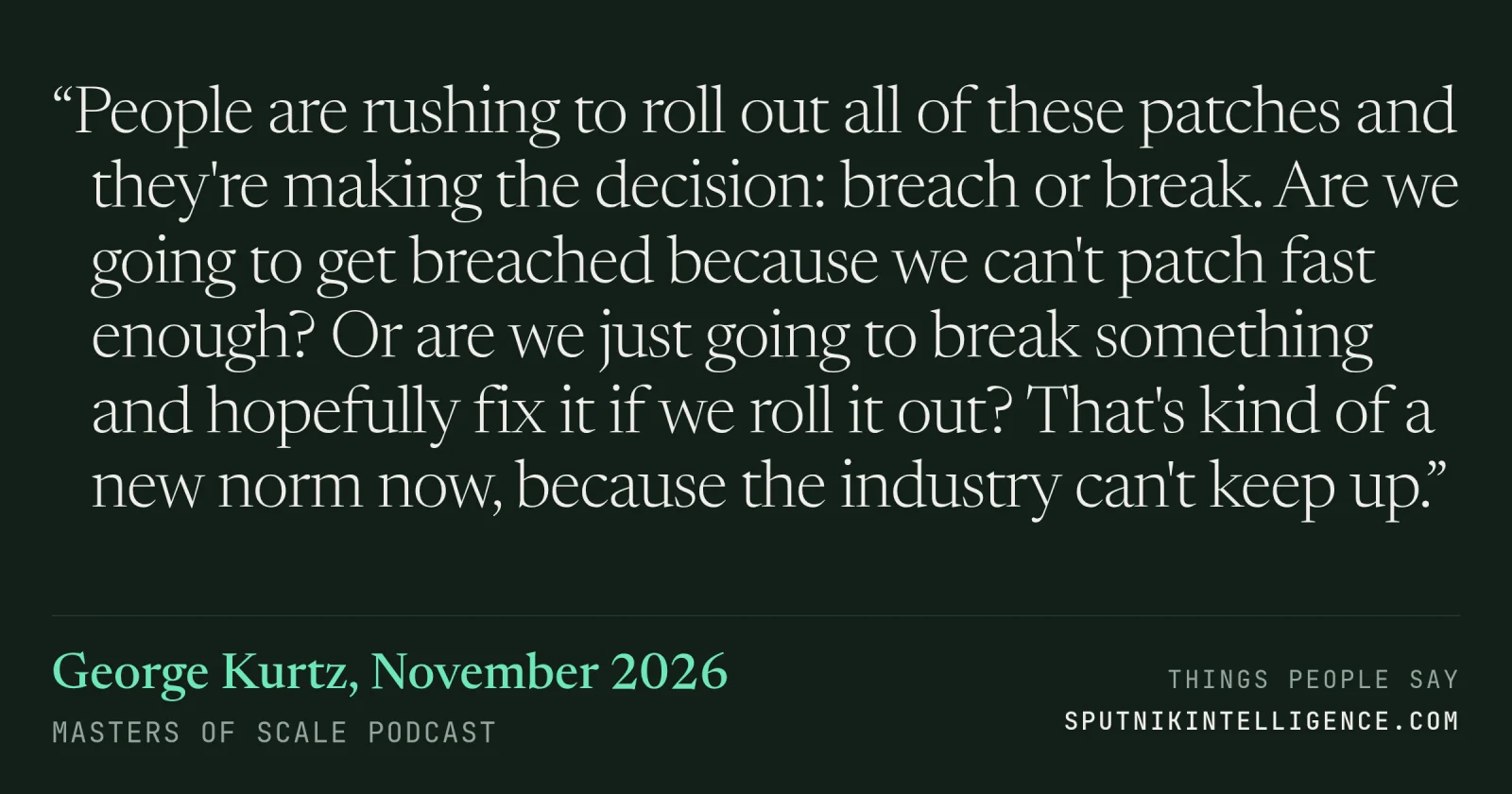
“People are rushing to roll out all of these patches and they're making the decision: breach or break. Are we going to get breached because we can't patch fast enough? Or are we just going to break something and hopefully fix it if we roll it out? That's kind of a new norm now, because the industry can't keep up.”
Masters of Scale · Startups & Venture · November 2026
Context
Safian compared the moment to recent PHP and Java security bugs. Kurtz describes the trade-off companies now face when they have to patch under pressure.
Transcript
…place over the last number of months. But what we've done now is we've hit the sound barrier of actually being able to roll out all these patches. So when you look at what's really taking place and you kind of look at all the issues that were found in Black October, you've got darker November.
This is like the PHP code and now Java that people are sort of scrambling to find and plug these gaps in.
Yeah, exactly. I think the Java one is actually going to be worse. There's already working exploits for all of that. But what people are doing now is they're rushing to roll out all of these patches and they're making the decision breach or break, breach or break. So that is, are we going to get breached because we can't patch fast enough? Or are we just going to break something and hopefully fix it if we roll it out? And that's kind of a new norm now because the industry can't keep up. As I said, they hit the sound barrier of patching. And that's, we've got to find our way in our sea legs a bit in terms of how we actually create these patches and get them rolled out without breaking things. And as an industry, we've never had to move this quick. And so in summary, what you're seeing, I think, is the culmination of all these vulnerabilities that have been found, all of these now rushed patches that have to take place. And it's technology is messy. Things happen. And we're going to get better and better as an industry to deal with this sort of AI speed that we're dealing with.
We're creating these bugs because we're introducing things in some ways. I don't want to say too fast, but at a speed that we're not able to test everything before it's out.
The number one thing that actually creates outages is change. Like things work and then somebody makes a change somewhere or it's an unintended change or it's one small item, you know, on the router and then all of a sudden, you know, things stop working. So that by far is the number one issue of…
You've talked about clarity in these sort of outages. You were very upfront when there was a CloudStrike update in 2024 that led to some Windows troubles and some grounded flights. But it can take time to get that clarity, can't it? I mean, do you always know how and what created these outages?…
More from Masters of Scale