George Kurtz

Things George Says on Podcasts

Where to Find Them

George Kurtz writes The Logan Bartlett Show . They have also been a guest on Mad Money w/ Jim Cramer (9 times) , Bloomberg Tech (6 times) , Closing Bell (6 times) , The Compound and Friends (6 times) , TBPN (4 times) , Squawk on the Street (3 times) , No Priors , All-In with Chamath, Jason, Sacks & Friedberg and The Twenty Minute VC (20VC): Venture Capital | Startup Funding | The Pitch .

Recently: “The New Apex Predator: CrowdStrike CEO George Kurtz on Adversaries Armed With AI Agents” on No Priors (October 2026); “9AM HOUR: Stocks Hit Record Highs, CrowdStrike CEO on AI and Stock Surge, Skydance Era Begins 10/6/26” on Squawk on the Street (October 2026); “Big Day for Apple, Ternus 9/9/26” on Closing Bell (September 2026); “LIVE From CrowdStrike's Fal.Con 2026 | George Kurtz, Michael Sentonas, Daniel Bernard & Justin Boitano” on TBPN (September 2026); “Closing Bell Overtime: Mag 7 Sheds $500B+ As Google Posts Worst Day In Over a Year 6/22/26” on Closing Bell (June 2026); “Intel Rips, Cursor's Plan, Thrive's Giant Bet, GPT 5.5 | George Kurtz, Professor Sendy, Gary Vaynerchuk, Yoland Yan, Ben Horwitz” on TBPN (April 2026).

What They Said

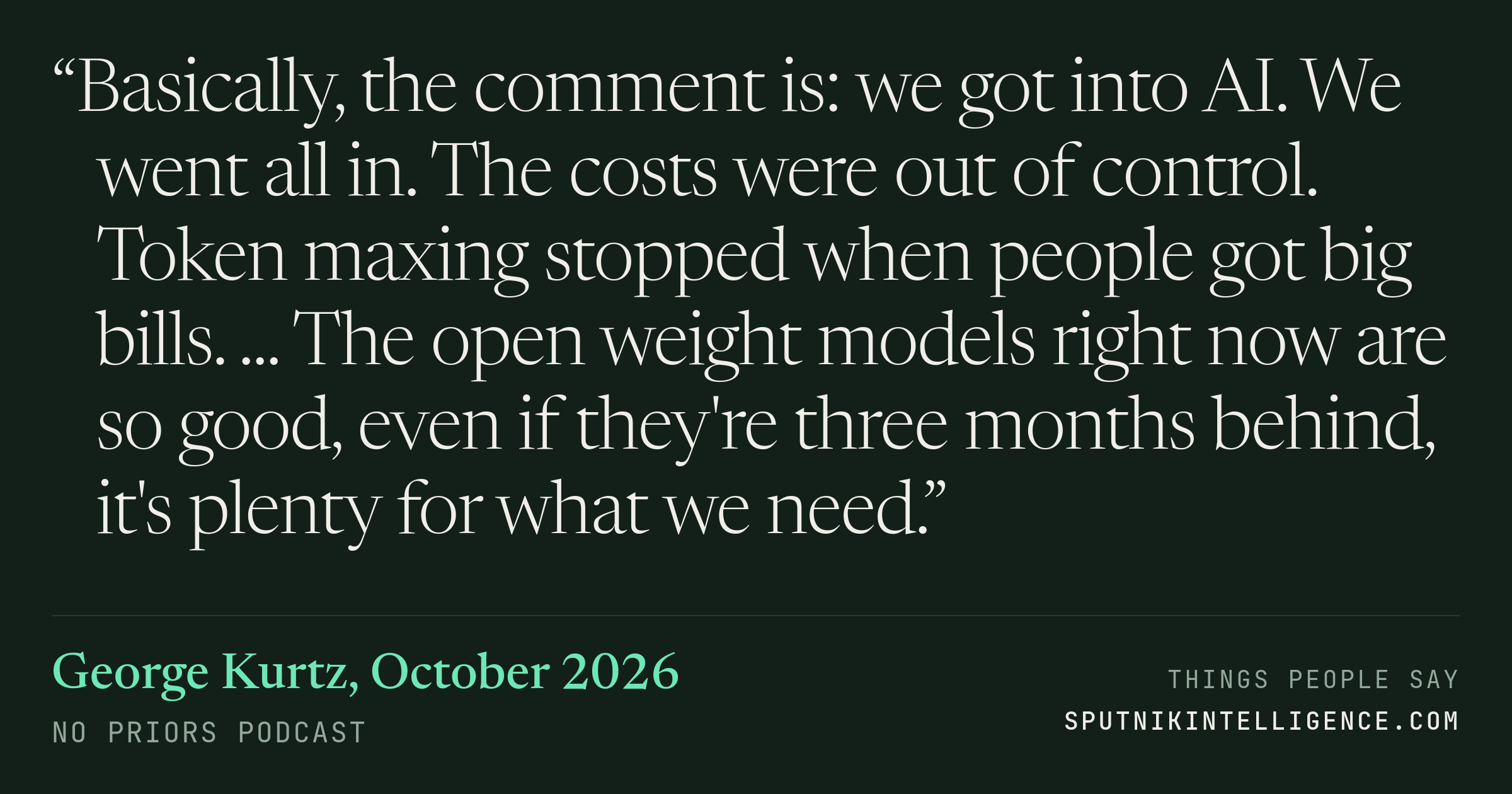
“Basically, the comment is: we got into AI. We went all in. The costs were out of control. Token maxing stopped when people got big bills. ... The open weight models right now are so good, even if they're three months behind, it's plenty for what we need.” — George Kurtz, No Priors

Kurtz was relaying what a CIO at a big New York bank told him over dinner. He said the bank plans to send only high-value "Formula One" work to frontier models and to post-train open-weight models for everything else, and that he sees the same shift customer after customer.

No Priors · 2026-10-22 Permalink → Listen →
No Priors Around 27:07 into the episode
Speaker 1

…have local models that are all running on people's computers. You may have a mixture of local models plus sort of last mile routing into frontiers in terms of what they look like. You're going to have a lot more open weight models. You can just see the shift in the tokens over the last six months.

Speaker 3

What is a shift that you're seeing? And what's the order of magnitude there? How long do you think that continues for?

Speaker 1

I talk to CIOs almost every day. I got dinner with one tonight from Big Bank in New York. And basically, the comment is: we got into AI. We went all in great. The costs were out of control. Token maxing stopped when people got big bills. And I said, well, how do you think about this? Like, what are you going to do? And they said, the models are so, the open weight models right now are so good, even if they're three months behind, it's plenty for what we need. And one of the customers' comments, and they know I'm into Formula One, they said any Formula One activity that we need for the bank will go to the frontier. Like if it's alpha and we're making money and it's like, you know, super important, we'll pay the money, no big deal. But for all the other things, like it's really expensive and we're going to create all of our own open weight models, you…

Speaker 3

so I guess on the open weight model, one of the statements that tends to be made is that they are at least in part distilled from the labs. In other words, you have Chinese open source players who are effectively training their models against that Anthropic or OpenAI model or other sort of frontier…

Speaker 1

I mean, I guess my first comment is what were the frontier models distilling when they got all that information? I mean, we know all of the sort of lawsuits around where the data came from and how that unfolded, right? So we kind of start from that. So it's

Speaker 3

like a fine liquor. It's triple distilled. It's triple
Speaker names from our own diarization · position estimated from where the line sits in the episode
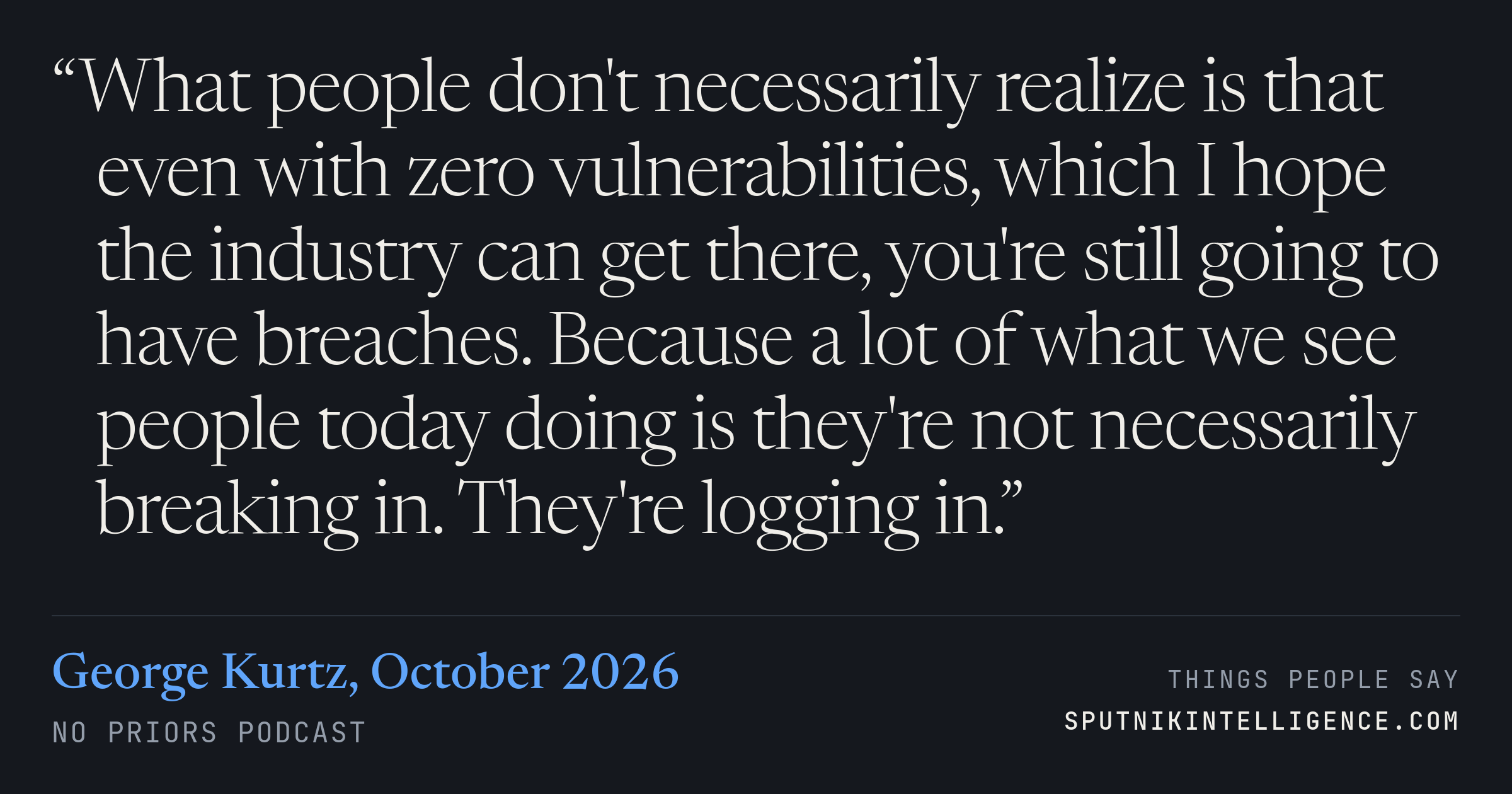
“What people don't necessarily realize is that even with zero vulnerabilities, which I hope the industry can get there, you're still going to have breaches. Because a lot of what we see people today doing is they're not necessarily breaking in. They're logging in.” — George Kurtz, No Priors

A host floated the hope that mostly agent-written code could end up more secure than human-written software. The CrowdStrike CEO agreed it would help, but said identity is the bigger problem, and that the long tail of legacy software won't be fixed overnight.

No Priors · 2026-10-22 Permalink → Listen →
No Priors Around 38:16 into the episode
Speaker 1

…you know, you've got to use the advantages you have. The defender knows their own systems. The defender has the architectural diagrams. The defender has the code, right? So how do you put all of that into something that you can dramatically increase your probability of outsmarting the offensive AI?

Speaker 2

…a limited number of them with limited capacity, and we're all trying to move very quickly. But if you can scale at the speed of compute or your willingness to spend and agents have infinite patience, like maybe we could actually end up with more secure software over time. It's an interesting hope.

Speaker 1

…I have my own developer license. I build my own sort of apps and things like Claude. And I have my own security agent that reviews the code. And it's like, well, Claude just created the code, but then Claude is now with its security app going, well, that code is insecure. Well, you just created it. Like, why just do that in the first part? You know, maybe there's some optimization, but I think what people don't necessarily realize is that even with zero vulnerabilities, which I hope the industry can get there, you're still going to have breaches. Because a lot of what we see people today doing is they're not necessarily breaking in. They're logging in. There's such an issue around identity. But at the end of the day, if we can get better code and we can have less vulnerabilities and we can ripple that through, that'll be great. The challenge is it's such a long tail. You take Microsoft as an example. Just because of all of the compatibility that they want to maintain going backwards, backward compatibility, there's things that never kind of…

Speaker 2

You've been running CrowdStrike for 15 years. And before that, you were an entrepreneur. Security, I've always loved security because we're never, as a business person, it's both an interesting and important mission. As a business person, this problem is not going away. Right. But I feel many CEOs…

Speaker 1

Yeah, I'm happy to jump into that. So, first, I think you have to recognize it's a different operating model and cadence. You know, we've got thousands and thousands of people, right? And when you think about some of the AI native companies that just started, they have a handful of people. You…

Speaker 3

So a lot of people right now are talking about job losses due to AI, although that really hasn't happened. I think the opposite has happened in terms of net job creation so far. And similarly, there's a lot of questions about should my kids study and what will happen in the future for jobs and the…

Speaker names from our own diarization · position estimated from where the line sits in the episode

Collections They Appear In