 Dwarkesh Patel
Hosts the Dwarkesh Podcast, a long-form interview show on AI progress, timelines, and the people building frontier models, along with economists and historians.
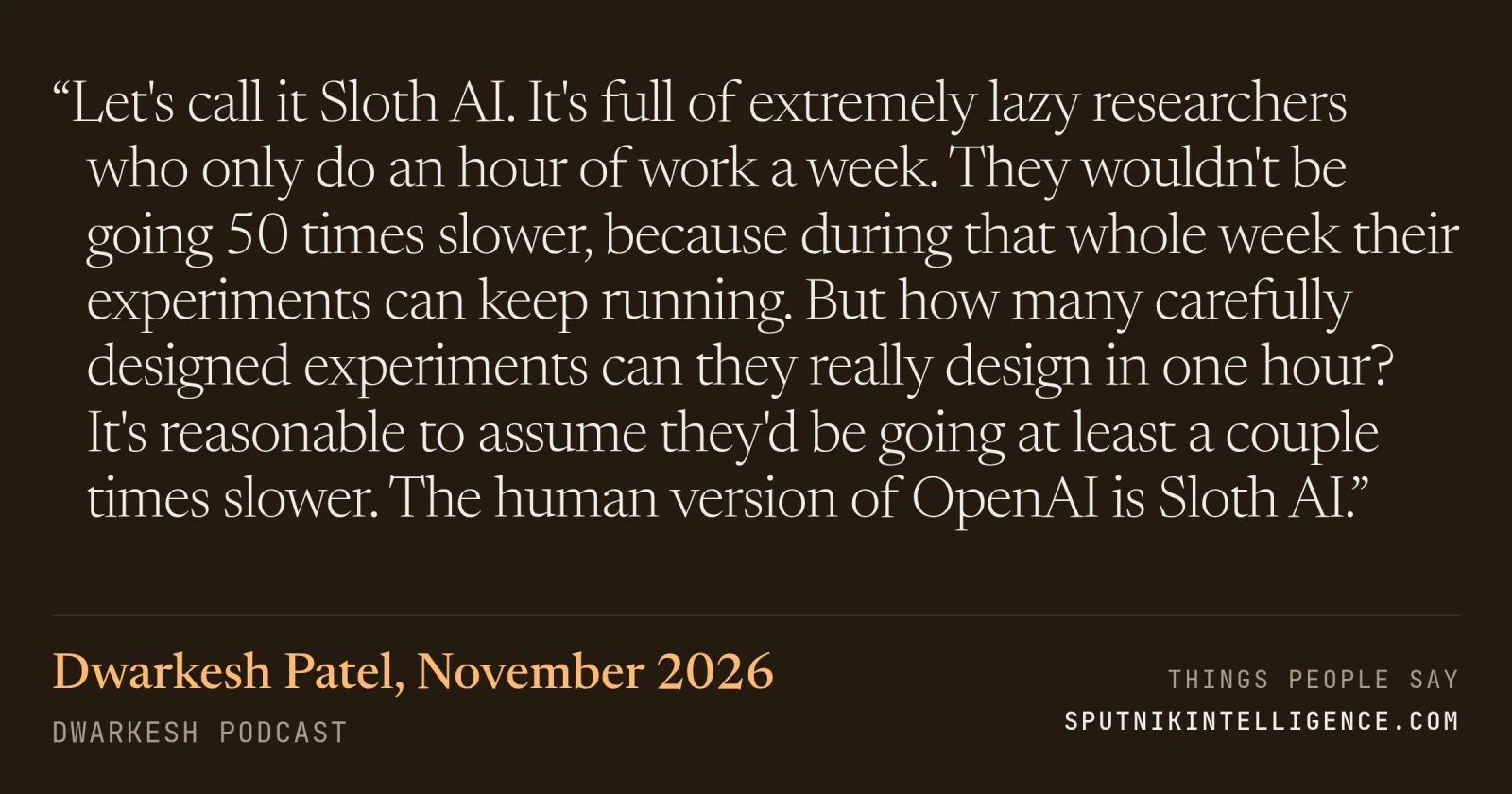
“Let's call it Sloth AI. It's full of extremely lazy researchers who only do an hour of work a week. They wouldn't be going 50 times slower, because during that whole week their experiments can keep running. But how many carefully designed experiments can they really design in one hour? It's reasonable to assume they'd be going at least a couple times slower. The human version of OpenAI is Sloth AI.”
Dwarkesh Podcast · AI Research & Frontier Labs · November 2026
Context
Responding to the objection that AI research is bottlenecked on compute for experiments rather than on researcher speed. Dwarkesh uses a thought experiment he credits to an essay by two other authors: a lab whose researchers think far faster would still make progress faster, even with the same compute.
Transcript
…ways in a persistent way and see what happens. And agreed, there will be diminishing returns. It won't be as fast as mathematics. If it's a tenth as fast, that would still compress a crazy amount of ML progress into a single year, enough to give us super intelligence by the end of that year.
…to quadruple their RD compute to maintain their current rate of progress. Right now, if you believe Epoch, the global compute supply is growing only 2.6x annually. So just maintaining a 4x ratio of compute availability year over year is a tremendous challenge for labs, let alone exceeding that. So
he's totally right that keeping the current rate of compute growth going, that exponential rate that labs have to undergo year after year, is necessary just to keep the current rate of progress going with human labor. And my arguments about why AI progress will speed up despite that are about why we should expect both the automation of AI research soon and that to speed up AI progress a bunch more. He is right that if that doesn't happen by 2030, then because this experiment compute growth will plateau, because we'll be spending double digit percentages of GDP on compute by that point, that the forexing can no longer continue. And so progress will slow down. Then there's a question of, well, how much is AI progress going to be sped up once you automate it? The bottleneck for experiments is severe because without that bottleneck, you would have an overnight singularity. And instead, because of that bottleneck, you're going to only be compressing three to six years of progress over one calendar year. Now, it's not so crippling that it will totally wipe out the advantages of automation. Just consider the fact that AI systems are faster than humans who are doing the same work. For…
Yeah, that makes sense to me. So as I've gone through a bunch of these different objections to prep for this conversation, I had a few takeaways. It is incredibly important to make very clear, especially because we're talking about potentially insane worlds, what you actually think versus like what…
I think by the end of next year, we'll have systems that you actually can describe as a competent colleague who is 24-7 working for you. I think current personal assistant type things like Muse or Duet or DOT are very weak versions of what we will see over the next year, where it really does feel…
Yeah, interesting. Just like AIs can already do a lot of things that humans can do now, but just sort of at like a very mediocre, passable level. But it's like, if you want to do it at a really high bar, if you have a high bar, you're still going to hire humans. That's sort of your argument. Like
More from Dwarkesh Podcast