 David Hoffman
Co-founder of Bankless, a media company covering Ethereum and crypto markets, and general partner of Bankless Ventures, an early-stage crypto investment fund he...
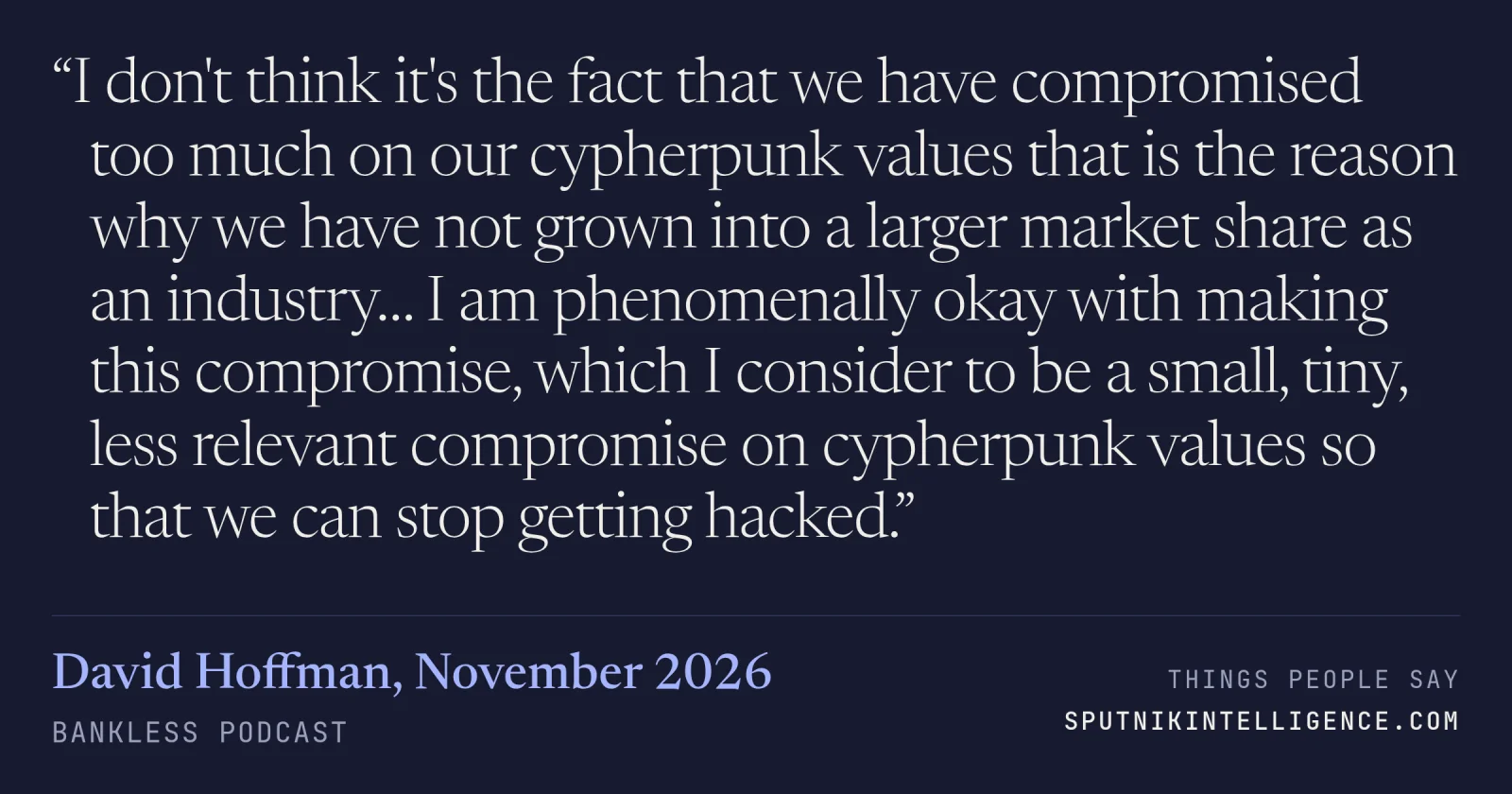
“I don't think it's the fact that we have compromised too much on our cypherpunk values that is the reason why we have not grown into a larger market share as an industry… I am phenomenally okay with making this compromise, which I consider to be a small, tiny, less relevant compromise on cypherpunk values so that we can stop getting hacked.”
Bankless · Crypto & Web3 · November 2026
Context
After the recent Binance hack, the hosts discussed an Ethereum security startup that lets block builders make malicious transactions fail. Ryan worried it could become a censorship vector; David says he accepts a small trade-off in cypherpunk ideals to stop exploits.
Transcript
…so that's kind of been their like, you know, their testbed. Now they are on the Ethereum mainnet in 50% of blocks, which is just a huge expansion of Philax's TAM. And then they are also working with LiDAR and also working with Derive as well. So landing some of the biggest projects in Ethereum too.
I'm cautious, but I'm definitely optimistic on this approach. I think a person is...
Bullish. I'm bullish. Because if you tell me, it's like, okay, like between the tension between growth and like product market fit for DeFi versus like making compromises on our cypherpunk values, admittedly, this makes a modicum of a compromise on our cypherpunk values. And the way I kind of said, the trade-off that you get is protection against the DeFi exploits, which I don't think it's the fact that we have compromised too much on our cypherpunk values that is the reason why we have not grown into a larger market share as an industry. North Korea is stealing five. Of billions of dollars is actually a much larger reason why crypto has become less relevant in the market. And so I am phenomenally okay with making this compromise, which I consider to be a small, tiny, less relevant compromise on CyberVoke values so that we can stop getting hacked. There's
some news out of the CFTC this week that's pretty relevant for crypto. What is it, David?
So perpetual futures on individual equity securities can now begin trading. If you are a CFTC registered DCM and DCO, and then you are also notice registered with the SEC as a national securities exchange, you might ask the question, okay, who are these people? It's Coinbase, Kraken, Calci, and…
or lighter? Not a hyperliquid. Hyperliquid
More from Bankless