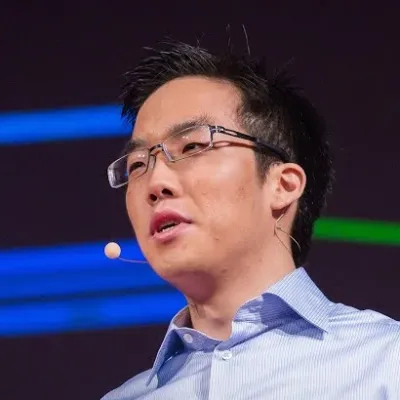
 Andy Yen
Runs Proton, an encrypted-email and privacy company, and argues on Uncanny Valley | WIRED that privacy-minded users object to companies misusing data, not to AI...
Andy Yen
Runs Proton, an encrypted-email and privacy company, and argues on Uncanny Valley | WIRED that privacy-minded users object to companies misusing data, not to AI...
“I think the users were allergic to big tech and not actually to AI. They just associated AI with big tech, which is actually kind of a fair and reasonable thing to do.”
Uncanny Valley | WIRED · August 2026
Andy Yen describes the backlash Proton got when it first shipped AI features, and how the same users who complained later complained that the AI wasn't good enough. His read: privacy-minded users don't actually object to AI itself, just to the companies that have historically abused their data.
Transcript
Yeah, if I were to describe Proton's stance, I would say we were reluctantly pulled in, but we saw the writing on the wall. And once we came to the conclusion that AI was here to stay, it was unavoidable if we are to fulfill our mission that we also enter the space to provide an alternative. I would probably prefer a world where AI didn't exist, but it's here.
Interesting. Well, do your users agree?
It's really interesting because this has shifted quite a bit in just the last two, three years. I think the users were allergic to big tech and not actually to AI. They just associated AI with big tech, which is actually kind of a fair and reasonable thing to do. When we first came out with AI features in Proton, there was quite a bit of backlash. People were sort of like, why are you doing this? It's a waste of resources. It's not what person stands for. You've just become like another tech company, you know. But then, after we put out, especially after we put out Lumo last year, what we really kind of saw in the weeks and months after was the exact same people. And I know because people are complaining on Reddit and complaining on Twitter. We see their username. We know it's the exact same person. Right. The exact same person that was flaming us for putting out this feature in like July by October after using Lumo for a few months was now flaming us for not making Lumo better. Like, oh, this is not good enough. You got to make this a better product. So, I think what I'm saying is, I don't think they were allergic to AI as a concept. I think they're allergic to what AI represents in the big tech definition of AI. But when Proton does it in a way that actually ensures privacy, security, and ownership of their data in their conversations, then actually they're okay with it.
Well, it's an interesting framing that, like, would you rather have Google have access to your chats with an AI, or would you rather have a company like Proton? Would you rather trust Proton? But I was kind of surprised when I dug into how Lumo works that it is not end-to-end encrypted chatting with an AI. I mean, maybe that's actually technically impossible, but it does seem like the privacy promise of Lumo is exactly that. It's a promise from Proton, we're not going to look at these logs. In fact, we're not going to log this at all. It's not the kind of technical promise of encryption, which is we cannot. Mathematics has prevented us from reading your email.
Yeah, yeah, and this is different from ProtonMail because ProtonMail the guarantee is actually mathematical. As a physicist, I like mathematical guarantees, right? The issue with LLMs is today the technology for doing that in a fully end-to-end encrypted way, it's not there yet. I think it will get there in a couple of years, but at the present moment, I would say it's not there yet. So, the choice was either sit on the sidelines and wait for a few years of tech to get there or begin to wade in and begin to understand the space and begin to offer a product. Now, a promise is not as good as a mathematical guarantee, but a promise made by the right people is still actually quite substantial. But of course, I hope in the years to come to be able to upgrade that from a promise of Proton as a foundation to a promise that is mathematically guaranteed. And there's some interesting research work being done actually by NVIDIA that in probably two years' time, I think, will get us to a point where you can actually do LLMs in a fully, let's say, end-to-end protected way.
Well, that's a really interesting idea that in a couple of years, there will be technical capacity to do end-to-end encrypted AI chatting. I think, are you talking about? I mean, I'm not trying not to get too nerdy here, but like homomorphic encryption where you can really,
More from Uncanny Valley | WIRED