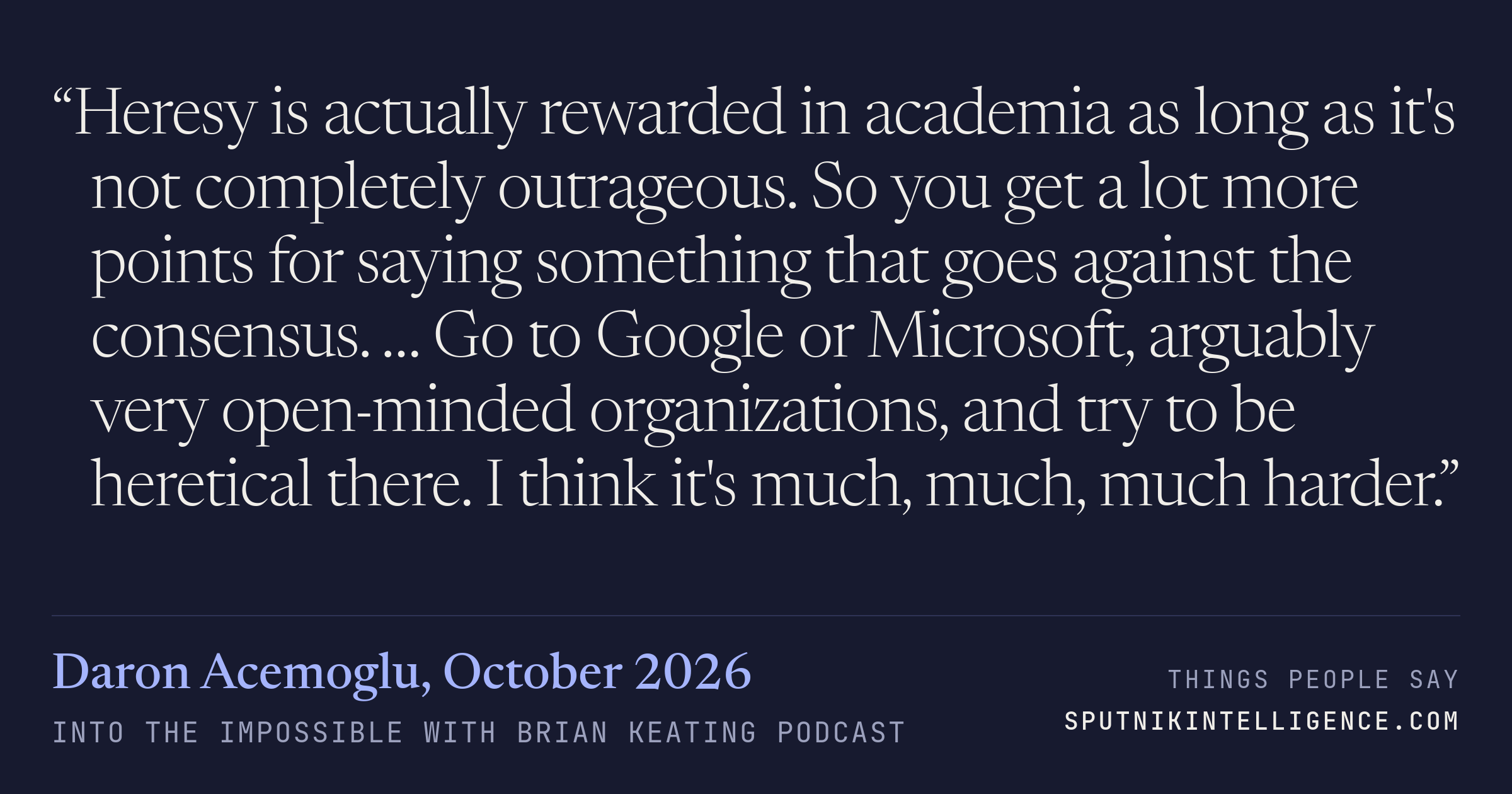
“Heresy is actually rewarded in academia as long as it's not completely outrageous. So you get a lot more points for saying something that goes against the consensus. … Go to Google or Microsoft, arguably very open-minded organizations, and try to be heretical there. I think it's much, much, much harder.”
Into the Impossible With Brian Keating · Ideas & Essays · October 2026
The host had asked how much dissent from consensus is healthy in science. Acemoglu's answer was that universities, for all their flaws, handle it better than hierarchical organizations do.
Transcript
I don't know. I think that's why there are, I say, there are many gray areas that liberal ideas, and even at its best,
liberal philosophy will not have an answer, but we have to navigate them, trying to reach compromise.
I think academia. Despite many imperfections, has a pretty good way of dealing with it. Heresy is actually rewarded in academia as long as it's not completely outrageous. So you get a lot more points for saying something that goes against the consensus. If you can defend it and if you can establish it, that's all the better. So there is rule for heresy in academia. I think it's outside of academia, it's a bit harder. Imagine having heresy in a hierarchical organization. Go to, you know, Google or Microsoft, arguably very open-minded organizations and try to be heretical there. I think it's much, much, much harder.
Yeah, it used to be their call sign, you know, move fast and break things. And now it's, you know, be careful, shareholder value. We have an IPO coming up, and we'll talk about open AI and Hugging Face and the Navier-Stokes controversy in just a minute. But you talk about paradigms, you mentioned Thomas Kuhn, and I'm recalling your fellow Nobel laureate Max Planck, who said that science advances one funeral at a time. My question is: how much self-correction, how much introspection is good for institutions? I mean, you and I, as I said in my invitation letter to you, I mean, we are the, you know, we're basically scratching on a rock, you know, a blackboard with another piece of rock like Gal like people did in the University of Bologna in the year 1000. Very little has changed, despite, you know, it seems like academia is very resilient. What will it take for academia to fully change? So it would be unrecognizable to Galileo should he come back, you know, from the dead.
New and exclusive holiday decor just launched online at the Home Depot. Check out the viral Grand Duchess collection with smart holiday lights you can control from your phone. Easily customize the twinkle across trees, wreaths, and garlands to match your holiday vibe. Create stunning light effects, then switch it up with the tap of your fingers. Even the man in red will be impressed. Shop the holiday decor you want online only at home depot.com.
Well, look, conditions are different. So I don't know to what extent some of these adaptations we've made have been good adaptations for our times versus distortions. But I wouldn't say our real problem right now is that science has slowed down. It's more like we are not getting the fruits of science in productivity. And we have also sacrificed freedom of speech and diversity of opinion in many areas outside of science, sometimes even touching on science, but outside of universities, in schools, in organizations, sometimes we don't discuss and compromise as we need to in a pluralistic society based on liberal ideas.
More from Into the Impossible With Brian Keating