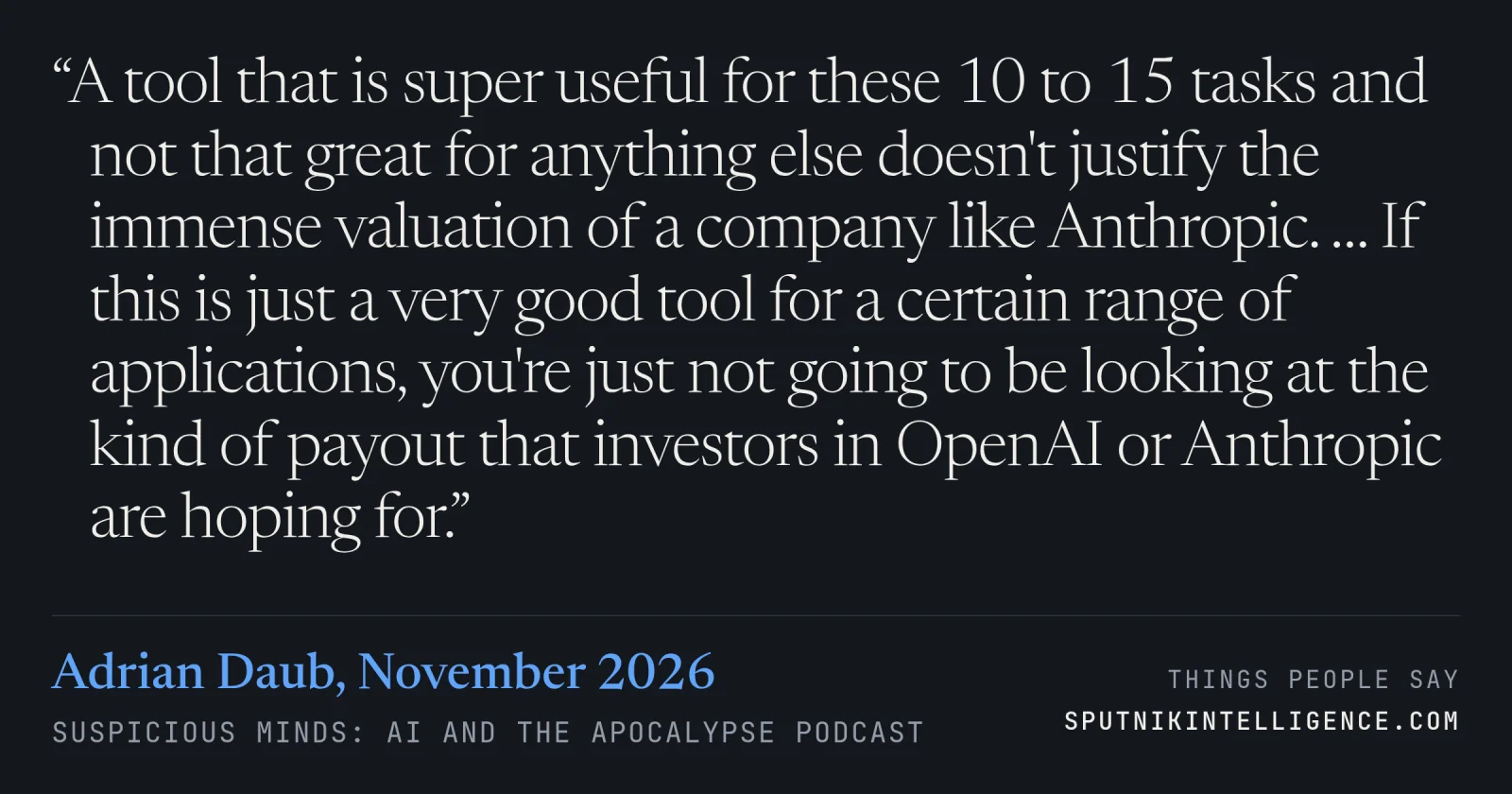
“A tool that is super useful for these 10 to 15 tasks and not that great for anything else doesn't justify the immense valuation of a company like Anthropic. … If this is just a very good tool for a certain range of applications, you're just not going to be looking at the kind of payout that investors in OpenAI or Anthropic are hoping for.”
Suspicious Minds: AI and the Apocalypse · AI Research & Frontier Labs · November 2026
Context
The host asked what an Anthropic employee could do about AI's cultural bias problem. Daub, a Stanford literature professor, answered that the technology will probably prove useful for some tasks and weak at others, and that the gap between that and the hype is a financial problem for the labs.
Transcript
…now it's used to keep the dead information about me alive. As it were, the Wraith version of myself now starts to torture the actual living version of myself. And really, what we're dealing with here is a sort of struggle between the past and the future, right? Is the past going to eat the future?
Is the past going to eat the future? I asked Adrian how we can prevent this from happening. What's the fix with where we are in the world and with this technology today? Like if I worked at Anthropic and I wanted to help overcome this problem, what could I do?
Oh, I don't know if I want to give Anthropic any advice until they've given me my money. You know, take this with a grain of salt. I'm a literature professor. I'm not a business person. It seems to me that given what I just suggested about the felicity of AI use, depending on cultural context, that if we look back in 10 years, it'll turn out that AI technologies work very well for some tasks and not well for others, and that people use them in those other contexts only sort of to be almost a random generator, right? And it's impossible to overcome that is my own suspicion, right? We're going to find that this technology has been vastly overhyped when it comes to some applications and has been accurately described in some others, right? The reason that an anthropic can't entirely be happy about that is because of their valuation, right? A tool that is super useful for these like 10 to 15 tasks and not that great for anything else doesn't justify the immense valuation of a company like Anthropic. So for them, this is a bit of a problem. For just the user, I think there'll be limits to where we socially and acceptably use…
Adrian's Duchamp-Urinal and Danto's Brillo boxes are kind of the same argument. Danto asks how you tell the art from the object. Adrian's answer is that we settled that 100 years ago. You can't. More with Adrian Daub when we get back from our last break. Thank you for sticking with us. This is your…
I mean, I got to be honest, I'm a total traditionalist in this. I don't think so. I know that a surprising number of authors have claimed AI use, although I think that's also because authors are old as hell. And what they mean is basically they've asked ChatGPT the way they would have Googled…
The death of the author, Adrian mentioned, is very broadly the idea that we can't use things like the author's perceived intent or their biographical details to help unlock some definitive meaning in a text. Not only is the text separate from the author, but we know the author as an idea is never…
More from Suspicious Minds: AI and the Apocalypse