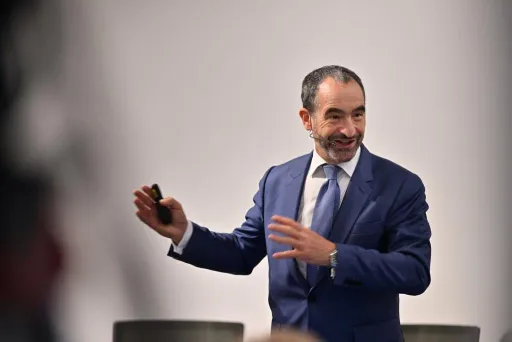
 Michael Liebreich
Host of Cleaning Up.
Michael Liebreich
Host of Cleaning Up.
“It's not going to be pop and it's gone, like the dot-com bubble. It's just going to be this kind of process of hopes slowly dying and ebbing away, sort of like a souffle just deflating as the air goes out of it.”
Everything Electric Podcast · Climate & Energy · October 2026
Liebreich explaining why he tags news of cancelled hydrogen projects "hydrogen souffle" and not "bubble". He said there is still money, political capital and unfinished projects in the system, so the decline will take years.
Transcript
So, Helen, it's great to be on the show, and I'm delighted to be considered a friend of Everything Electric. It's a bit scary that after all the things that I've tried to do with my life, I'm most famous for hydrogen, the hydrogen ladder, and now the hydrogen souffle. And the hydrogen ladder, I think I was talking about last time I was on the show, which is the things you will do with hydrogen, which is very few, and the things you won't, which is most of the stuff people talk about. The hydrogen souffle is just a little thing that I started to post. It's a hashtag and I posted it on social media just as a way of flagging that the things that I said wouldn't work are indeed starting not to work. And that was a couple of years ago. So as people announced or as things went bankrupt or projects were shelved or reports came out that said that some crazy hydrogen idea wasn't going to happen, I just posted this thing called hydrogen. So it was, I would say things like, today's hydrogen souffle or hashtag hydrogen souffle is brought to you from Denmark where they're not building a pipeline or from Germany where they're dismantling hydrogen charging stations and so on. And I actually have not posted it for quite some time because I don't want to dance on the grave of anybody's great hopes and entrepreneurial efforts and so on. And I think that the world has largely moved on. I think I've made my point. And there will continue to be hydrogen souffles, quite obviously for the next, you know, two, three, four, five years, because there is still money in the system, which is sort of slowly bleeding out. But so we're not quite done, but it's not. I don't think anybody's really still holding the same hopes for hydrogen that they were in 20, well, 2019, 2020, 21, 22. And then 23, it pretty much started to ebb away.
So this is the deflation of a suit. This is a souffle gone wrong. It's all sort of slowly, the gas is hissing out of it.
You're right. I should have explained the visual metaphor as somebody who's only ever tried to make soufflés once and they did a hydrogen souffle. In other words, they kind of went up and then, you know, sort of they went down my souffles. And so maybe I'm still bitter about that, which is why I call it the hydrogen souffle. But yes, that's the idea. And actually, the choice of word, it wasn't, you know, hashtag hydrogen bubble pop, because actually it was an acknowledgement that there is money in the system. There is political capital in the system. There are all these strategy documents. There are careers. And there are projects that are still. Not yet commissioned, so yet to come online, but they are kind of walking dead. And it will take some time for all of that to ebb away. So it's not going to be pop and it's gone, like, I don't know, the dot-com bubble. It's just going to be this kind of process of hopes, you know, slowly dying and ebbing away, sort of like a souffle just deflating as the air goes out of it. And so that's why I chose the word.
It's very, it's very memorable. I'm all for describing economic activity in food metaphors. I'm there with that. So, and I mean, it came from this, you've mentioned the hydrogen ladder and this list of, you know, you've had several versions of the hydrogen ladder. So they kind of start at the, is it the bottom is the end where those are definitely not going, hydrogen's not going to be useful. And then as you go up, there are the things where it might actually one day be useful. So the last version of that was in 2023, was it? That's right. Is it going to get an update or is everything, you know, in terms of what technologies may or may not have a future involving hydrogen, is that pretty much the same now as it was in 2023?
So there is another version. I have actually pretty much finalized version 6.0 because 2023, October 2023, when version 5 came out, is already quite some time ago. And things have moved on. Principally what has moved on has been batteries have just become even cheaper. I mean, over that period, they've more than halved in cost. And we've got line of sight on things like sodium chemistries and also possibly the first glimmerings of solid state. And so I would say that the competition to hydrogen has enormously moved on in the last three years. And hydrogen has, if anything, gone in the other direction. There's more people understanding more of the challenges. And also the political cycle has turned. So where there were all these hydrogen ideas that would cost huge amounts in carbon terms, $500 a ton, $1,000 a ton, things like sustainable, not sustainable, but ESAF, sustainable aviation fuel, but made from hydrogen and carbon dioxide capture, which people were very happy to say, oh, it's the only way to do it. And this is the future. Now they understand that it's kind of 10 times too expensive. And so there's less money in the system supporting hydrogen. So those two things have changed. And there is now a new version. I'm going to be honest, I don't know when it'll come out. It's not my day job to produce hydrogen ladders or to do hydrogen analysis. I don't want to say I've moved on, but I don't feel the same sense of urgency to deal with massive misallocation of resources in society. But there is another version. And I would say most of what has happened is that things have moved down. So one example would be long distance trucking. There's other examples around backup for things like uninterruptible power supplies. You look at it now and you think, why did anybody ever think that that was going to be hydrogen? And so that has gone from kind of, I don't know, highly improbable to even more highly improbable. And the row of doom keeps on getting bigger and bigger. One of the big problems producing the ladder is just the visual, which I do on a PowerPoint. There's nothing clever. It gets harder and harder to accommodate all of the really stupid things on the rows of doom of doom down at the bottom. It's just getting bigger and bigger.
Maybe you just need a kind of bucket at the bottom to put them all into different, you know, just falls off the end and into the bucket of doom or the abyss of doom or something like that. It
More from Everything Electric Podcast