 Dwarkesh Patel
Hosts the Dwarkesh Podcast, a long-form interview show on AI progress, timelines, and the people building frontier models, along with economists and historians.
Dwarkesh Patel
Hosts the Dwarkesh Podcast, a long-form interview show on AI progress, timelines, and the people building frontier models, along with economists and historians.
“One misconception of Machiavelli that I had — because I hadn't read these books before — is that he says the means don't matter, only the end. But he's way more concerned about means than I would have naively thought. He thinks the means are incredibly important, because the means by which you achieve power determine how stable and how fruitful that power will be.”
Dwarkesh Podcast · AI Research & Frontier Labs · June 2026
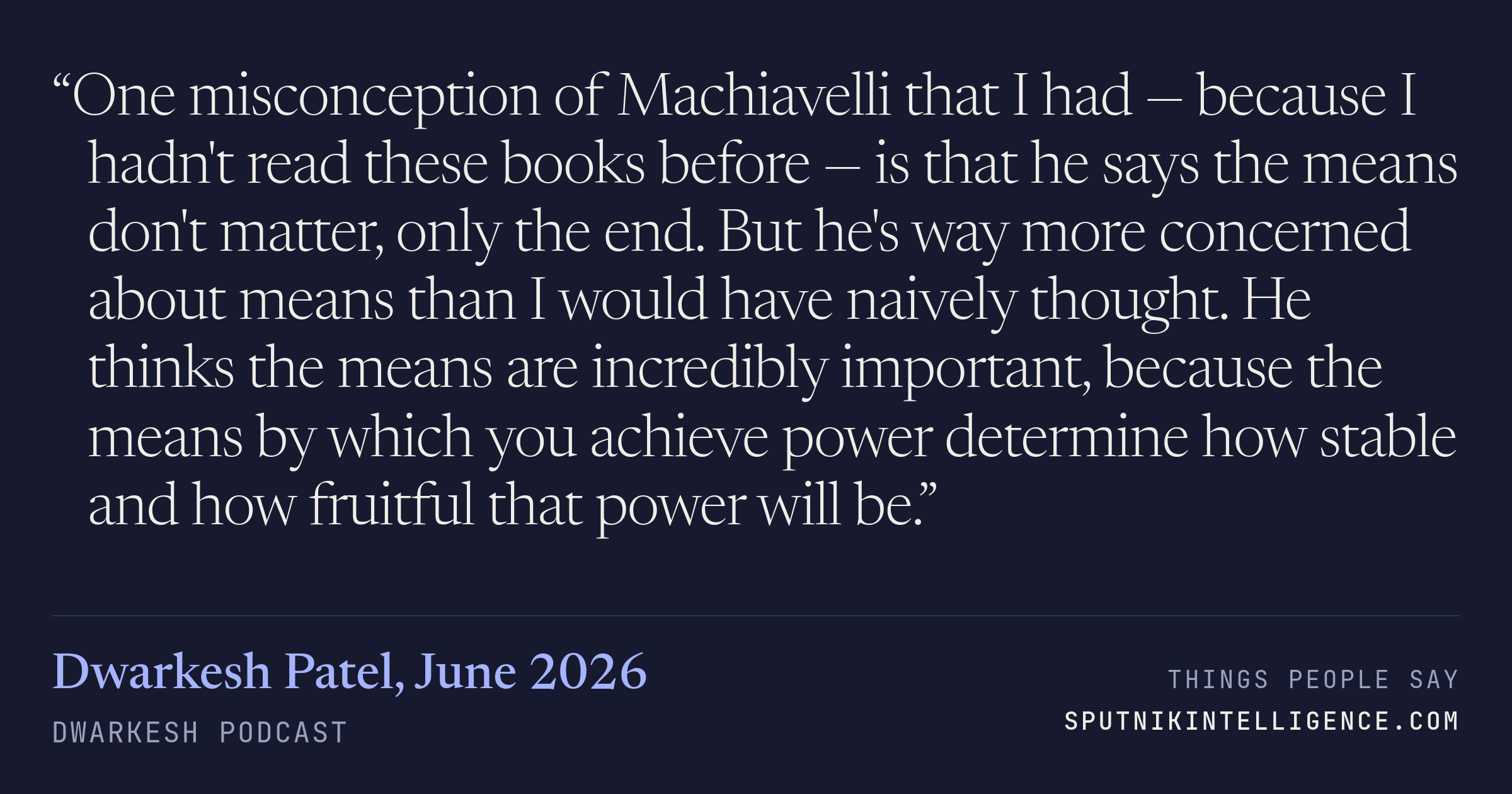
Said to Ada Palmer partway through a conversation about The Prince and the Discourses on Livy. The correction is that Machiavelli's interest in means is instrumental rather than moral — cruelty and broken promises are costly because of what they do to your position later. Palmer's answer is that it's subtler still.
Transcript
Doesn't it contradict what he was saying in the prints about never rise with the help of great powers? For even in success, you have empowered somebody who's stronger than you and whose mercy you're at.
I mean, this is not Florence aiming to rise. This is not Florence expecting that it will gain anything by this. This is Florence knowing it will lose. And Machiavelli is very open about the fact if Alexander had lived another year, Valentino would have finished his conquest and taken Florence and taken it at last, and it would have been over. But popes are mortal. And buying time is sometimes the survival mechanism. And so Machiavelli has this incredible first-hand experience of being with Valentino through all of these decisions, being with him at the massacre at Senegalia, when rumor had reached Valentino that some of his people were terrified of him and plotting to overthrow him. And then they were so scared of him, they decided to abandon the plot. And he heard and he met with them and told them, I forgive you. It's okay. You've renewed your loyalty to me. You've passed the test. I trust you all as well. And then he invites them to the banquet and then massacres them all. The forgiveness is false. The betrayals are punished. There's this amazing letter that's a couple months afterward where Machiavelli's loved ones are writing from Florence because they've received a letter from him after the massacre at Senegalia. And they say, oh, thank God, you're alive. We had no idea. All we heard was that he had massacred a large number of the people who were with him. We didn't know if you were alive because it took months in the chaos. The postal system had completely broken down, right? It took months for them to get word that Machiavelli was still alive. They didn't know whether he had been caught up in the conspiracy. He easily could have been on a list of names of people the conspirators intended to recruit and be gone. So his wife and his loved ones back at home, his children had to wait months to find out whether he too had been slaughtered. And it felt to them like a miracle that he hadn't. But it meant that he watched these incredible deeds of you encounter them, you forgive them, you renew vows of amity, sacred vows taken in the cathedral, and then you slaughter them at dinner, violating the laws of hospitality, right? That Dante would say, if you do that, you've committed such a grave sin that you're not just regular damned. A devil comes up out of hell and takes your soul out of your body and inhabits you. And that you're actually already in hell, even though your body is still alive on earth, because that's how heinous a sin this is. And yet, it works. And all the rest of Valentino's men are more loyal to him afterward than ever before and won't even whisper to each other about dissatisfaction because even the faintest whiff of conspiracy might result in death. So why does Valentino's kingdom, for which he did everything right, ultimately fall apart? Because he happens to eat the same thing that gives him food poisoning as his father and happens to be ill at the wrong moment. And also the puppet that he manages to get in power, Pius III, dies too fast. And then he's outmaneuvered by Julius. If all those things hadn't gone wrong in a row, the kingdom would have stood. And indeed, he would have conquered Florence. So Machiavelli is constantly reminding us that, yes, we have all of these things we can try to do. We can remember it's better to be feared than loved. We can remember not to be hated. We have power over maximum half of what causes outcomes. The other half is always going to be fortune, right? Because we look at Machiavelli, we know he's the origin of utilitarian thought and that he says we need to evaluate people's deeds based on outcome. But he doesn't just say we need to evaluate their deeds based on outcome. He says we need to evaluate their deeds based on what the most probable outcome was before fortune intervened. And so he says people look at Valentino Borgia and say, but the Borgias fell. They were feared and then they were hated and then they fell and then their enemies took power and then chiseled their coats of arms off of every surface in Rome. So that to this day, you're walking through Rome and you sit down at a pizzeria and there's a weird scar on the wall and that scar is where the Borgia bull is no more, right? And people want to make the moral of that be don't do what the Borgias did. They fell. And Machiavelli's like, no, they did not fall because of their choices. They fell because half of what happens in the world is never in our control. And you can do everything. Right, and it's out of your control, but we have to evaluate what would have happened. And therefore, we should imitate them because everything they did was right.
I think one misconception of Machiavelli that I had, because I had not read these books before, um, is that he says the means don't matter, the end matters. And there's a virtue ethic sense in which maybe he doesn't think the means matter, but like he is way more concerned about the means than I would have nightly thought. He thinks the means are incredibly important because the means by which you achieve power determine how stable and how fruitful that power will be. Right. In the context of military conflicts, he says, if you achieve some power with the help of mercenaries or with the help of great powers, people who will become stronger than you as a result of you achieving power, that is a very precarious spot to be in. But speaking of Julius, he makes another point that if you achieve your power by lying, by breaking oaths, by being unfaithful, that this is okay because his view is that people will forget that you are not faithful. They will just take you at your word the next time they encounter you. And so it's actually a very interesting meditation on by what means can you achieve power that will make that power stable versus not. And the fact that he thinks breaking your word is totally fine. Well, it's
more like it's even subtler than that. Because it's if you are someone who breaks your word and you break it this way, it'll bite you in the ass. And if you break it these ways, it'll be okay. Because he also does analysis of figures like Savannah Rola, who would make prophecies and promises, and then some of them would happen and some of them wouldn't. And then he would make new ones and sort of correct what he said yesterday. And he handled his manipulation and untruths badly in Machiavelli's analysis in a way that did turn people against him and make him lose power. Partly because Savannah Rola, as a religious demagogue, the core of his power was people believing that he was divinely inspired and that he wouldn't make mistakes and wouldn't err. And so his power base was fragile vis-à-vis untruth. And for him, because of the specific shape of his power and then the specific way he handled his contradictions, that did hurt him. Whereas if it's somebody like Cesare Borgia who will make an alliance and work with that ally for a while and then betray them, because meanwhile he was such an effective conqueror and he was so scare, scary, and everyone was so afraid of him. Even when he would betray an ally, his other allies would say, I gotta be more faithful to him so that the next person to be betrayed isn't me and try to work hard to be in the good graces of the prince so that I'm not next, as opposed to turning on him because he was so scary. Savonarola was not scary. Savannah Rola was charismatic and persuasive and had one of these voices that made you crowds thrill and women swoon. And decades later, when people asked Michelangelo what Savannah Rola had been like when Savannah had been dead for decades, Michelangelo's answer was, I still hear his voice. He had one of those charismatic presences that wasn't enough when he started flip-flopping on policy and truth. Whereas Valentino was so scary that he could betray his top general and seize his lands and overthrow his city. And all of his other generals would say, better step even further into line. So it's not just that lying is okay. It's that lying is sometimes okay if you check these other boxes. And it's not if you don't. So this is even more reinforcement of he zooms in so much on the means. And if you do A and B, you're okay. But if you do A and C, you're not. Looking at the minutiae of different ways you can wield power and different reasons people can have to follow you. If you're a prince who's decided to invested in being loved, you have to keep it up or cultivate being feared alongside it. If you've invested heavily in being feared, there are things you can then do that you can't do if you're a prince whose power depends on being loved.
And this actually gets so the famous quote in the prince: it is better to be feared than loved. What he's getting at there is I think he's just like very cynical about people's nature. And if people make you a promise, they'll just go back on it. If your power base depends on people's promises and loyalties, as soon as your rule seems tattering, they'll go back on it. Whereas if your rule depends on people just having expectation that if they break their oath to you, they will be punished. That's much more stable. But his cynicism about he basically thinks people will act as badly as they are allowed to. I mean, yeah, his whole justification of checks and balances is not dissimilar to the founders of the US and their reason for wanting checks and balances and wanting to put different factions against each other. He's just kind of cynical and thinks people will. Just act as badly as you allow them. I mean,
on that topic, Machiavelli is the first person that we have ever in the European tradition to suggest that it could be viable for there to be more than one political party in a state at the same time and that they would compete against each other and sort of vent the society's tensions through competition and vie to try to dominate an election and then the next one. This is what we're used to. This is innovative, Immachiavelli. Machiavelli talks about how competition within a city, if the parties are kind of stable, he's observing Siena as one of the examples of this, can vent local tensions and allow interior adjustments of who has power. And the norm, the standard attitude toward political parties, is if there are two political parties in Nepality, it will not be stable until one of those political parties is dead and their heads have been cut off and put on spikes and their houses have been burned down and paved over. That has been Florence's solution to political parties before. Florence massacred its Ghibellines and killed all of them and raped salt into the earth where the houses used to be so nothing can grow there. Nothing still grows there. And then when the black Guelphs and the White Guelphs split into two sub-parties, they immediately started slaughtering each other as well. The standard was one party must wipe out the other party for there to be stability. And there are comparatively few examples, although Florence's neighbor Siena is one, where political parties manage to not only coexist side by side, but be politically helpful.
More from Dwarkesh Podcast