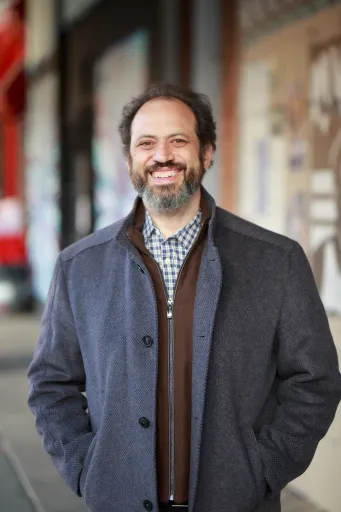
 Ethan Mollick
I am a professor at the Wharton School of the University of Pennsylvania.
“The AI has personalities. They're all remarkably similar to each other. … They're kind of obsessed with a bunch of ideas from 2022. Like they love VR and they love NFT stuff and they like solving things through consensus. And if you ask them for creative ideas for a game or something, they love the idea of resonance and drowned cathedrals comes up a lot for some reason, long-lost continents.”
Freakonomics Radio · Ideas & Essays · October 2026
Mollick on research finding that AI does well on creativity tests but its ideas are less diverse than a group of people working alone. Chinese and US models, he says, cluster around the same attitudes, though prompting can widen the range.
Transcript
…that's actually less good than assembly a group of people who each have mostly bad ideas, but one good idea. Because with ideation, you could select the best idea out of a pile. More doesn't hurt you. And it does turn out that AI is less diverse than individual. Doing the work on their own, right?
Can you explain why that clustering would happen? I would think that AI is capable of scanning much further and wider than any human.
…This is sort of off-the-dome work. There are things you can do that makes the AI more creative. And we found that with the right prompting techniques, you could generate hundreds of ideas that are different from each other and approach the level of diversity or even match the level of diversity of a group of MBAs and a design thinking course. So there are ways of making it more diverse, but the AI has personalities. They're all remarkably similar to each other. There's a bunch of studies that show that AI attitudes sort of cluster. And whether you're talking about a Chinese model or a US model or Grok, which is supposed to be very different, they all have very similar attitudes. And if you've worked with AI a lot, just like the language sort of comes up over and over again, you'll know that they're kind of obsessed with a bunch of ideas from like 2022.…
In terms of the creative arts, tell me what you know about how AI is being used now, whether openly or covertly in various creative industries.
There's a few things to talk about. By the way, on the family side, I have two sisters. One is a Hollywood producer who's pretty well known, and the other is a graphic designer. So I am the non-artist in the family, but I've actually become much more of an artist since using AI because it lets me…
You told our producer that you know Hollywood screenwriters who publicly or at least professionally have reason to fear AI or to maybe critique it, but privately love using it. Tell me about that.
More from Freakonomics Radio