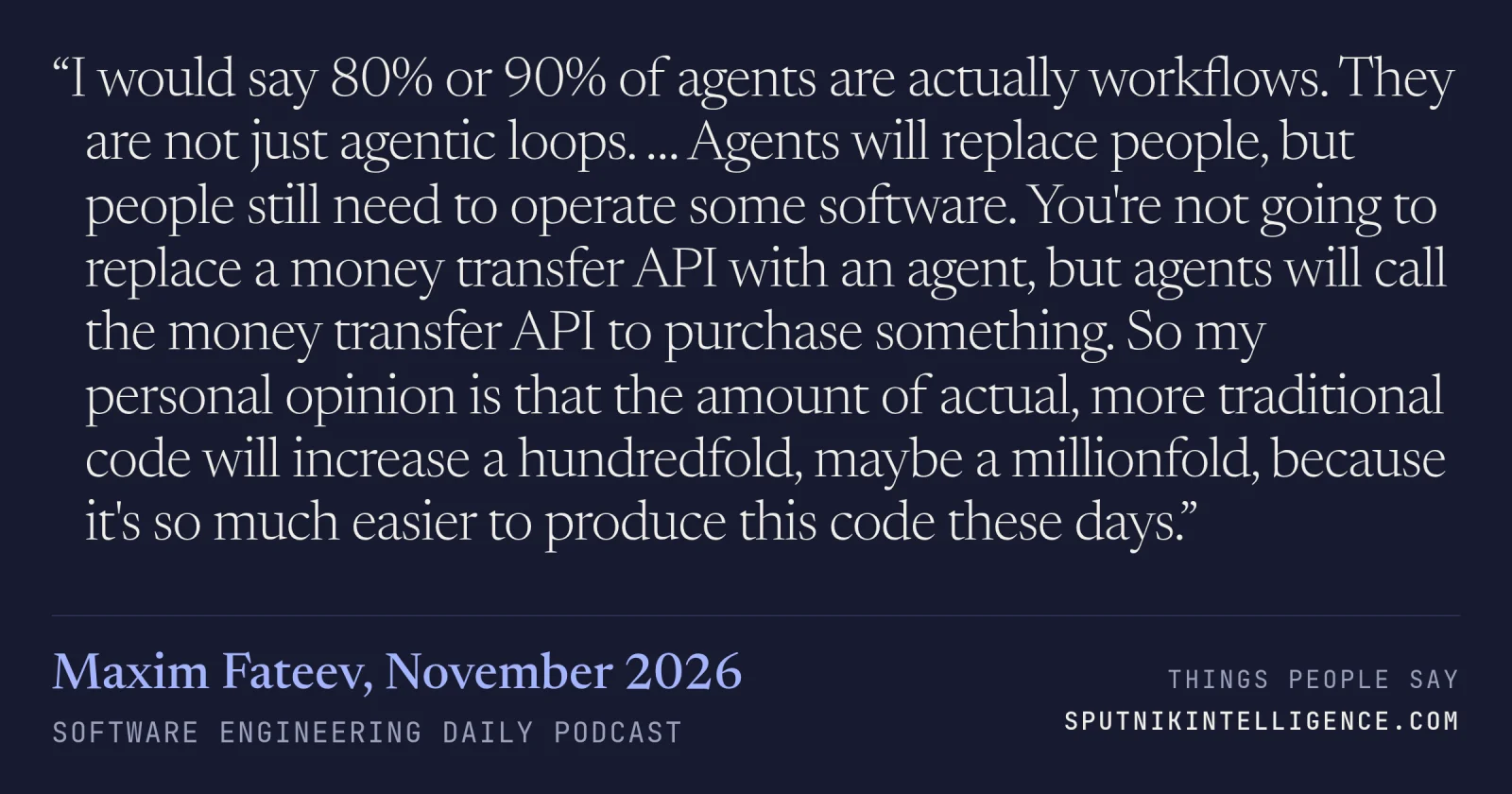
“I would say 80% or 90% of agents are actually workflows. They are not just agentic loops. … Agents will replace people, but people still need to operate some software. You're not going to replace a money transfer API with an agent, but agents will call the money transfer API to purchase something. So my personal opinion is that the amount of actual, more traditional code will increase a hundredfold, maybe a millionfold, because it's so much easier to produce this code these days.”
Software Engineering Daily · Hands-On Engineering Podcasts · November 2026
Context
Asked what is missing when agent frameworks build durability for themselves, the Temporal co-founder argues that most production "agents" are hard-coded workflows with an LLM step inside. He also predicts AI will multiply the amount of conventional code.
Transcript
…for each specific integration. So, our idea is to be an open platform which supports all of them and the new thing gives them durability, but we are not opinionated about specific framework or specific data formats and so on. If you're writing your own, you can absolutely use Temporal for that.
…frameworks have started to add some level of state management, crash recovery, and basically the starts of durable execution, but specifically focused on the agent. I guess, what is the limitation of that approach versus provided using a more general platform like Temporal to solve this problem?
I think it's the same thing as we talked about, like more traditional applications. You can do it, right? You can take your queues, database, and checkpoint, and it kind of works until it doesn't. But Temporal just gives you on the platform level, and then it just makes it easier to implement. And you don't need to maintain all of that. And again, the moment you hit a very large scale or like specific edge case, you will need to maintain that and support that. That is one. Another is that I still we talk agents all the time, but if you look at real production use cases, I would say 80% or 90% of agents are actually workflows, right? They are not like just agentic loops. Yes, we have some, like especially coding agents, even coding agents started to add these kind of workflow things, right? Sub-agents and so on. But most applications right now, I don't think will be like pure agents and applications, right? It will be a big mixture of things. Like, think about it, like, most basic one. Oh, I want an agent which will look at the GitHub issues and submit pull requests, right? Yes, you can have an Agentic loop with SCIL, but reality is you probably want to have hard-coded workflow which will say, look for issues, start a sandbox, like start, I don't know, with…
Yeah, and I think that agent has become a pretty overloaded term as well, where people use flexibly agents to
refer everything from single shot to an LOM to like fully dynamic decision-making and so forth. And I think the reality, like I agree with you, I think that most of these systems are going to be full-body software systems where there's some level of by definition agent sort of dynamic…
a durability standpoint, you don't want just the agentic loop to be durable. You want the whole software system to be durable. So the durability expands beyond just the sort of single point of the agentic loop.
More from Software Engineering Daily