 Dwarkesh Patel
Hosts the Dwarkesh Podcast, a long-form interview show on AI progress, timelines, and the people building frontier models, along with economists and historians.
Dwarkesh Patel
Hosts the Dwarkesh Podcast, a long-form interview show on AI progress, timelines, and the people building frontier models, along with economists and historians.
“One of the things you've been doing is rebuilding and improving and hacking on AlphaGo. Why is this the project you decided to do on sabbatical rather than just hanging out at the beach?”
Dwarkesh Podcast · AI Research & Frontier Labs · May 2026
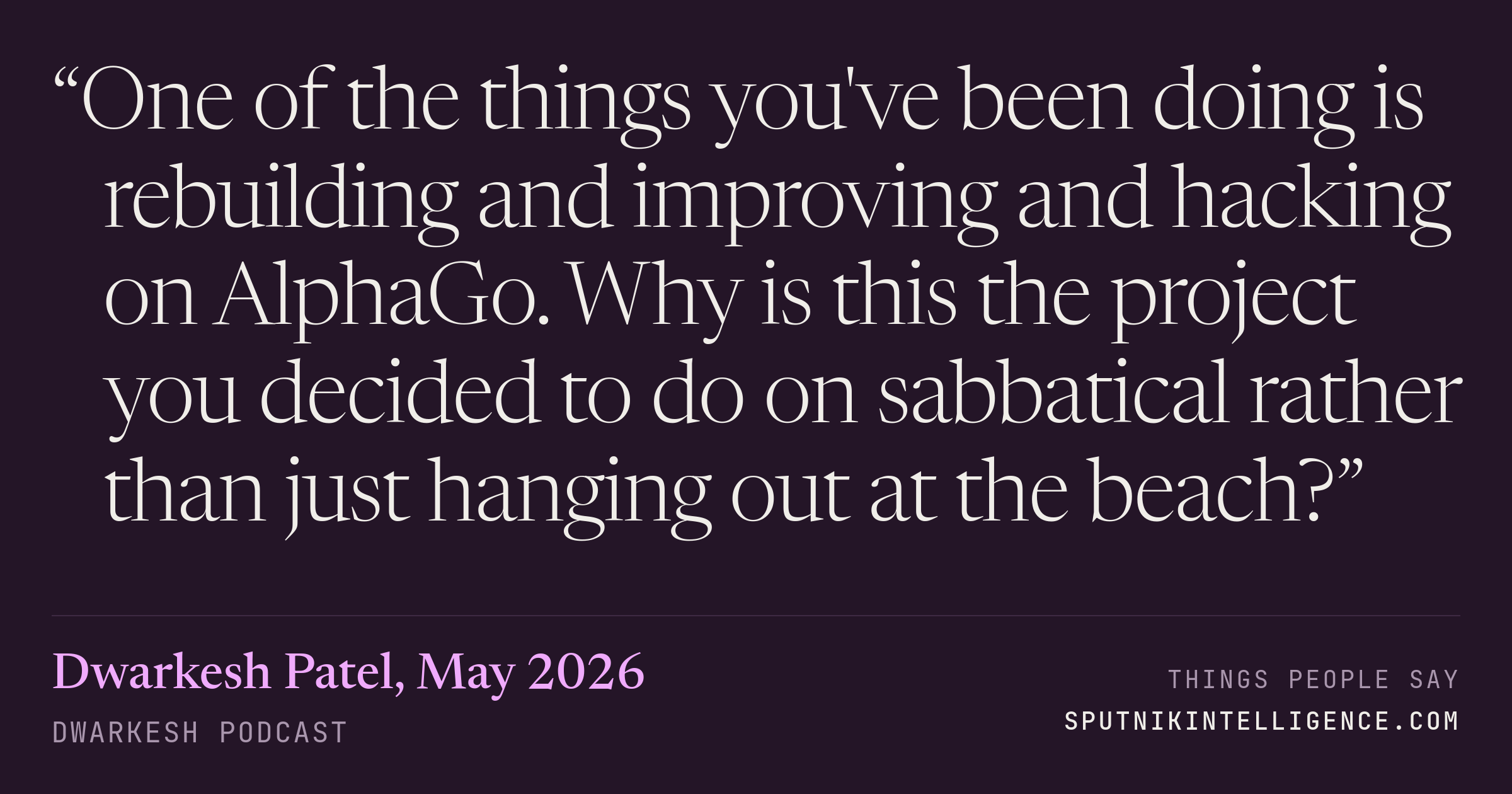
The opening line of the episode, to Eric Jang, who spent a sabbatical rebuilding a DeepMind-scale research project on his own with modern tools. The question does the work of establishing the premise and the oddity of it in one sentence. Jang's answer is that AlphaGo is what got him into the field in the first place.
Transcript
Today I'm here with Eric Jang, who was most recently vice president of AI at 1X Technologies, before that senior research scientist at what is now Google DeepMind Robotics. And you've been on sabbatical for the last few months. One of the things you've been doing is rebuilding and improving and hacking on AlphaGo. And so today what we're going to do is you're going to explain building AlphaGo from scratch and what it tells us about the future of AI research and development. But before we get to that, why is AlphaGo interesting? Why is this the project you decided to do on sabbatical rather than just hanging out at the beach?
Sure, yeah. I like making things. And AlphaGo and Go AI is one of those things that really got me into the field. When I saw the kind of early breakthroughs on AlphaGo in 2014, 2015, 2016, and so forth, it was just profound to see how smart AI systems could become and the kind of computational complexity class that they could tackle with deep learning. This is a problem that has long been understood to be kind of intractable for search, and yet it was solved through deep learning. And so that was quite mysterious to me, and I've always wanted to understand that phenomena a little bit better. My training is often in deep neural nets for robotics, where the decisions made by the neural networks are a bit more intuitive. Building AlphaGo is a sort of problem where the decisions are actually the result of a very, very deep search. And it's always been very mysterious to me how like a 10-layer network can sort of amortize the simulation of something so deep in the game tree.
Yeah, interesting.
So if you plot out how much compute it took to build various iterations of strong GoBots over the years, you can see that in 2020, there was an open source project called Katago by David Wu from Jane Street, who basically achieved a 40x reduction in compute needed to train a really strong GoBot Tableaur Raza. I'm not certain if it's stronger than AlphaGo 0 or AlphaZero or Mu0, but it's very, very strong. And this is what most Go practitioners today train against when they're playing in AI. And thanks to LLM coding, what took a whole team of research scientists at DeepMind and millions of dollars of research and compute can now be done for a few thousand dollars of rented compute.
More from Dwarkesh Podcast