“The inference market is going to be a $10 trillion market within 10 years. … If we knock off a zero, one order magnitude of efficiency on delivery of a token, that effectively 10x's the market in some ways. … So I actually think robotics is going to be 100 times larger than agentic coding.”
The Twenty Minute VC (20VC): Venture Capital | Startup Funding | The Pitch · Startups & Venture · October 2026
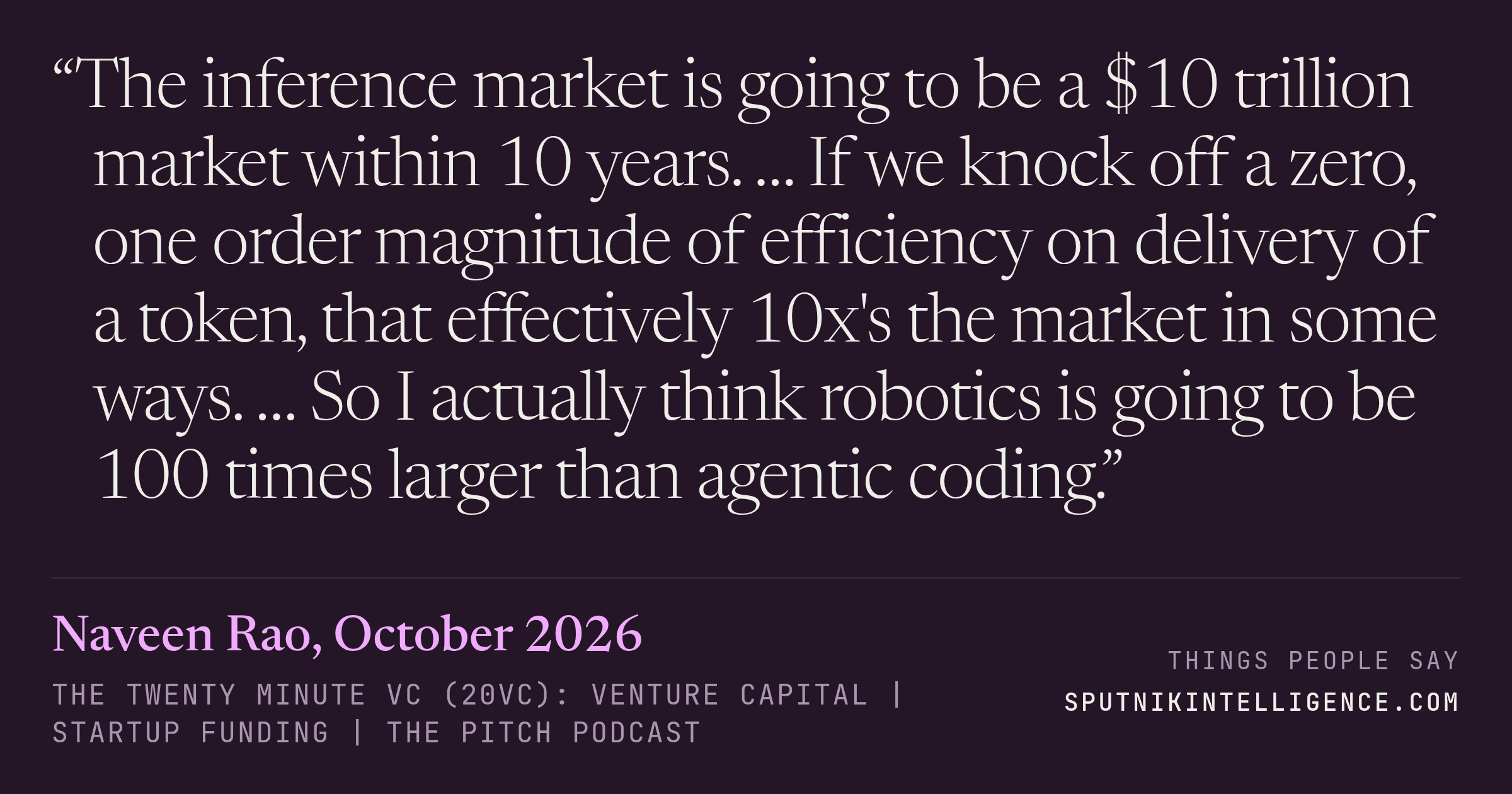
Rao argues that each big drop in the cost of producing a token opens up far more uses, the Jevons paradox applied to AI. He says that is why tech markets that once looked bounded now look like they run to trillions of dollars.
Transcript
You know, I think we're going to be in this weird world where we live in exponential development cycles. It's really hard to apply our old models. Something that looks like so far away today with an exponential curve ends up being much faster than you thought.
And like TAMs, you know, a market size is I think the inference market. What do I know now that I wish I'd known 24 months ago? That the inference market was just like unbounded. It's
…And the inference market is going to be a $10 trillion market within 10 years. So this is insane to think about, right? And to your point, we're moving some of that labor market and part of the value generation stack to technology. So that's where we're getting these giant TAMs. So the way I look at like unconventional, the reason that I think it's a, it's a fantastic market to be in is that if we knock off a zero, one order magnitude of efficiency on delivery of a token, that effectively 10x's the market in some ways. So something was a trillion dollar market, now all of a sudden you have way more applicability. The base of potential uses just increases more than 10x. This is Jevin's paradox. So I think we're in this place where we can build these exponentials and it just unlocks massive value and markets. So I actually think robotics is going to be 100 times larger than agentic coding.
Well, well, that is slightly disagreeing with me, Naveen. Can we just like, before we do a quick five, can we just unpack that? Because I don't want to be completely moronic. Why do you say that?
I think we're still scratching the surface of how to see the output of intelligence. So the physical world is something we've just not been in at all for intelligence. Like I would argue robotics to date, like industrial robotics, are not really intelligent. They're rote. We're imbuing them with…
Can I be blunt? Where specifically then do you invest in robotics? In the model companies that power them, the data companies that power the model companies, the consumer application layer, where? I
More from The Twenty Minute VC (20VC): Venture Capital | Startup Funding | The Pitch