 Dwarkesh Patel
Hosts the Dwarkesh Podcast, a long-form interview show on AI progress, timelines, and the people building frontier models, along with economists and historians.
Dwarkesh Patel
Hosts the Dwarkesh Podcast, a long-form interview show on AI progress, timelines, and the people building frontier models, along with economists and historians.
“At the frontiers of physics today, in your experience, does it feel like if you just have millions of them running autonomously, you could have enormous discoveries? Or are we in a different era now, and really there's limited usefulness of that parallelism?”
Dwarkesh Podcast · AI Research & Frontier Labs · July 2026
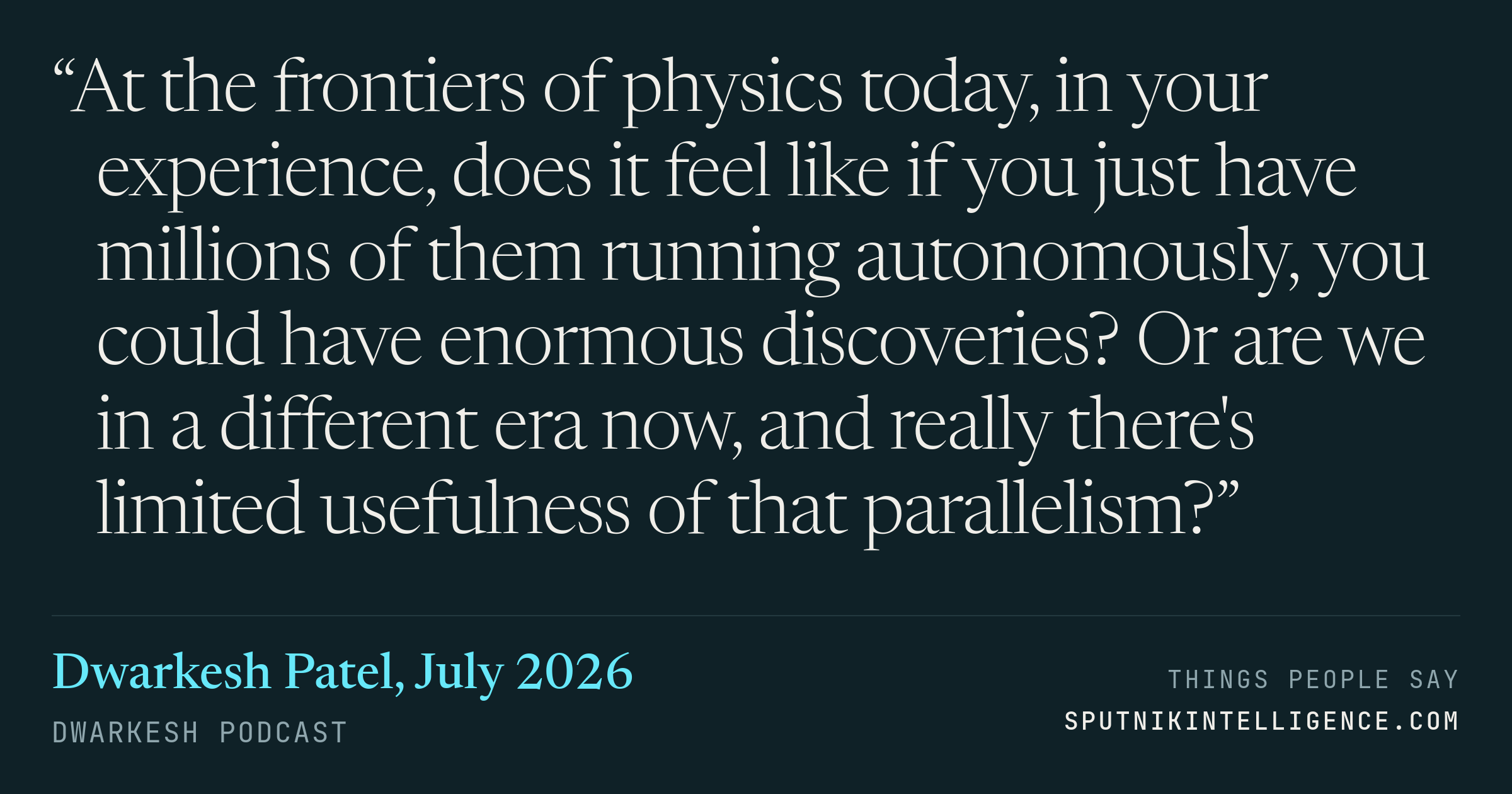
The 'them' is Einsteins — Adam Brown had just said that with lots and lots of Einsteins you could explore the whole tree of options in parallel, because general relativity needed so few empirical inputs. Dwarkesh is asking whether that still holds at today's frontier. Brown's answer is that different parts of science have different branching fractions, and string theory is the cautionary case.
Transcript
Yeah, increasing the demand curve on the theoretical physicist, but yeah.
That's right. Yeah, not so cheap anymore. But how far can that get you? I would say that general relativity is perhaps one extreme of that. That is not how it usually works in the history of physics. This really is closer to some Ayn Rand hero just sitting alone, you know, the product of a single mind. He got lots of help in various ways, but it really was just like a singular vision that he pursued for years. And it was pretty, you know, he wrote it down and a lot of people were very impressed almost immediately. It did require launching a somewhat expensive eclipse expedition to go confirm it before he really achieved global celebrity. And most people were sold on it. But it was, it's perhaps one of the most extreme examples of this, where just somebody just sits down and thinks very hard and writes down a true theory. And in some sense, physics has been chasing that high ever since. People love that romantic vision of themselves just sitting down and thinking with very few empirical insights and just thinking very, very hard and doing thought experiments. And it's typically not worked out quite as well for everybody else as it worked out for Einstein. In fact, it didn't even work out that well for Einstein in the later part of his career. Yeah, how far you could get just by thinking, what do you need to do general relativity? You need the financier of the speed of light. You need to convince yourself not just that the speed of light is finite, but that there's the symmetry that protects that that Einstein came up with in special relativity. Then you probably want the equivalence principle, that the inertial, it's an empirical fact that the inertial masses and the gravitational mass are the same for everything. But that's pretty sparse. And from just those two things, there's still a few options. But if you have lots and lots of large language models, you can just, if there's only a limited number of options, you can just explore the entire tree and say, okay, focus on this, you know, the equivalence principle is something that's super significant. And this other thing, now, okay, now abandon simultaneity and see how far that takes you. So still, there's only a finite number of things to explore there. I don't know how that, how well, I think we got very, very lucky with general relativity that that's quite so powerful under those circumstances. But if you just had lots and lots of Einsteins and you just give each of them various options, you could presumably see them in parallel.
At the frontiers of physics today, in your experience, does it feel like if you just have millions in them running autonomously, you could have enormous discoveries? Or are we in a different era now? And really, there's like limited usefulness of that parallelism.
I think there is usefulness. I do think that different parts of science have different branching fractions and how much you need experiment to cut off that branch. I talked about chasing the high of Einstein. Arguably string theory has
really been going all in on that. So Einstein's theory is just general relativity. There's also quantum mechanics and trying to marry those two in a consistent way that general relativity doesn't do it all. There's no quantum mechanics in general relativity. How to do that has motivated a lot of people. The problem is that in order to see that in experiments, if you just do the dimensional analysis, you need ginormous particle colliders, absolutely galactic-sized particle colliders. It's just very hard to see any of
that stuff. But that doesn't stop people. I mean, it stopped many people, but many people didn't stop and keep trying to do it. And so there you just have to kind of hope that it works out sort of like how it did with general relativity, where just by thinking very, very, very hard with minimal input from experiment, you can feel your way to the right answer. And for that to be true, it needs to be the case that the number of possible, the tool you have at your disposal is mathematical consistency and does it reduce correctly in the known limits. So you better hope that there's only one or a very small number of possible consistent theories that would work out if you're going to do that. If it turns out that there's an unlimited number of consistent theories, you're never going to feel your way to the correct answer because they're all consistent. And the only tool you have is consistency and perhaps some notion of aesthetics. But if there's only a few, then maybe you could do it all the way. And so string theory has kind of kind of gone all in on that, I would say, is just trying to, with minimal experimental input, believing that there's only one consistent theory of gravity, and just by doing sufficient consistency checks, you can find it. For other examples, it's much harder. There's clearly many condensed matter physics. Often you simply need to go and do an experiment to turn out which one is correct.
More from Dwarkesh Podcast