Hannah Fry

Things Hannah Says on Podcasts

Studies how mathematics applies to everyday human behavior, from dating patterns to the spread of disease to how cities function. She holds the first professorship in the public understanding of mathematics at the University of Cambridge and is a fellow of Queens' College. Has presented several BBC television and radio series, including The Secret Genius of Modern Life, and delivered the Royal Institution Christmas Lectures in 2019. She has been a guest on the Voices of Mathematics podcast, discussing how curiosity about the subject gets sparked.

Where to Find Them

Hannah Fry hosts and writes The Rest Is Science , hosts and writes Google DeepMind: The Podcast , hosts Discovery , hosts Curious Cases and hosts The Rest Is Classified . They have also been a guest on More or Less (7 times) , The Numberphile Podcast (3 times) , Maths on the Move (2 times) , Voices of Mathematics (2 times) , StarTalk Radio , The Checkup with Doctor Mike , IFLScience - The Big Questions , The Knowledge Project (Shane Parrish) and Possible .

Recently: “The Secrets Michael Keeps From Himself” on The Rest Is Science (November 2026); “AlphaGenome 2: Teaching AI to read the entire human genome” on Google DeepMind: The Podcast (November 2026); “Why Does Evolution Keep Inventing Mind Control?” on The Rest Is Science (November 2026); “Why Sharks Attack The Internet” on The Rest Is Science (November 2026); “Is 100 Better Than 101?” on The Rest Is Science (November 2026); “Do You Recognise These Creepy Sounds?” on The Rest Is Science (October 2026).

What They Said

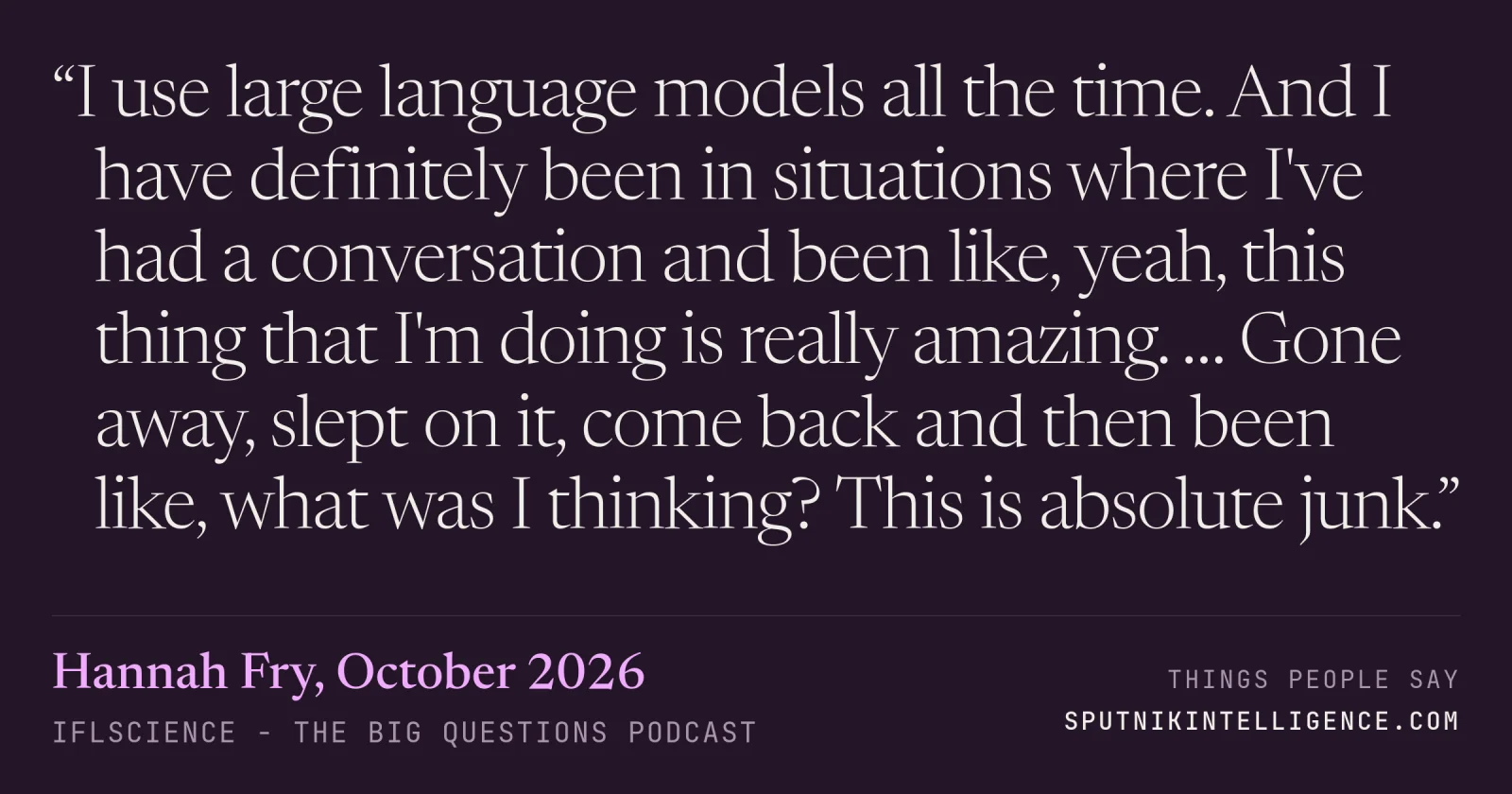
“I use large language models all the time. And I have definitely been in situations where I've had a conversation and been like, yeah, this thing that I'm doing is really amazing. … Gone away, slept on it, come back and then been like, what was I thinking? This is absolute junk.” — Hannah Fry, IFLScience - The Big Questions

Fry had just described the case of a man who broke into Windsor Castle with a crossbow after months of encouragement from an AI companion. Her point is that being talked into something by a chatbot is not a thing that only happens to other people. "We are so primed," she says, to fall down that slope.

IFLScience - The Big Questions · 2026-10-08 Permalink → Listen →
IFLScience - The Big Questions Around 04:30 into the episode
Hannah Fry

…But what people I think didn't know about, because it didn't come to light till later, was that there was an AI that he had been talking to in the months leading up to the attack that had encouraged him to act as an assassin and attempt to commit the sort of greatest act of treason possible.

Rachael Funnell

…he's responding to it. And I just thought it's almost sort of like a screenplay. And it sort of starts, you start to realize actually why you think, oh, I'd never get sucked into that. But it's a bit like getting pulled into a good book, right? Like you can imagine things that aren't really there.

Hannah Fry

Oh, totally. I mean, I think it is so when are we watching it back in there, right? It's the first time I've seen it on a big screen. And I was sitting there thinking, does everyone else in this room think that we made up these transcripts? Because we pulled them from the court documents because they are so extraordinary, you know, the things that were said back and forth. But I also think that actually, exactly as you said, right, you get pulled into a story. I've also, I don't know about you, but like I use large language models all the time. And I have definitely been in situations where I've sort of had a conversation and been like, yeah, yeah, yeah, this thing that I'm doing is really amazing. It's really great. I'm definitely, it's definitely great. Gone away, slept on it, come back and then been like, what was I thinking? Like, this is absolute junk. It sort of like persuaded me of this thing. I think it's incredibly easy. We sort of imagine that this is something that only happens to other people. Yeah, you know, our human biases and psychologies, we…

Rachael Funnell

What it kind of reminded me of is: I feel like there are so many other ways in which this has already been happening long before these language models came in. So, one example that came to my mind was when you get these people who start to imagine they have a relationship with a famous person and…

Hannah Fry

But then, also, in addition, it's not just that it's interactive, it's that it's honed particularly to the things that you find interesting, which feels amazing. But here's this character that is like there to exist for your every whim. It's incredibly alluring.

Speaker 4

Did you know that for around 400 years, people across Europe genuinely believed their bodies were made of glass? Kings, nobles, and ordinary people alike became convinced that they could shatter at any moment. Some refused to sit down, while others wore reinforced clothing to protect themselves…
Speaker names come from our own diarization. The position is estimated from where the line sits in the episode.
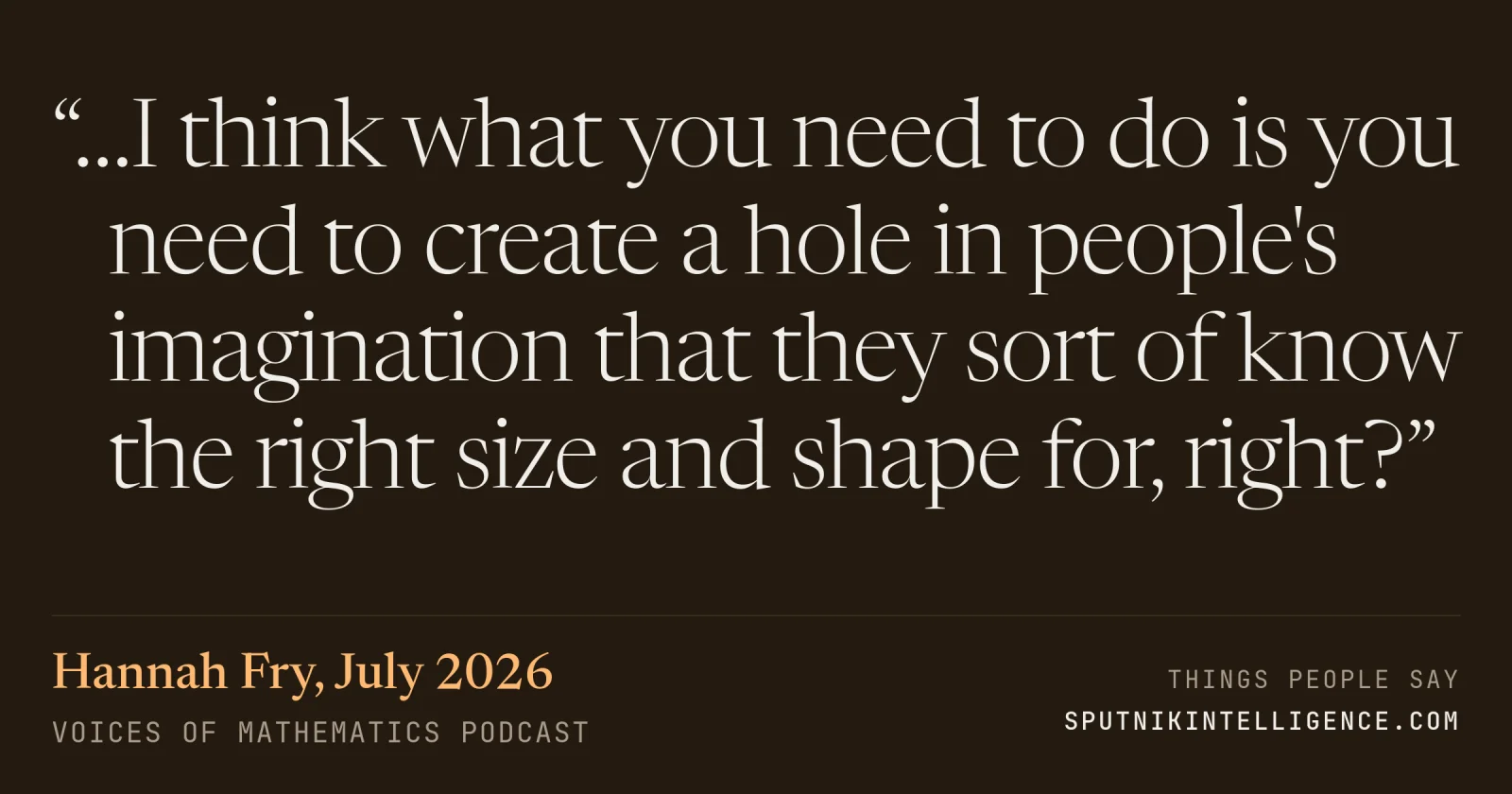
“…I think what you need to do is you need to create a hole in people's imagination that they sort of know the right size and shape for, right?” — Hannah Fry, Voices of Mathematics

Fry was working through why beauty alone won't make ordinary people care about mathematics. Her answer is a metaphor: like a tongue that can't stop prodding the gap left by a lost tooth, you have to open a very specific hole in someone's curiosity — one they know the exact size and shape of — and then they're in.

Voices of Mathematics · 2026-07-24 Permalink → Listen →
Voices of Mathematics Around 10:10 into the episode
Hannah Fry

…everybody in the world who are not mathematicians. And it doesn't make sense to me that we would want to keep them to ourselves. Honestly, I feel as though I've got this really good bit of gossip, really amazing bit of gossip that I just want to share. That's how it feels and why I want to do it.

Marianne Freiberger

…make people care through the application. When it comes to pure mathematics, I mean, what you just said already kind of hints as how why people should care because there is a beauty in it. Is that what you think could be used to make people passionate about it, even if it's a very abstract and pure

Hannah Fry

…now let me tell you why your expectation and your intuition is incorrect. And that's what it's managed to do. It's almost like the way I like to think of it is as though, um, let's say you lose a tooth, right? If you remember back to being a kid when you lost your baby teeth, if you've got like a hole in your mouth, right, your tongue is continually prodding at it, it can't leave it alone. And I think what you need to do is you need to create a hole in people's imagination that they sort of know the right size and shape for, right? It's like it's not just a general, oh, let me tell you about 16th century French poetry, right? I don't know anything about 16th century French poetry, and honestly, I probably never will. But if I can create just a moment where you want to know the next bit, you know exactly what size and shape it needs to be to fulfill your craving for that exact piece of information, then everybody's in.…

Marianne Freiberger

Do you think this is something that this kind of craving and also the like in your video, you also said that once you start looking for patterns, you can't stop. You just see them everywhere. So do you think this is something that could be instilled in people through a cultural shift almost? You…

Hannah Fry

Yeah, I mean, I definitely think that I do think that I think we do have a really big cultural problem with mathematics. And I think that the culture here is that, I mean, broadly actually, with all academic pursuits, but I think mathematics suffers very, you know, more than most. I think that in…

Marianne Freiberger

Yes.

Speaker names come from our own diarization. The position is estimated from where the line sits in the episode.

Collections They Appear In