Paul Graham

Things Paul Says on Podcasts

Where to Find Them

Paul Graham has been a guest on The Social Radars (3 times) , Y Combinator Startup Podcast (3 times) , EconTalk , Conversations with Tyler and TBPN .

Recently: “How To Build The Future: Paul Graham & Amjad Masad” on Y Combinator Startup Podcast (November 2026); “Paul Graham On Startups, Ambition, and Great Founders” on Y Combinator Startup Podcast (September 2026); “Paul Graham: Should you move to Silicon Valley?” on Y Combinator Startup Podcast (May 2026); “Paul Graham, Founder, Y Combinator” on The Social Radars (March 2026); “🟠 YC Demo Day, Paul Graham Joins, Will AWS Buy TPUs From Google? | Harj Taggar, Paul Graham & Jessica Livingston, Richard Wang, Philip Ho, Ali Attar, Kurush Dubash & More” on TBPN (December 2025); “Founder Mode: Paul Graham, Founder, Y Combinator” on The Social Radars (August 2025).

What They Said

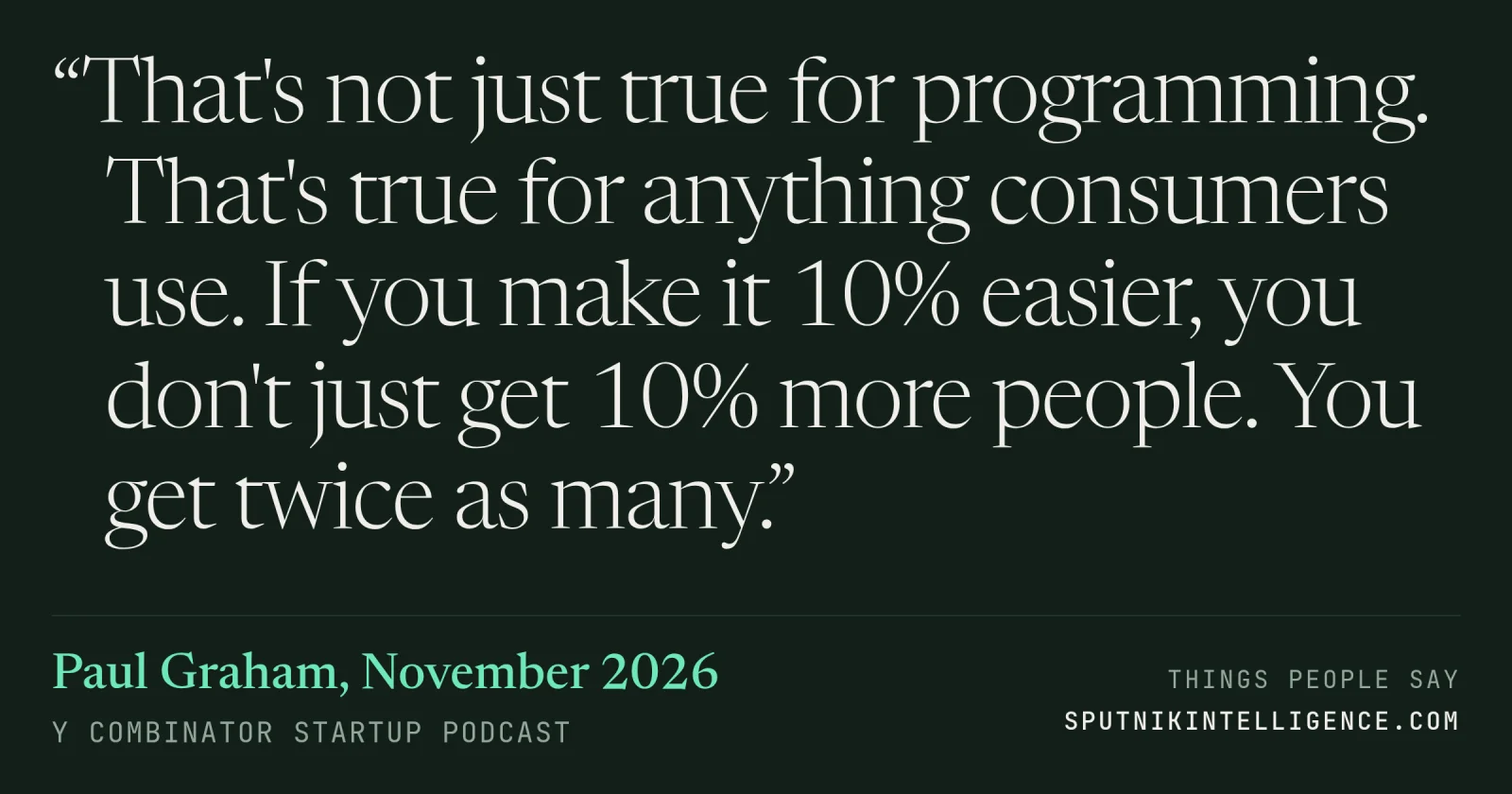
“That's not just true for programming. That's true for anything consumers use. If you make it 10% easier, you don't just get 10% more people. You get twice as many.” — Paul Graham, Y Combinator Startup Podcast

Masad reminded Graham of what he said when he first backed Replit: there is a super-linear relationship between how easy programming is and how many programmers you get. Graham confirms the principle and generalizes it.

Y Combinator Startup Podcast · 2026-11-07 Permalink → Listen →
Y Combinator Startup Podcast Around 07:39 into the episode
Paul Graham

Yeah, I know, I know, because I, the way I program, is the exact opposite of this. I like, I program, you know, I spend three years writing a thousand lines of code. And if I can get it down to 980 in the next month, so much the better. But you

Amjad Masad

give me the principle for all of this, which is when you first invested in Replo, when you first backed Replit, you said there's a super linear relationship between how easy it is to program and how many programmers you get.

Paul Graham

Yes, that's true. That's not just true for programming. That's true for anything consumers use. If you make it 10% easier, you don't just get 10% more people. You get twice as many.

Amjad Masad

Yes.

Paul Graham

Yeah, I remember that. I didn't mean make it this easy.

Amjad Masad

It went too far. I mean, you just talk
Speaker names come from our own diarization. The position is estimated from where the line sits in the episode.
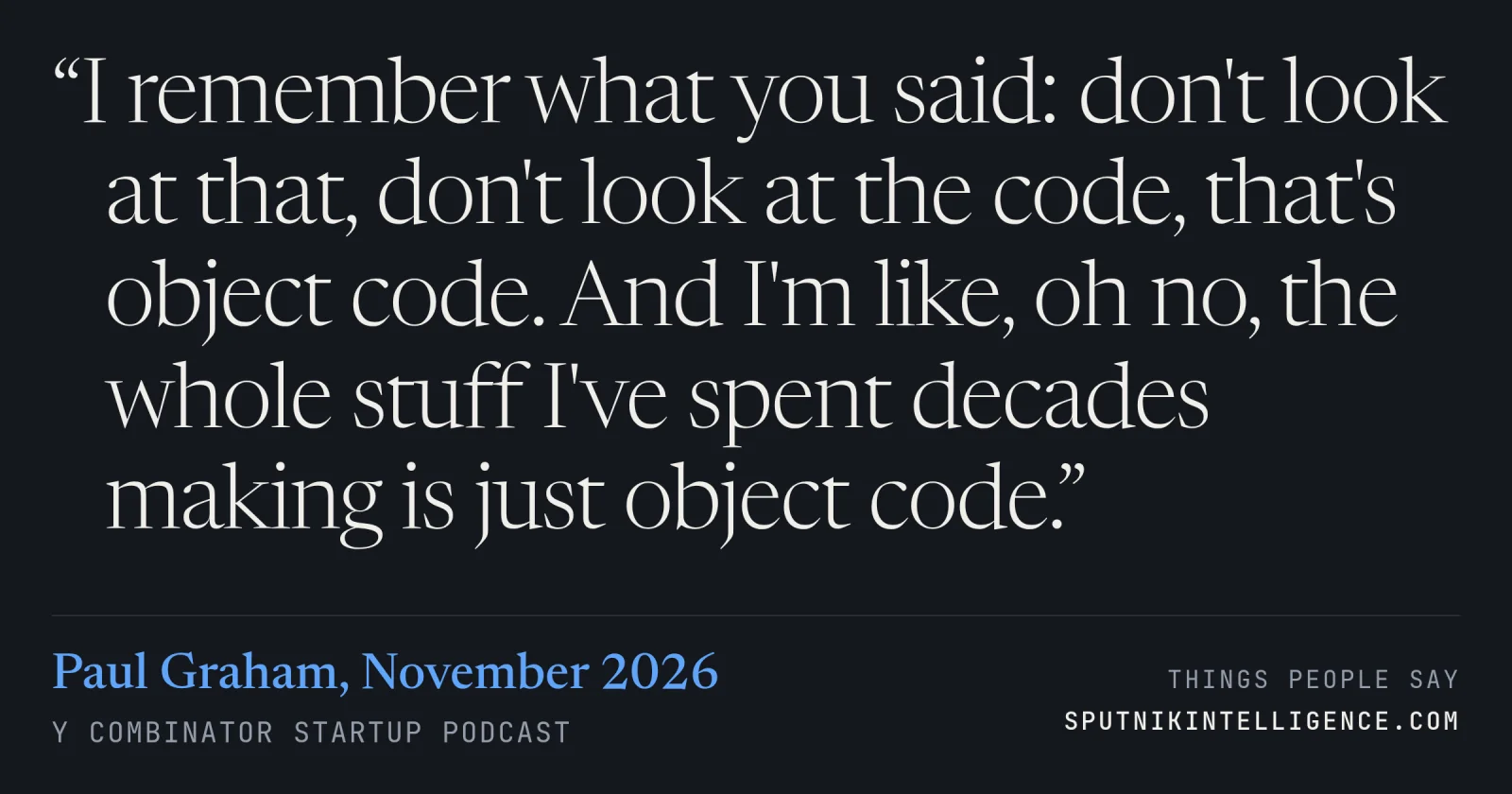
“I remember what you said: don't look at that, don't look at the code, that's object code. And I'm like, oh no, the whole stuff I've spent decades making is just object code.” — Paul Graham, Y Combinator Startup Podcast

Graham was recalling Masad's summer 2024 demo of what later became vibe coding, and the dismay he felt. It captures how a veteran programmer reacted to AI-written code.

Y Combinator Startup Podcast · 2026-11-07 Permalink → Listen →
Y Combinator Startup Podcast Around 11:44 into the episode
Paul Graham

…been trying to, you were trying to build Replit before it was called Replit for like, you know, years and years and years, right? This has always been the big thing. Right. So of course you thought of stuff before everybody else. So you knew back to that famous demo, right, in the summer of 2024.

Amjad Masad

When you called me a bond villain.

Paul Graham

Well, you seemed like a bond villain, you know? That's what I felt like that I was being shown this frightening thing because I remember, I still remember what you said. Don't look at that. Don't look at the code. That's object code. Yeah. Right. And I'm like, oh no, the stuff I, the whole stuff that I make, the whole stuff I've spent decades making is just object code.

Amjad Masad

No, everyone was realizing that. Like, I think I've been seeing like engineers that were also repulsed by that. I remember your tweet was very controversial when I tweeted that.

Paul Graham

That guy who generated vast amounts of code using AI. Yeah.

Amjad Masad

Well, even that tweet about me being the one. Bill and object code and all of that was also controversial. But now all engineers are, you know, I think with AI, everyone will have to go through this period of, you know, denial and then, and then sort of later on, you know, depression and then, you…

Speaker names come from our own diarization. The position is estimated from where the line sits in the episode.

Collections They Appear In