NP

Nicole Perlroth

Things Nicole Says on Podcasts

Where to Find Them

Nicole Perlroth hosts and writes To Catch a Thief: North Korea On Our Payroll and writes Your Undivided Attention . They have also been a guest on The Lawfare Podcast (3 times) , Pivot (Kara Swisher & Scott Galloway) (3 times) , The Lawfare Podcast: Patreon Edition (2 times) , On with Kara Swisher (2 times) , Greymatter (2 times) , The Daily (NYT) (2 times) , Lex Fridman Podcast , Summation with Auren Hoffman , Plain English with Derek Thompson , Darknet Diaries and The Ezra Klein Show .

Recently: “The ‘Everywhere, All at Once’ Cybersecurity Crisis” on The Ezra Klein Show (November 2026); “Why Everything Is Breaking All at Once” on Plain English with Derek Thompson (November 2026); “The Cyberattack We’re Not Ready For” on On with Kara Swisher (July 2026); “Ep. 6: The North Korea Model” on To Catch a Thief: North Korea On Our Payroll (July 2026); “Ep. 6: The North Korea Model” on To Catch a Thief: North Korea On Our Payroll (July 2026); “Ep. 5: The Heists” on To Catch a Thief: North Korea On Our Payroll (July 2026).

What They Said

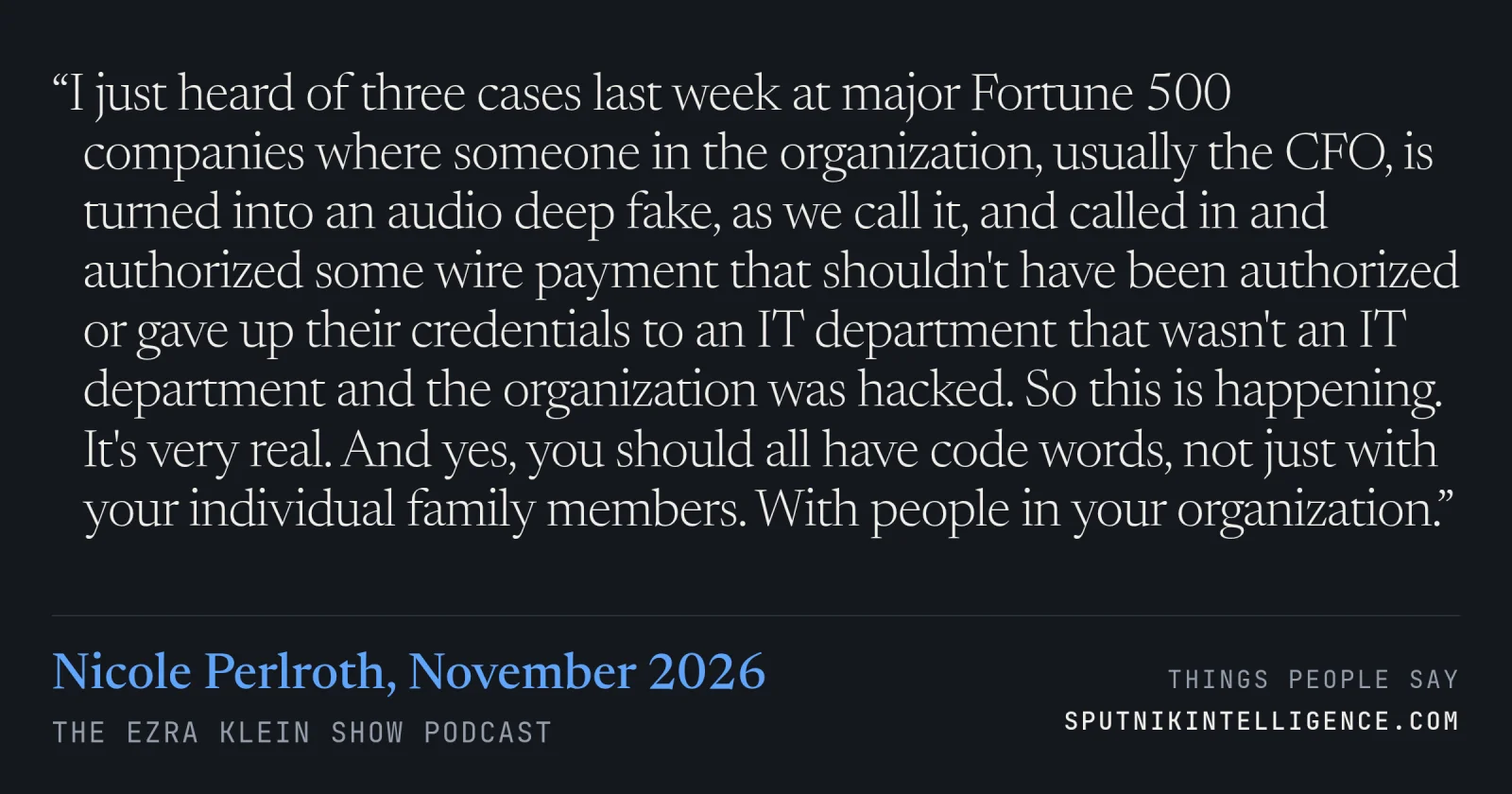
“I just heard of three cases last week at major Fortune 500 companies where someone in the organization, usually the CFO, is turned into an audio deep fake, as we call it, and called in and authorized some wire payment that shouldn't have been authorized or gave up their credentials to an IT department that wasn't an IT department and the organization was hacked. So this is happening. It's very real. And yes, you should all have code words, not just with your individual family members. With people in your organization.” — Nicole Perlroth, The Ezra Klein Show

Ezra Klein argued that even a hardened system fails when AI-grade phishing and voice cloning get to a person instead. Nicole Perlroth says this is already hitting large companies.

The Ezra Klein Show · 2026-11-24 Permalink → Listen →
The Ezra Klein Show Around 34:34 into the episode
Speaker 1

…yourself up for risk? Small firms also, as you're noting, they have to invest in their core products. They don't have a whole cybersecurity team. So here you have maybe not the issue of organizational procedure and bloat, but the reality of just very, very, very limited bandwidth. What do you do?

Nicole Perlroth

…hey, you didn't deprovision this employee and you don't have MFA installed. So in some sense, AI will help us here. It's just that we're in this window where it's able to find vulnerabilities and exploit them much, much quicker than we can patch and make sure that we're adequately protected.

Speaker 1

I know that was an answer supposed to make me feel somewhat better. It made me feel much worse. I want to be clear about this. And for a couple of reasons, but one is that we keep talking, we have been talking about this so far: like every vulnerability is a poorly written line of code. But you kept mentioning there are things like two-factor authorization, which is where when you go and log into something, it has a kind of a second touch where you take a code out of your email or take a code off of your phone, that kind of thing. What that's getting at is one of the really, really, really common ways you hack into something is you get login credentials from somebody who has them. It is through phishing attacks where you're sending somebody a message. It looks like it's from their bank. It's through social engineering. It's for all these things that have been done for a long time now. And a lot of the time they're done pretty clumsily, right? Like the old Nigerian prints emails people would get. And I currently get tons of phishing emails, and most of them are, they're getting better, but they're still pretty clumsy. The problem is AI is going to make social engineering, phishing, et cetera, really, really, really good. I mean, in some of the more scarier frontier versions of this that are already…

Nicole Perlroth

Yep. It's why I say cybersecurity is also an education and culture problem. And how do you fix people in this case to understand that, you know, someone's calling them or their child's calling them or their parent is calling them and announcing that they've been kidnapped, that they need to take a…

Speaker 1

a cheerful episode of the show today. Right. I know. Just a

Nicole Perlroth

beach read of information. So just to synthesize it for people, definitely have a code word, but also the advice I give to everyone is to just ask yourself right now. And this is true for companies too. What is the thing that is most precious to you personally, professionally? Identify it and…

Speaker names come from our own diarization. The position is estimated from where the line sits in the episode.
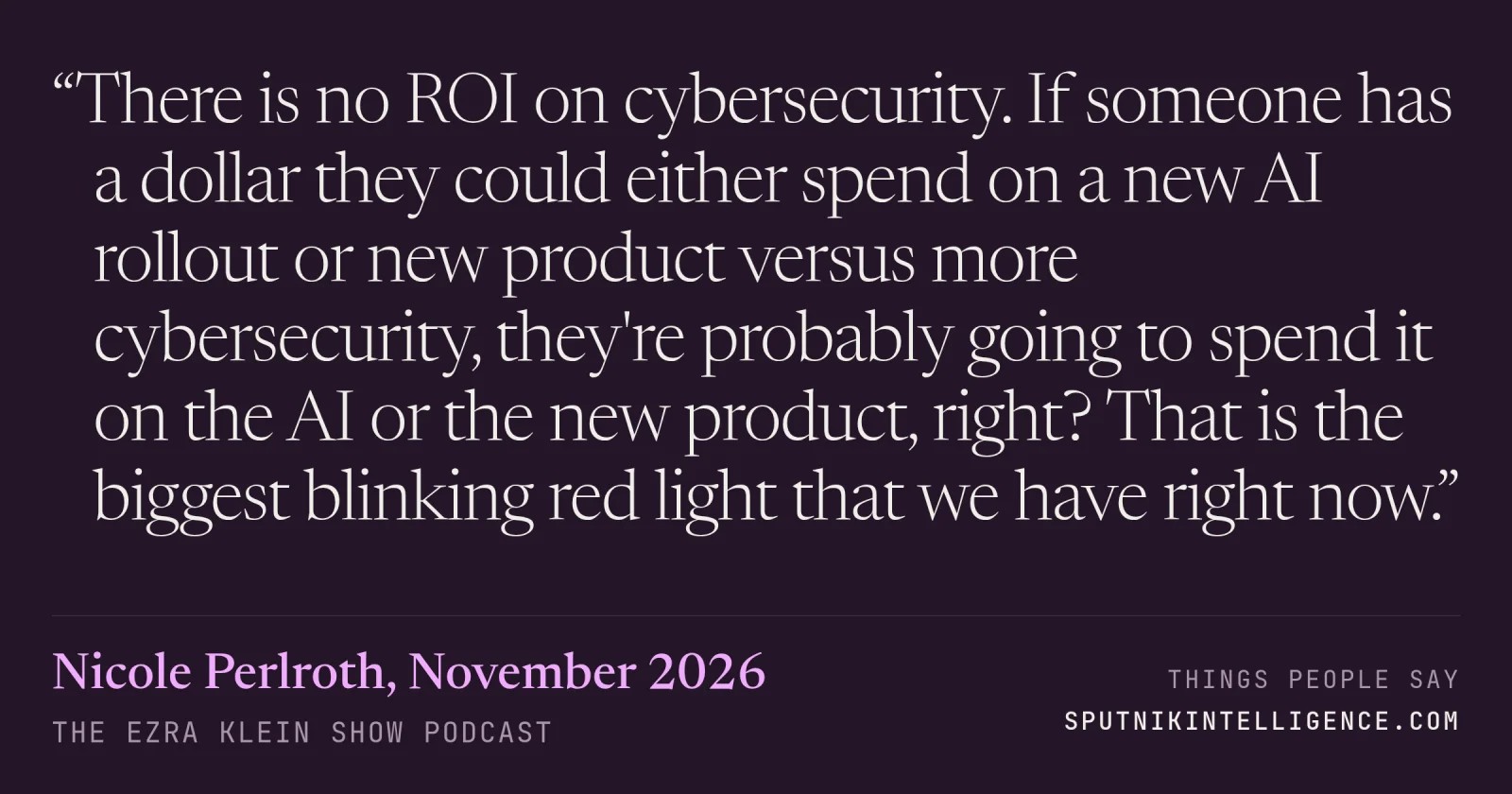
“There is no ROI on cybersecurity. If someone has a dollar they could either spend on a new AI rollout or new product versus more cybersecurity, they're probably going to spend it on the AI or the new product, right? That is the biggest blinking red light that we have right now.” — Nicole Perlroth, The Ezra Klein Show

Asked how companies can keep hardening their systems when new models keep finding more bugs, Nicole Perlroth says banks have blank cheques for security but most firms below the Fortune 500 do not.

The Ezra Klein Show · 2026-11-24 Permalink → Listen →
The Ezra Klein Show Around 29:15 into the episode
Speaker 1

…the attacks on ourselves and take risks that organizations are not. I mean, the government first and foremost are not set up to take because in a bureaucratic logic way, it is worse to be the one who broke it than to simply be the one who wasn't able to secure it against a Chinese hacking force.

Nicole Perlroth

…one major issue actually with cybersecurity is that large enterprises aren't using the power of the purse to demand that their vendors test their software for flaws before they roll it out to customers, check for indicators of compromise, essentially get ahead of this. And that hopefully is coming.

Speaker 1

So one thing, and this maybe gets us into the firms as well, to not just only speak about the government. If you were to really harden yourself in the way we're talking about, you would have to move enormous amounts of resources, not just once, but in a very ongoing way into this, right? Because also new AI systems keep coming out. And it turns out that the more powerful the system gets, the more vulnerabilities it's able to find. And people's business models, their personnel, they don't have enough people who do this kind of thing. The government certainly don't have enough people in IT and are not paying the IT people. They do have enough that we're not designed for this at the organizational level. And it's very hard to get organizations to do in an ongoing way things that they're not really designed to do.

Nicole Perlroth

Yeah. And there's also just a very disturbing story of the haves and have-nots in cyber. You know, there are some organizations, predominantly banks and financial services, that understand that with one bad cyber attack, their business could end. If all of our bank accounts at JPMorgan were to be…

Speaker 1

One thing that brings up to me, and I'm going to shift in this conversation in and out of what you do as an individual, is whether you should be, even if this is kind of a shame, centering your digital life in the largest possible companies. So I remember when Anthropic brought out Mythos and…

Nicole Perlroth

So this is actually going to be a threat of hope I'm going to offer here. AI. We are seeing new solutions come to market, new AI solutions that for a small, medium-sized enterprise, there are now companies out there that use AI to look at your, you know, as you put it, your whole digital life to…

Speaker names come from our own diarization. The position is estimated from where the line sits in the episode.
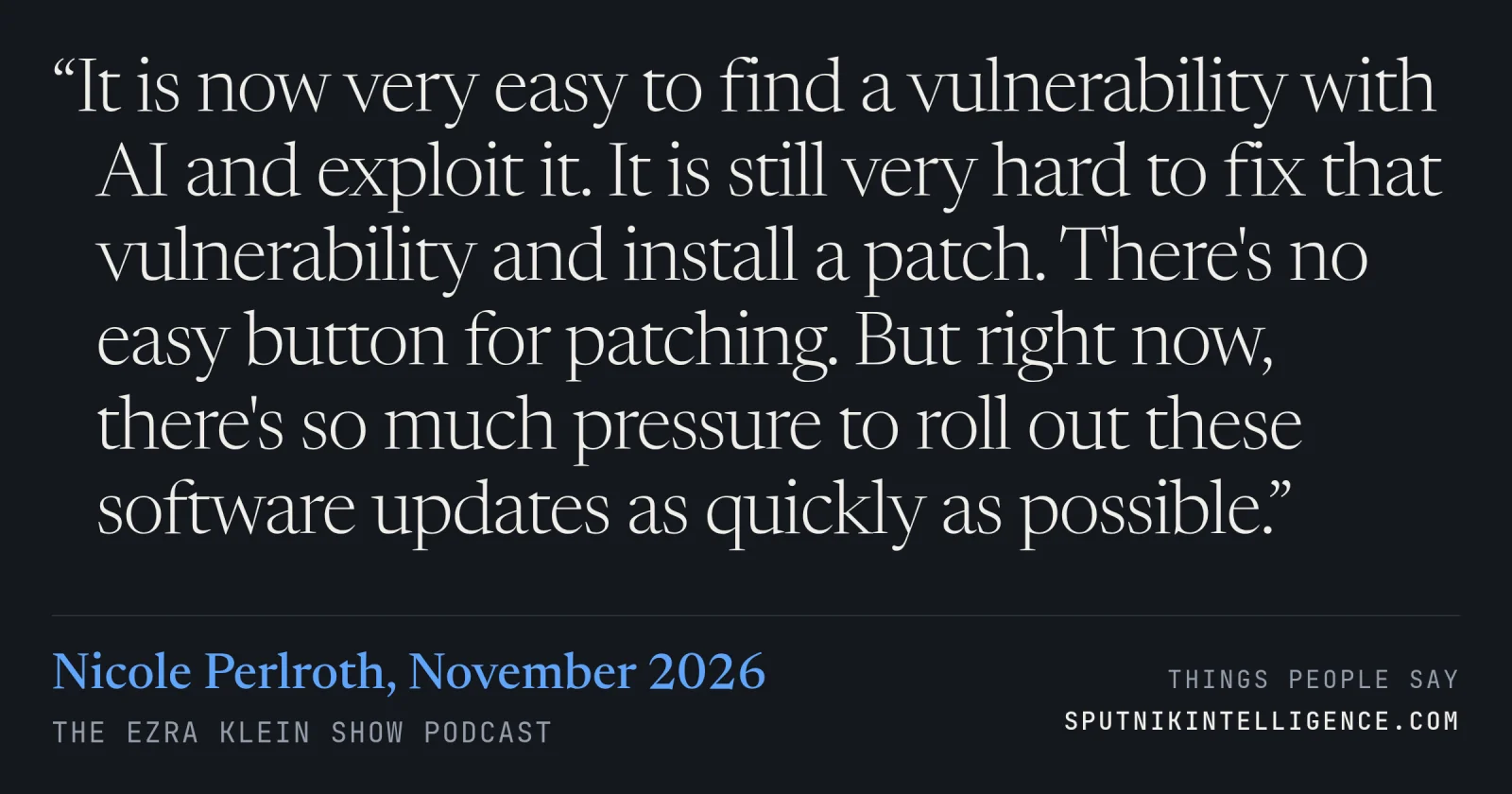
“It is now very easy to find a vulnerability with AI and exploit it. It is still very hard to fix that vulnerability and install a patch. There's no easy button for patching. But right now, there's so much pressure to roll out these software updates as quickly as possible.” — Nicole Perlroth, The Ezra Klein Show

Nicole Perlroth explains the asymmetry she thinks is behind this month's run of US outages: organisations rushing out patches before AI-driven attacks reach them.

The Ezra Klein Show · 2026-11-24 Permalink → Listen →
The Ezra Klein Show Around 11:58 into the episode
Nicole Perlroth

…with AI capabilities. And so here we are. And we are entering this new phase of a software Beirut where things that we were just accustomed to working day in and day out will start flickering on and off. There will be outages. There will be attacks. And this is just going to become our new normal.

Speaker 1

…people were not paying that much attention to. And then just very recently, we had a series of outages, which, you know, seem to have had different causes, but that kind of cohered a public narrative. Can you sort of walk through like what we've actually been seeing, what has actually happened?

Nicole Perlroth

Yeah, let's just start with the outages. We just saw this almost near simultaneous outages. We saw them in the most visceral of systems, the FAA GroundStop, Microsoft Outlook, Chase, Apple. You know, these were happening in very quick secession. In each case, and again, we haven't seen the full post-mortem yet, but in each case, it sounds like there was no malicious attack. These were sort of self-owns. People were trying to get ahead of this AI attack era we are now in by doing what you're supposed to do, which is roll out software updates that can fix vulnerabilities. And in the process, it broke something on the other end. Okay. So that's what's been happening. Unfortunately, it is now very easy to find a vulnerability with AI and exploit it. It is still very hard to fix that vulnerability and install a patch. There's no easy button for patching. But right now, there's so much pressure to roll out these software updates as quickly as possible because of what is happening in this other stream. So in this other stream, we are now seeing AI go offensive.…

Speaker 1

So you've kept using the term machine speed. And I want to unpack that a little bit. I was listening to a conversation between Nili Patel of The Verge and Alex Stamos, who's a cybersecurity leader and a really, really thoughtful person. And one way they described it was helpful for me, which was…

Nicole Perlroth

I wrote a book that was essentially about this, which was the closing of the capabilities gap between what we, and when I say we, I mean U.S. intelligence agencies in the United States, the sort of sophisticated attack that they could pull off on systems like Iran's nuclear facility, like they did…

Speaker 1

When I hear you say some of this, it sounds so terrifying. And then I also have this quality of like, I look up and, well, okay, what's really happening? There was a period of time when flights were grounded, which appears to have not come from attack, but from actually an effort to upgrade systems…

Speaker names come from our own diarization. The position is estimated from where the line sits in the episode.
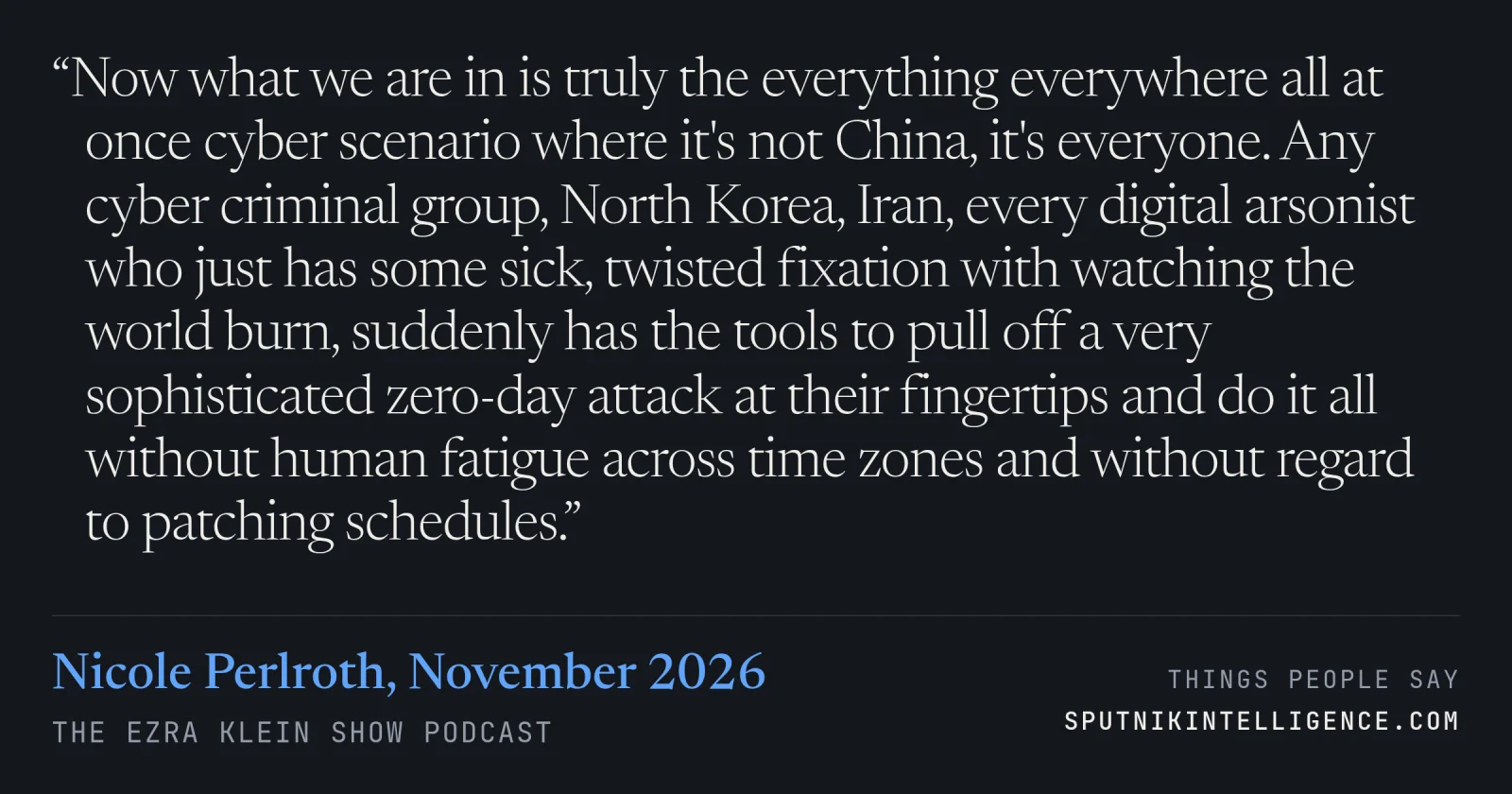
“Now what we are in is truly the everything everywhere all at once cyber scenario where it's not China, it's everyone. Any cyber criminal group, North Korea, Iran, every digital arsonist who just has some sick, twisted fixation with watching the world burn, suddenly has the tools to pull off a very sophisticated zero-day attack at their fingertips and do it all without human fatigue across time zones and without regard to patching schedules.” — Nicole Perlroth, The Ezra Klein Show

Nicole Perlroth says the scenario everyone feared two years ago was one country, China, quietly pre-positioning in US infrastructure. With AI, she says, every attacker now has nation-state tools.

The Ezra Klein Show · 2026-11-24 Permalink → Listen →
The Ezra Klein Show Around 14:37 into the episode
Nicole Perlroth

…that logically we're going to end up breaking some things on the other end because these systems and infrastructure that we've created over the last few decades is very, very complex. And it's very hard to understand where you might break something or crash something when you install these updates.

Speaker 1

…vulnerabilities. And so just like the cost of very, very, very, very good attack has plummeted. So to what degree is like, are we looking at just an economics problem that the cost of attack has plummeted? The cost of defense is still actually quite complicated. And now the entire balance is off.

Nicole Perlroth

…they wanted to make a move on Taiwan, that they would leverage the access they have in our critical systems to shut down or at least flicker on and off critical American services like water and power and gas to make us think twice before we would jump to support an island 7,000 miles away. And what if they did this all simultaneously? So that's really where we were focused about two years ago. Now what we are in is truly the everything everywhere all at once cyber scenario where it's not China, it's everyone. Any cyber criminal group, North Korea, Iran, every digital arsonist who just has some sick, twisted fixation with watching the world burn, suddenly has the tools to pull off a very sophisticated zero-day attack at their fingertips and do it all without human fatigue across time zones and without regard to patching schedules. And that's what we're up against right now. That's what we need to expect is that everyone is going to be using these tools to scan for vulnerable systems. There's something else we used to talk about a lot in cybersecurity, which was the name of the game was not perfect security, that that was a pipe dream. It was more like, don't be the slowest gazelle in the savanna. You know, be just secure…

Speaker 1

When I hear you say some of this, it sounds so terrifying. And then I also have this quality of like, I look up and, well, okay, what's really happening? There was a period of time when flights were grounded, which appears to have not come from attack, but from actually an effort to upgrade systems…

Nicole Perlroth

Yeah, I think the most frustrating thing covering cybersecurity was the attacks were significant, but the average person didn't really feel the impact. I think we are just in the opening chapter of this, though. You know, what I've seen over the past two years is largely experimentation. You know…

Speaker 3

Hi, New York Times. I would be very interested in having separate logins for a shared subscription. I'm 35 years old. I still share my parents' New York Times subscription.

Speaker names come from our own diarization. The position is estimated from where the line sits in the episode.

Collections They Appear In