Kris Brandow

Things Kris Says on Podcasts

Works on Go tooling and hosts Fallthrough, a podcast for Go developers that picked up after Go Time ended. Talks through the language's proposal process, package tooling, and the tradeoffs of writing code that models will read. Co-hosted Go Time before it wound down after 340 episodes, now runs Fallthrough with Matthew Sanabria, Ian Wester-Lopshire, and Dylan Bourque, and co-hosts its aftershow, Break, with Sanabria.

Where to Find Them

Kris Brandow hosts Fallthrough , hosts Go Time and hosts The Changelog .

Recently: “Git Out” on Fallthrough (October 2026); “Close Encounters of the Human Kind” on Fallthrough (October 2026); “Keep Your Enemies Closer” on Fallthrough (October 2026); “Thinking, Fast and Cheap” on Fallthrough (September 2026); “Apocalypse Not Now” on Fallthrough (September 2026); “The Elements of Slop” on Fallthrough (September 2026).

What They Said

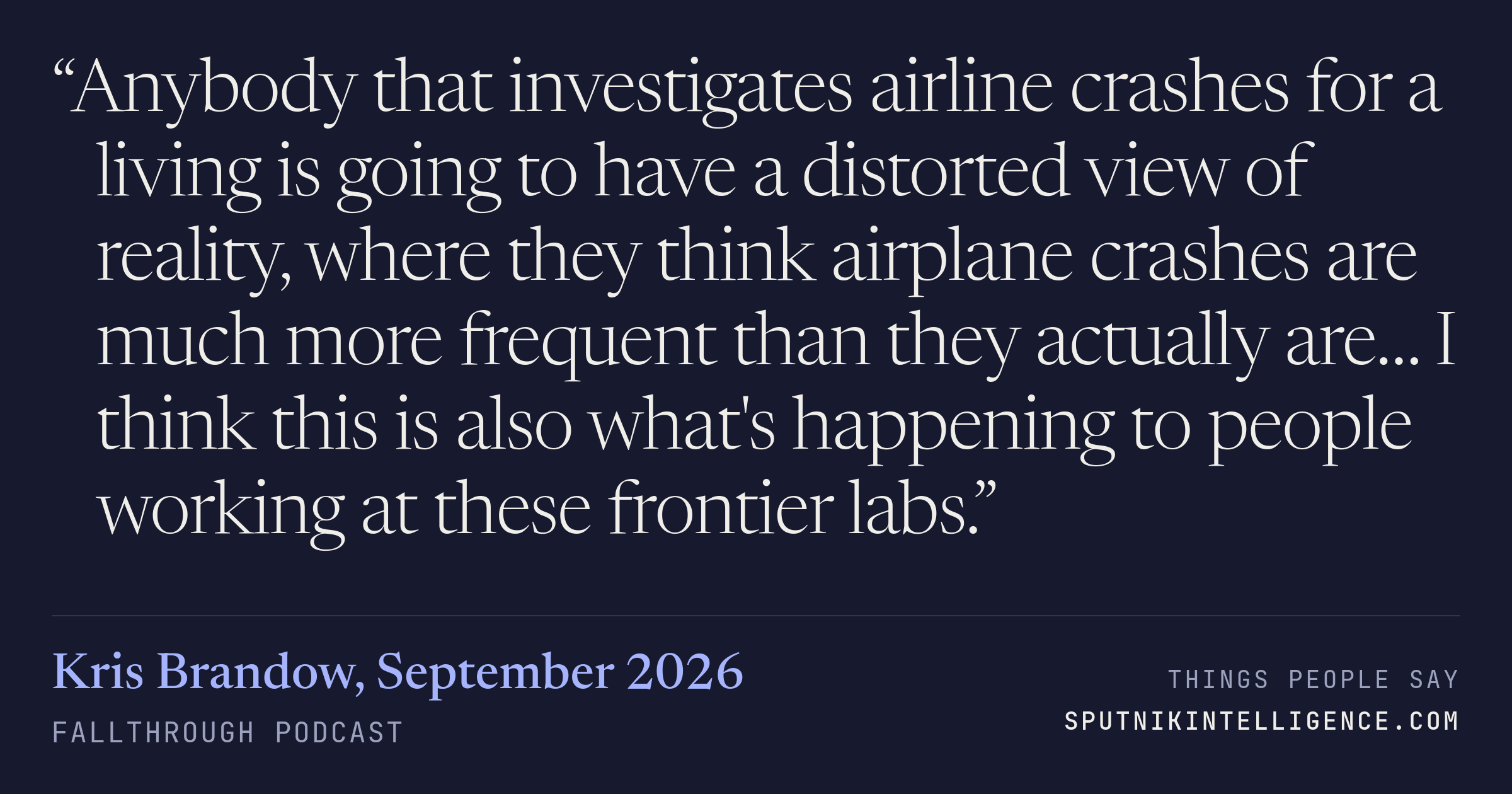
“Anybody that investigates airline crashes for a living is going to have a distorted view of reality, where they think airplane crashes are much more frequent than they actually are… I think this is also what's happening to people working at these frontier labs.” — Kris Brandow, Fallthrough

Brandow and Dylan Bourque had been pulling apart claims like 'this percentage of our code was written by Claude' — statements they say put words on paper without saying anything. He extends the point to AI extinction predictions: people inside the labs marinate in this material daily, which warps how likely any of it feels. Earlier in the episode he argued that the people operating deployed models, not the researchers, are the ones worth listening to.

Fallthrough · 2026-09-26 Permalink → Listen →
Fallthrough Around 51:08 into the episode
Kris Brandow

Yeah. It's, it's a classic form of laundering one's argument where it's like

Dylan Bourque

that they all have a little, every statement has a little asterisk at the end with the small print down at the bottom that no one looks at.

Kris Brandow

Yeah, which is like, I think, you know, anybody that works at one of these labs has a kind of their mind warped a bit, has a distortion, a distorted view of reality because they are working in the middle of this thing. It's like, it's also coming up from like kind of one of the conversations I was having with ChatGPT, where it's like, if you're someone that investigates airline crashes, like airplane incidents crashes, like, and that's your job, you're going to have a distorted view of reality where you think that airline, like airplane crashes are much more frequent than they are, say, compared to, say, car crashes, which are by like, I think, two orders of magnitude like more likely to happen. Yeah. And so it's like, even if you know it's still like less likely, you still think it's more likely than it actually is because your localized experience is, you see this all the time. You see this every day because that's the environment you live in. And I think this is also what's happening to people that are working at these frontier labs. They…

Dylan Bourque

Yeah. The never-ending challenge of not attaching your personal wealth, your personal worth to the thing that you built.

Kris Brandow

Yeah. And I think that that's like there's people are really, there's a lot of fear out there now, especially with these stupid, again, really silly takes by people jumping into the consciousness of the rest of society without that right context, right? Even, and I will say, like, some of this is…

Dylan Bourque

On the on the journalist side, there's the dopamine loop. If I put it out there with a sensational headline and I get views and clicks and people react to it and now I'm popular and they're, it's, it's difficult for humans to force themselves out of that dopamine loop and be rational and say, hey…

Speaker names from our own diarization · position estimated from where the line sits in the episode
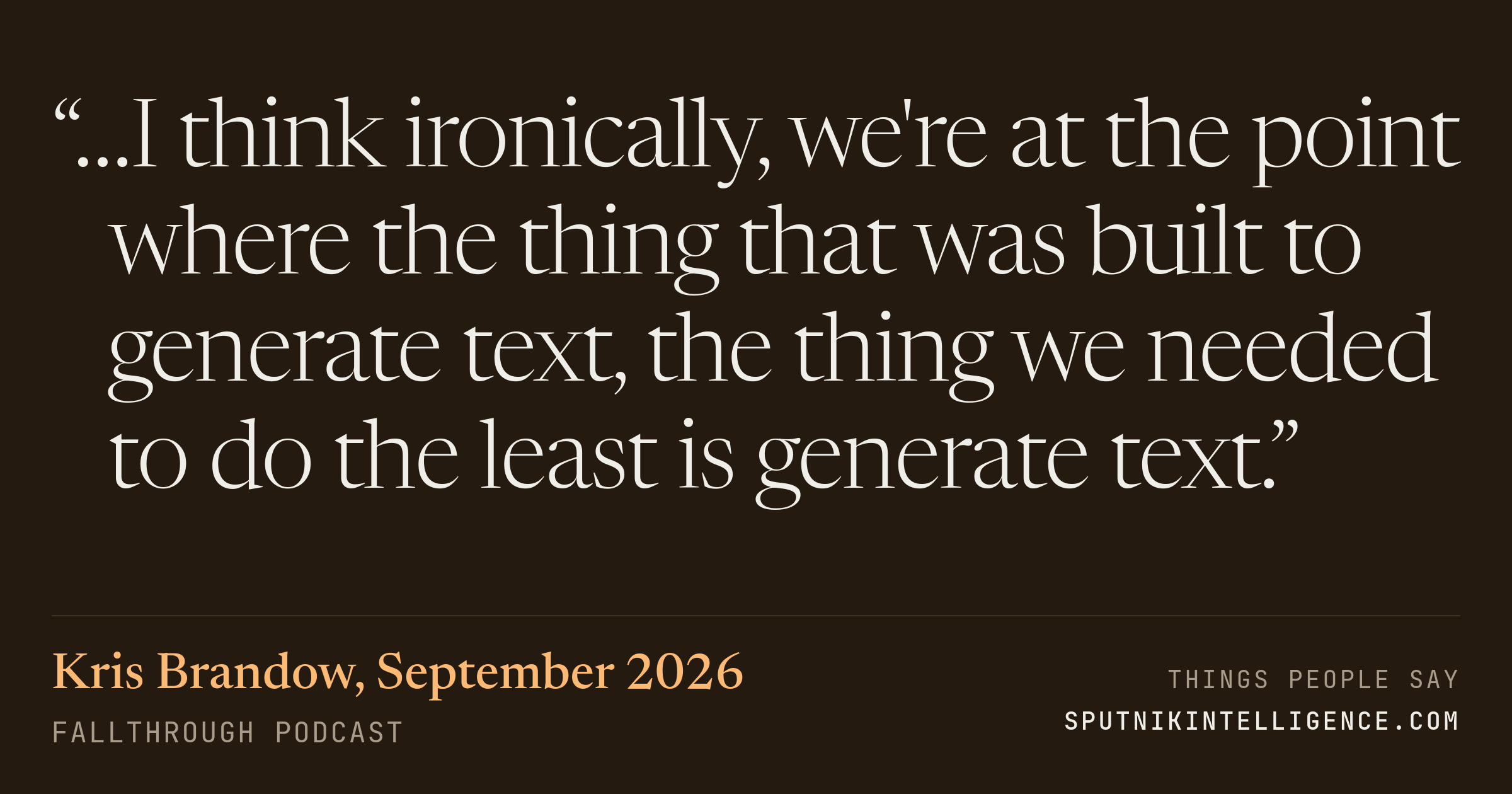
“…I think ironically, we're at the point where the thing that was built to generate text, the thing we needed to do the least is generate text.” — Kris Brandow, Fallthrough

Brandow arrives here after walking through a project that burned billions of tokens largely because agent-written comments padded every file the model then had to re-read. His argument is that LLMs can read gnarly code directly, so the explanatory prose written for humans is now pure cost. He goes on to say words are expensive in the same way lines of code are.

Fallthrough · 2026-09-12 Permalink → Listen →
Fallthrough Around 18:58 into the episode
Kris Brandow

Yeah.

Matthew Sanabria

It's stupid. It's silly. Well,

Kris Brandow

…really like gnarly, I'm probably going to stumble over. It's going to be much nicer if there's just a comment there. But like LLMs are very good at understanding gnarly code. If you hand it, it's like, no, this is how this thing works. They can like reason through, especially more modern LLMs can like reason through it. So like, I don't even think we need it for writing code in that way. Like, I think ironically, we're at the point where the thing that was built to generate text, the thing we needed to do the least is generate text. Because like, I think we all forgot how expensive words are. In the same way that like lines of code are expensive, I think words are expensive. And when you only have like a 250,000 token context window or maybe like a high and a million, but it really doesn't really go as far as I think people think it does over the course of like a long conversation. You can't just be like wasting words on…

Matthew Sanabria

I mean, that was kind of me in a way, not for my own writing, but for detecting other people's writing, whether it's AI generated. Because Brian and I had conversations about this internally at Oxide, where I would review application, I would review candidate materials at Oxide for people that are…

Kris Brandow

Right.

Matthew Sanabria

No shades of PlanetScale. They have good tech and whatever. They're doing good stuff. But I can't do it, man. I'm sorry. I just can't do it.

Speaker names from our own diarization · position estimated from where the line sits in the episode
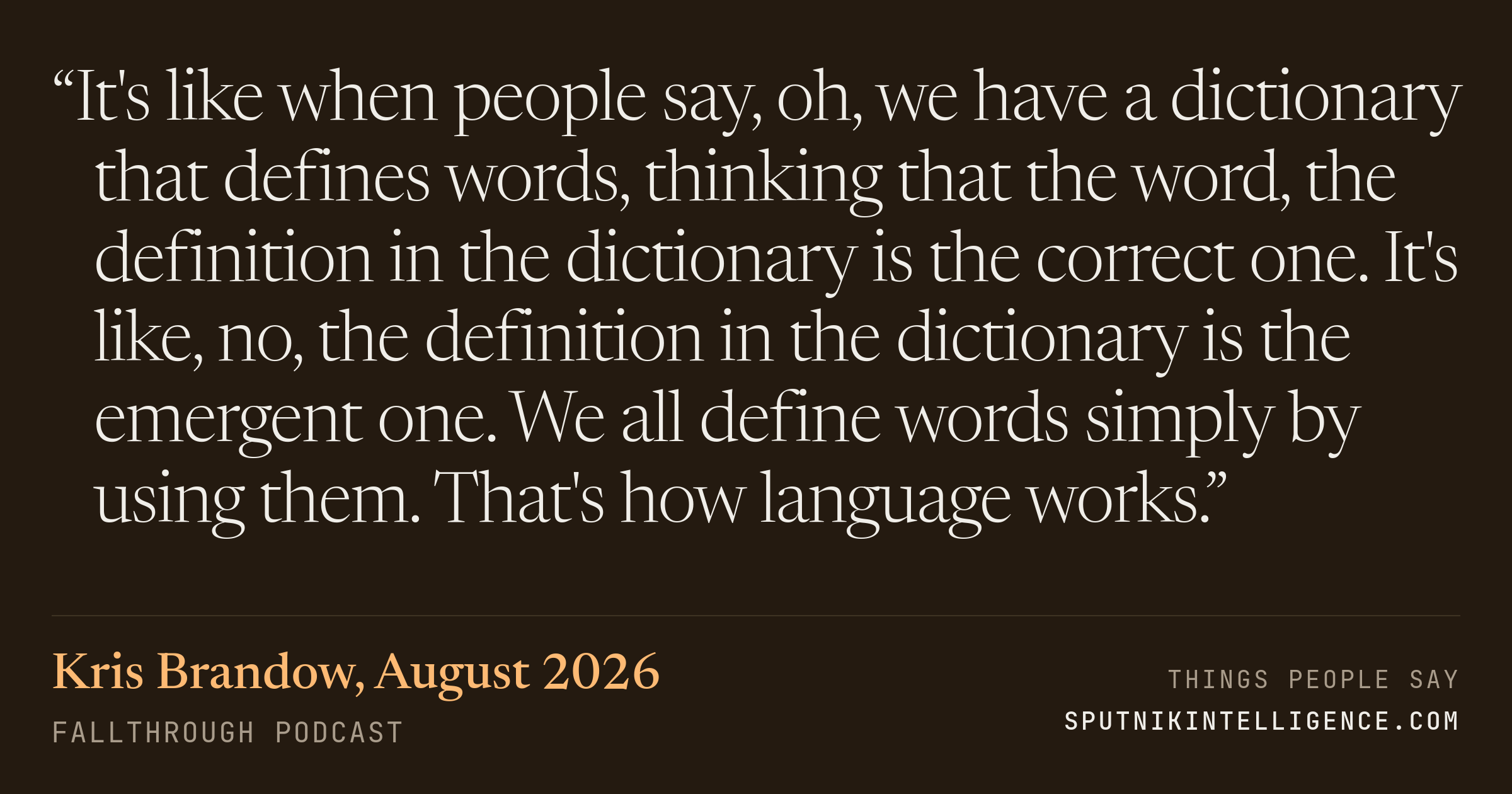
“It's like when people say, oh, we have a dictionary that defines words, thinking that the word, the definition in the dictionary is the correct one. It's like, no, the definition in the dictionary is the emergent one. We all define words simply by using them. That's how language works.” — Kris Brandow, Fallthrough

The hosts were arguing about whether Go's proposal process needs a formal gate between discussion and commitment, with Sanabria wanting a clear line and Brandow insisting there is not one to draw. The dictionary analogy is how he explains it: the line is an emergent property of the conversation rather than something anyone can declare. He closes on the position that a decentralised community cannot be made authoritarian without breaking what makes it work.

Fallthrough · 2026-08-22 Permalink → Listen →
Fallthrough Around 1:09:23 into the episode
Kris Brandow

ending them. It's not putting an arbiter. It's actually making sure they're moving. And what I'm saying

Matthew Sanabria

is there needs to be a way to differentiate things that are just in discussion versus things that we're committing to actually doing and working on.

Kris Brandow

…going to go back and something's going to go forward. Sometimes this one proposal that we're like, we're definitely going to accept it gets affected by a proposal that already got accepted and implemented. Now we got to go rethink this one, right? This is a very dynamic and fluid process. I think any attempt to like shut it down in a way or to draw a line somewhere, it's just not going to work. It's like when people say, oh, we have a dictionary that defines words, thinking that the word, the definition in the dictionary is the correct one. It's like, no, the definition in the dictionary is the emergent one. We all define words simply by using them. That's how language works. And similarly with these discussions and things we want to implement, we won't know the point at which something is ready to be implemented until we've had the conversation and figured out that we have talked about enough, this enough to implement it. And there's someone that's going to go implement it. Like, that's the gate. That's the thing at the end of the day. If the Go team wants to have a…

Matthew Sanabria

I don't want to do that. But I also don't see how just like letting people discuss in perpetuity like solves the ever-growing sort of backlog problem that we're, that the community is in today. You know what I mean? Like that, that's part of the problem. That's why they're proposing a proposal…

Kris Brandow

But is that the question, right? Is that because we as a community do not possess the ability to have discourse in such a way that allows us to come to consensus on things? Or is it we've as a community been put in a position where the discourse just can't happen or it just continually happens and…

Matthew Sanabria

mean it's both. There are people that don't know how to have discussions. Very, very evidenced in the proposal in the proposal process.

Speaker names from our own diarization · position estimated from where the line sits in the episode

Collections They Appear In