Ed Elson asked why investor anxiety about US fiscal behaviour seemed to flip this summer when the underlying trend has been the same for years. Marks, who has been complaining about it for decades, credits the roundness of the number and cognitive dissonance finally giving way. His summary: you don't need a very good reason for things to happen.
That was really not in reference to the high rates. That was reference to the debt and deficit problem of the United States. So I think that as you and I said, the most likely implication of a possible implication of what's going on with the debt and deficit is a demand for higher interest rates because of U.S. fiscal behavior. And maybe the right response for that is to reduce your holdings, not of stocks, because this isn't a stock market problem, not of investments in U.S. companies. This is not a company problem. You're holding of dollar-denominated assets. You know, that makes some sense. If the dollar is going to deteriorate, because the government wants to debase the currency, maybe you want to hold less dollar-denominated assets. The problem with that, as I laid out in the memo, is that there are very good reasons to be in dollar-denominated assets. We are still, I think, the best functioning developed world economy. And so if you trade out of U.S. assets into other countries, companies, or something like that, you have to face the possibility that your fundamental company level possibilities get worse. It's not an easy decision. And given that the U.S. continues to be the, I think, the best functioning developed world economy, if you were going to do any, I wouldn't do very much. Part
of the question here seems to be, when will our luck run out? And this is, I mean, you point out, Warren Buffett has made this point. Like, we don't know if this is going to, if the reckoning is going to come in two years or if it's going to come in 20 years. I'm not sure if there's any way to know that, but that seems to be a pretty significant point for investors to grapple with. Do you land anywhere on that spectrum? Do you have any thoughts on how to even address that question?
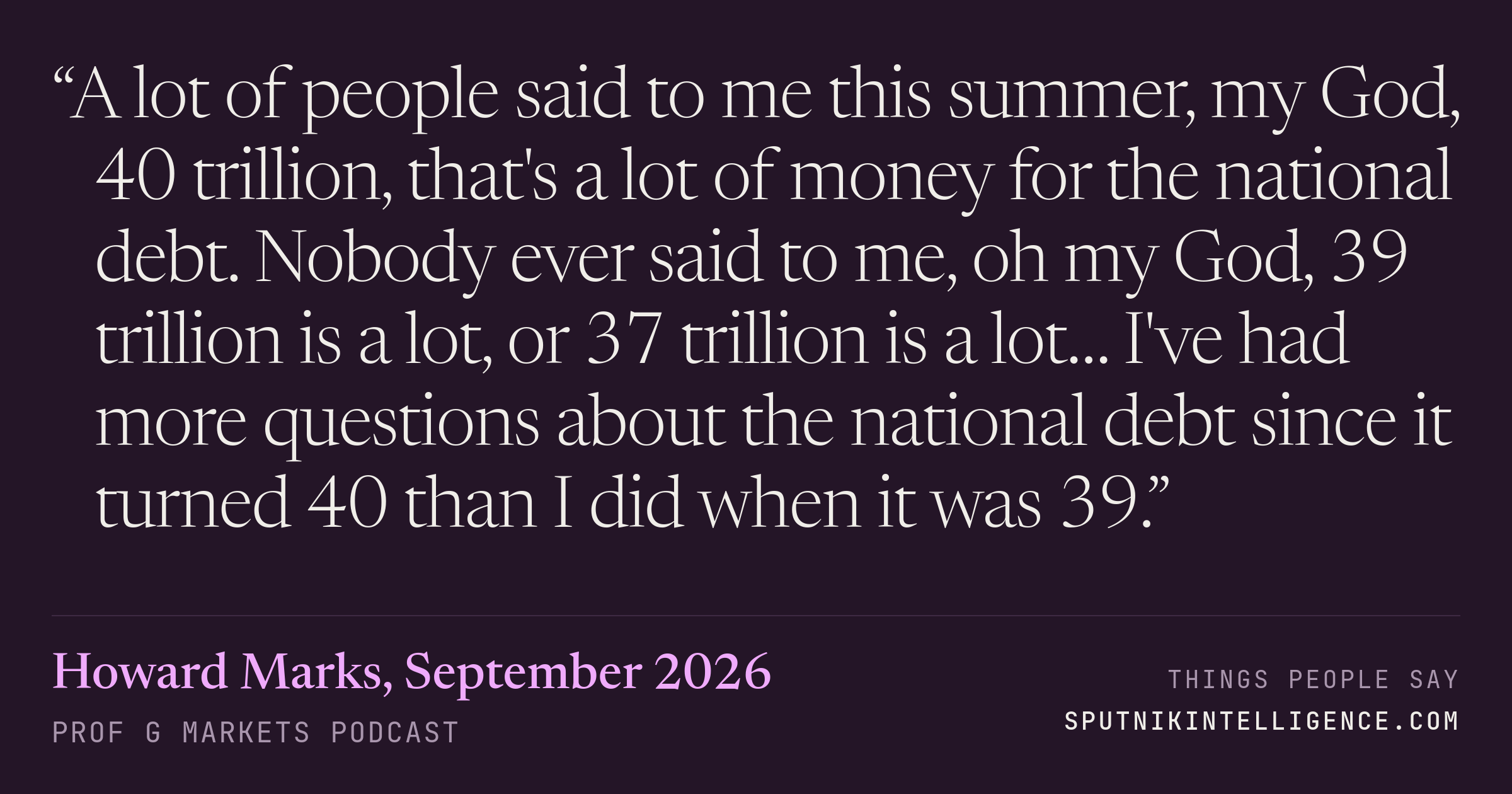
No, there's nothing intelligent to be said about that question. And, you know, usually in the invest, especially in the investment world, where in the investment world, we're not talking about fundamentals. Mostly, we're mostly talking about how people feel about fundamentals. And in the investment world, what I say is we sometimes have an idea what's going to happen, but we absolutely never know when. And I wanted to say earlier in reference to, you know, you said that maybe it seemed this summer like something switched. You know, people seem worried about it all of a sudden. There's a great saying in the investment world that things take longer to happen than we thought they would, but then they happen faster than we thought they could. And that's very true. So, you know, some people, like me, have been complaining about U.S. fiscal behavior for years and years. Why are people exercised about it now? And again, it has to do with human psychology. You know, cognitive dissonance says we can reject information which is at odds with our basic understanding for a long time. Maybe at some point in time, a critical mass is reached where you can't resist your lying eyes anymore. And you say, well, I guess that's the way it is. Maybe that was reached. And, you know, a lot of people said to me this summer, my God, 40 trillion, that's a lot of money for the national debt. Nobody ever said to me, oh, my God, 39 trillion is a lot, or 37 trillion is a lot. Now, maybe it's the roundness of the number 40 or the fact that you changed that first digit. But, you know, I do think that I've had more questions about the national debt since it turned 40 than I did when it was 39.
It seems as good a reason as any to care about it. Exactly.
Well, that's the point. The point, you don't need a very good reason for things to happen.
Yes. Just before we let you go here, Treasury Secretary Scott Besson says that the yields do not reflect the fundamentals of the U.S. economy. He says that basically the bond markets are wrong, or maybe that they're lying. They've got something. Off about what's happening in America. What do you make of that claim? Are the bond markets at the very least reflecting something that is actually true about our situation?