Stebbings relayed other guests' view that companies should own their own AI. Almeida pushes back on the whole 'AI coworker' framing. He argues it copies the shape of a human job instead of what automation is good at.
The Twenty Minute VC (20VC): Venture Capital | Startup Funding | The Pitch · 2026-11-16
Permalink →
Listen →
The Twenty Minute VC (20VC): Venture Capital | Startup Funding | The Pitch
Around 26:06 into the episode
Diogo Almeida
…we change the interface to make it smoother? And there's not a chance anyone at OpenAI or Anthropic knows how to do that, right? Like, they are still living in their ivory tower and thinking that like software is just not going to exist as a concept. So, they could be the big winners. You said
Harry Stebbings
…and they both said about the importance of owning your own intelligence as a company and the benefits of having this incredible proprietary data and these specialized models on a per company basis. Diogo, if the importance is in the process and the workflow, surely this is the holy grail, no?
Diogo Almeida
Oh man, how do I say this elegantly and Britishly? You know, like that's a very, that's an opinion, I think, that goes in the current rails of how the current world works, the current world thinks about AI, where AI is trying to be posed as a coworker. So, AI is being like presented as a coworker. This is like the direction Anthropic is really pushing towards, where it's kind of like the same interface as like a human being. And I believe that this is going to be like the horseless carriages of the AI era. Just like, you know, in the industrial era, people were like, let's just make it look like a carriage, but like without the horse. I believe that the AI co-workers are a form of that. It just makes sense that if you're doing automation, automation will have a different strength profile than a human would be, and you'd want to lean into the strength of automation. Kind of like in the industrial revolution, you don't need to wait for a whole coworker, like a humanoid robot, to do tasks. You just find the extremely narrow thing, like twist bottle cap on bottle, and then you automate it, and it just gets solved forever. So I think that's how work will generally go. I think that if you…
Harry Stebbings
So fireworks have helped several very top-tier brand name firms in the valley. I think you are Harvey's in your ramps and I think it's cognition. I might have got some wrong there. Building their own models. Are you saying that is a mistake to pursue that route and horizontal or alternative models…
Diogo Almeida
Oof, oof, oof. It's complicated. I would 100% believe narrow models would. So, number one, benchmarks are incredibly misleading, and the people who are making these have like a lot of perverse incentive to look like their models are better internally and also from an external narrative perspective…
Harry Stebbings
Diego, I'm fascinated. I know the Harvey Lagora market pretty well. Do you think they are a thin wrapper? To me, it is a very specific domain that requires deep product functionality that can only be done in a vertical fashion. And that is why they exist and they're very successful. I'd push back…
Speaker names come from our own diarization. The position is estimated from where the line sits in the episode.
Stebbings asked why the big labs can't copy what Almeida's company does. Almeida argues the field has stopped trusting benchmarks as a measure of model quality. It lands in a week when Alibaba claimed Qwen4-Max beats Western models on coding benchmarks.
The Twenty Minute VC (20VC): Venture Capital | Startup Funding | The Pitch · 2026-11-16
Permalink →
Listen →
The Twenty Minute VC (20VC): Venture Capital | Startup Funding | The Pitch
Around 19:26 into the episode
Diogo Almeida
fucking clue how little they care.
Harry Stebbings
What? How? They want enterprise. They want revenue. How are you going to get a CIO to sign up if you don't have reliability?
Diogo Almeida
I think people have a hard time understanding intelligence as a product, which is why people try to use benchmarks as band-aids. You know, like benchmarks are kind of a proxy for understanding the intelligence of the underlying thing. But as far as I can tell, the string field, you know, over maybe like the last nine months have learned that benchmarks don't mean shit. Anthropic models are just the best, even if the Chinese models match it in benchmarks. And like even when you like measure benchmark maxing, you still think like the anthropic models are better than this, better than the competition, even though they're not on the Pareto curve of pretty much any benchmark. Basically, it looks like the subfield of like system one or decision models learned this in like, I think there was like competition maybe like starting a week after. It felt like they people learned it in like two, three weeks, where we're like, oh yeah, the other stuff is just benchmark max. It's total crap. It's very easy to see that it's different. I think that it takes a different type of organization to again really, really care about reliability.
Harry Stebbings
If they don't care about reliability, what do they care about then, Diogo?
Diogo Almeida
Well, it really depends on like their business objectives, right? Back in the chat GPT is everything days, this is before Claude Code, they cared about like monthly active users. That's actually a very different metric to optimize for than the best chatbot experience. This is how psychofancy…
Harry Stebbings
When you look at the decision model product landscape for models that you're in, what does that look like in three years? Is it like an Uber Lyft market? Is it like a GCP, AWS, Azure market? Like what is the market composition? Look like in three years' time.
Speaker names come from our own diarization. The position is estimated from where the line sits in the episode.
Stebbings asked why reliability is the biggest obstacle to automation. Almeida says he means how reliable the model's thinking is, not uptime, and argues that slow adoption of AI is a reliability problem, not slow diffusion.
The Twenty Minute VC (20VC): Venture Capital | Startup Funding | The Pitch · 2026-11-16
Permalink →
Listen →
The Twenty Minute VC (20VC): Venture Capital | Startup Funding | The Pitch
Around 04:06 into the episode
Diogo Almeida
…can't be trusted for the big decisions. How can that be the case? Because it seems so good at some stuff and so bad at other stuff. And to me, what we are doing and what Jev is, is trying to bridge that gap, make AI too good to be true for automation instead of just human in the loop assistance.
Harry Stebbings
I spoke to Sonali at Secora, and speaking of kind of full and automation, she said, why is reliability the biggest obstacle to automation?
Diogo Almeida
Ooh. Well, I will give a caveat first about reliability, which is that I don't mean like uptime. I don't mean like, oh, it's like, you know, available and you get lots of throughput. I mean reliability of intelligence, which I'm still trying to find a good word for, but like this non-jaggedness of intelligence. And I would argue almost everyone who's paying attention to AI knows reliability is the absolute largest bottleneck. So here's the example. How good are you at math? How good am I at math? There's not a chance we could even help the Millennium Prize solution. I believe. I haven't read it, but I would wager that. And yet, that these same models cannot be even used for accounting. You know, much simpler stuff. And the question is why? And it's not about these models are extremely high variants. It's that you get, people love this saying that I've coined. But it's like, you get Einstein, like maybe 95% of the time, and Mr. Bean the other 5%. And the problem is that in expected value, it just doesn't work out. Therefore, companies quite wisely learn that you can't actually automate stuff. The number of companies I've seen over like the multiple AI…
Harry Stebbings
So how do we get there? What is the solution then to removing Mr. Bean as much as I love Mr. Bean?
Diogo Almeida
I love Mr. Bean too. I actually, you know, I love when agents are like insane, you know, bad vibes forever. It's very fun. It's a very fun story. And also, that is not what I want in my software that runs in the background. Like as an engineer, I want to write a thing. I want to spend a lot of…
Harry Stebbings
Than Compute so much for bluntly giving me so many forums. Can I say one thing? Can
Speaker names come from our own diarization. The position is estimated from where the line sits in the episode.
Harry Stebbings asked how to get rid of the unreliable side of model behavior. Almeida lays out his main thesis, a sharper version of Rich Sutton's 'bitter lesson'. He argues that the tasks models are trained on, pleasing humans and scoring well on benchmarks, don't produce reliable automation.
The Twenty Minute VC (20VC): Venture Capital | Startup Funding | The Pitch · 2026-11-16
Permalink →
Listen →
The Twenty Minute VC (20VC): Venture Capital | Startup Funding | The Pitch
Around 05:07 into the episode
Diogo Almeida
…And it's because the math doesn't work out. It's not a diffusion problem in the slightest. Reliability is what gets you, maybe you can trade off like some level of Einstein for just getting it more commonly and more often and getting the same functional intelligence. That to me is Jev's superpower.
Harry Stebbings
So how do we get there? What is the solution then to removing Mr. Bean as much as I love Mr. Bean?
Diogo Almeida
I love Mr. Bean too. I actually, you know, I love when agents are like insane, you know, bad vibes forever. It's very fun. It's a very fun story. And also, that is not what I want in my software that runs in the background. Like as an engineer, I want to write a thing. I want to spend a lot of effort up front. Like maybe I don't realize it'll be a lot of effort, but it always is. And I want it to run in the background and solve the problem forever. And you just need like nines of intelligent reliability to do that. And I would argue that the way to do that, oh man, I wish I could bring up my slides here, but I'll try to use my heads, I guess. So I call it AI's bitterest lesson. Sutton coined a bitter lesson, which is roughly that compute matters more than algorithms. This is all of like the scaling-pilled era we had for 2019 to 2022 to 2023 was a scaling-pilled era. You know, like just scale and the models get better. This kind of plateaued at GPT 4.5, and then we kind of stopped scaling as a field because it stopped having a payoff. I would argue that there's a bitterer lesson, which is that data matters a lot more than compute. This is very obvious to anyone who's done any applied ML, but…
Harry Stebbings
Than Compute so much for bluntly giving me so many forums. Can I say one thing? Can
Diogo Almeida
I say one thing about this too? On the note of reliability, ChatGPT never fails at being chat GPT. Like, when is the last time you got random characters, right? Like, it's kind of odd that it, or even if you ask for a polite email, it's not going to start saying, I probably shouldn't curse in a…
Harry Stebbings
You said there about kind of the plateauing of compute in terms of the benefits that accrue. First, have we got to that stage? Are you serious? I thought the whole point was dreaming? Purely on pre-training, sure. But like, more and more compute still leads to better and better output, no?
Speaker names come from our own diarization. The position is estimated from where the line sits in the episode.
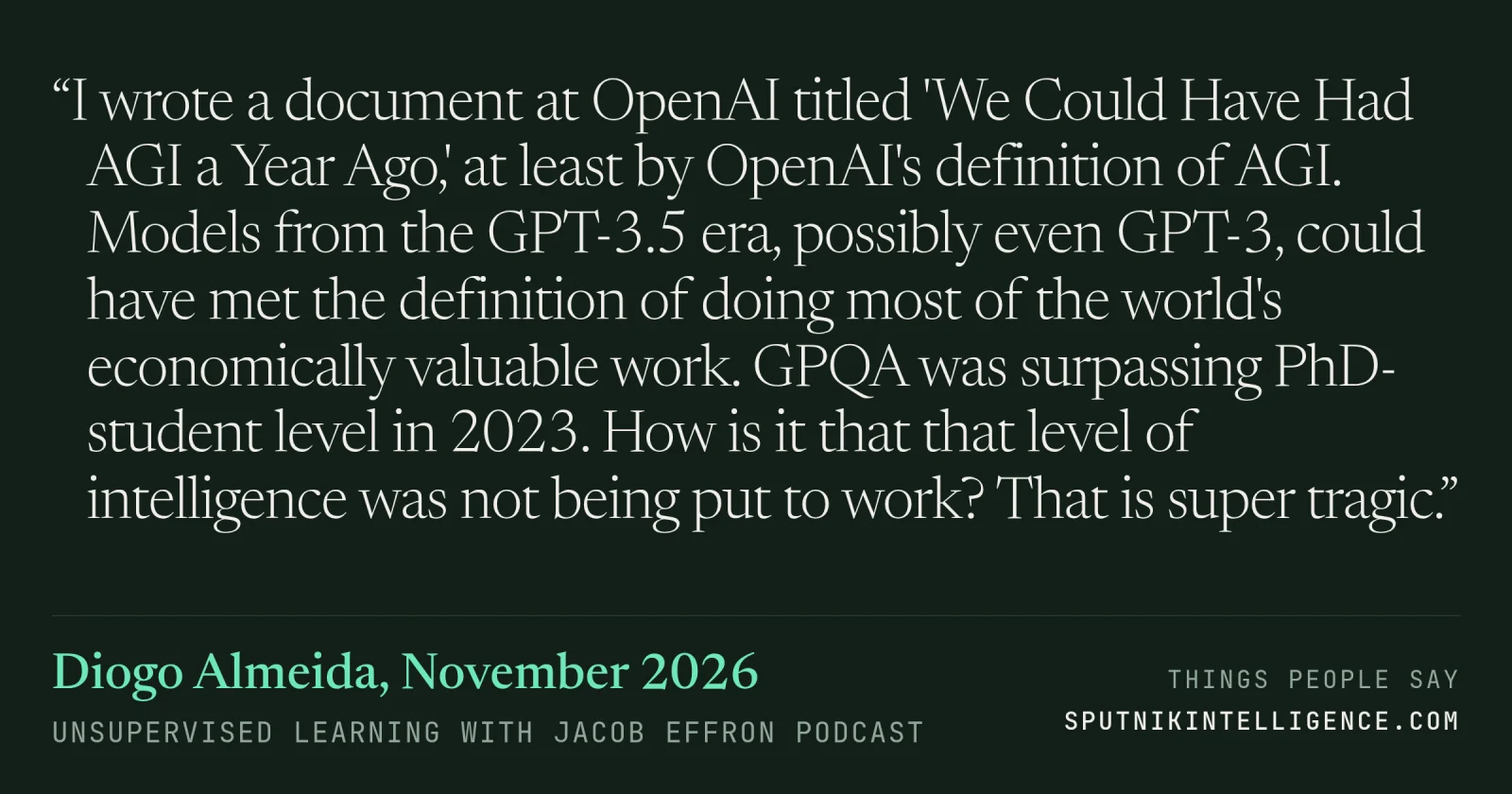
Asked whether his company's model could have been built five years ago, Diogo recalls an internal OpenAI memo arguing existing models were already smart enough to automate much routine work. His point: the gap is reliability and deployment, not raw intelligence.
Unsupervised Learning with Jacob Effron · 2026-11-05
Permalink →
Listen →
Unsupervised Learning with Jacob Effron
Around 39:19 into the episode
Diogo Almeida
…stop slop. For me personally, it might be bad for the internet. Like the internet is funded by ads. So like maybe it's a good thing. I don't know. But I would love if I could have some, or someone would make me like a slop stopper where I just don't need to see it anymore. That would be lovely.
Jacob Effron
…you have just done this five years ago? Like obviously you have a different approach that is like in some ways orthogonal to the rest of the field. Like couldn't you have done this five years ago or how much of what you built like does leverage some of the stuff that's been done on On the LM side?
Diogo Almeida
Five years ago, it would have been harder, but doable. Back when I was more naive, oh man, I sound like an old dude. When I was more naive and I thought that this would take a week of work, what convinced me, I love writing documents. I think it's a great way to think. I wrote a document at OpenAI that was titled, We Could Have Had AGI a Year Ago, at least by OpenAI's definition of AGI, which I don't think that people really listen to the letter of the definition, but I think it's actually a really great letter. I think that models from the starting from GPT 3.5 era, possibly even GPT3 era, could have met the definition of AGI at the time, which is still the same, like doing most of the world's economically valuable work by volume. It doesn't say by volume, but I assume the spirit of that is by volume. Because the models are so unbelievably smart. Like GPT 3.5 level models surpassed median level intelligence at all sorts of things. And shouldn't that be used for tons of automation, at least for the easy work? And so, yes, I think that something like this would have been harder, but it could have been done five years ago. Absolutely. And, you know, like on the people…
Jacob Effron
Yeah. I mean, speaking of that craziness, I think part of, I imagine there's a lot of noise. You know, I feel there's been a lot of noise in the ecosystem. And I bet many of our listeners will be familiar with, you know, after you guys came with these models, you had OpenAI and Cloudflare and…
Diogo Almeida
Oh boy. It feels like other people are digging our moat for us, which is kind of not how I thought it would go. And I think that that's kind of bad for the field. I think that releasing models that are like kind of more benchmark optimized than real world optimized actually burns that goodwill for…
Jacob Effron
I mean, speaking of investors, I guess you obviously recently raised a pretty big round. How did you even think about the amount of capital that made sense to raise for this business? I'm sure people were trying to throw money at you. So, you know, how did you even think through that?
Speaker names come from our own diarization. The position is estimated from where the line sits in the episode.
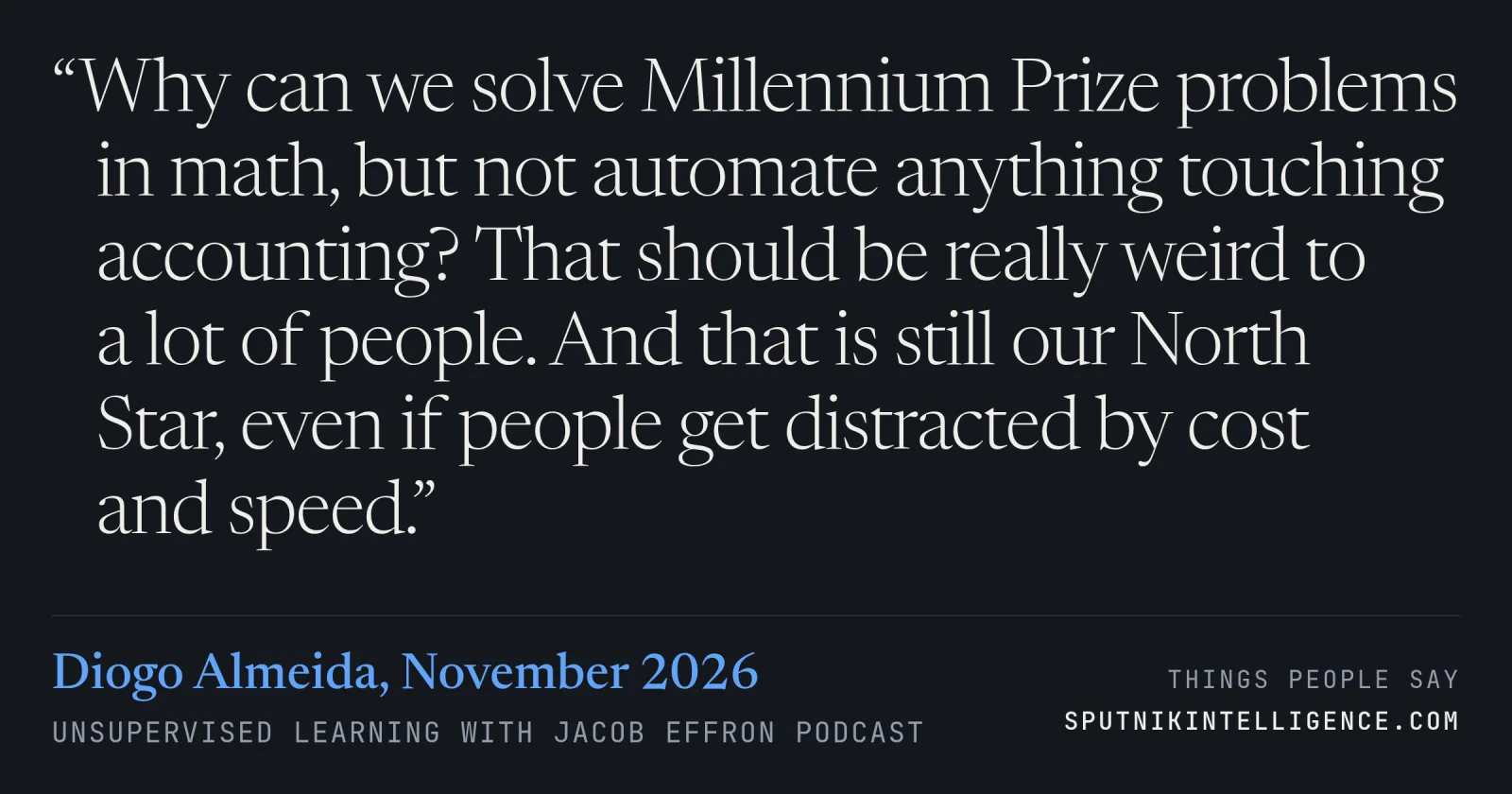
Diogo was explaining why his company builds 'system one' decision models and stresses their weaknesses. His point is that most of what software needs is reliable, boring decision-making, not the flashy capability milestones the field chases.
Unsupervised Learning with Jacob Effron · 2026-11-05
Permalink →
Listen →
Unsupervised Learning with Jacob Effron
Around 10:53 into the episode
Diogo Almeida
…of what you can extract from these models. The reason we call them system one models, and among other things, and system one actually, people did not want us to name that it either, because system one thinking tends to be a bad thing. Like people use that as kind of like an insult, right? Yeah,
Jacob Effron
it's like the part that just naturally happened from evolution, you know, from back in the day before makes mistakes, et cetera.
Diogo Almeida
Exactly. But and like people often like say that that is the mistake making side. And I believe that the shape that actually AI gets compressed to happens to be like very system one. And therefore the honest thing to do is to communicate its weaknesses because I think that on its own can be incredibly, incredibly valuable for software. And most of what people need actually is system one stuff. You know, like, why can we solve Millennium Prize problems in math, but not automate anything touching accounting? Like that is, that should be really weird to a lot of people. And like, I think that that is like still our North Star, even if people get distracted by like cost, speed, you know, like, oh, it's, it's, it's good for like really fast decisions or whatever else. Like I see these as like distractions compared to what is really needed for AI to meet its potential. And that is my, my North Star.
Jacob Effron
And so obviously you put the models out there and you have a lot of people using them in different ways. How much does like the real world usage of the models come and feed back into the roadmap versus just like the stuff you were you all planning to do?
Diogo Almeida
I would say it's almost none real world feedback. I think people should be complaining to us so much more. I think that like this the field is still in a Stockholm syndrome of like, oh yeah, the model providers just do stuff in their one track path and we happen to be like the victim is the wrong…
Speaker names come from our own diarization. The position is estimated from where the line sits in the episode.
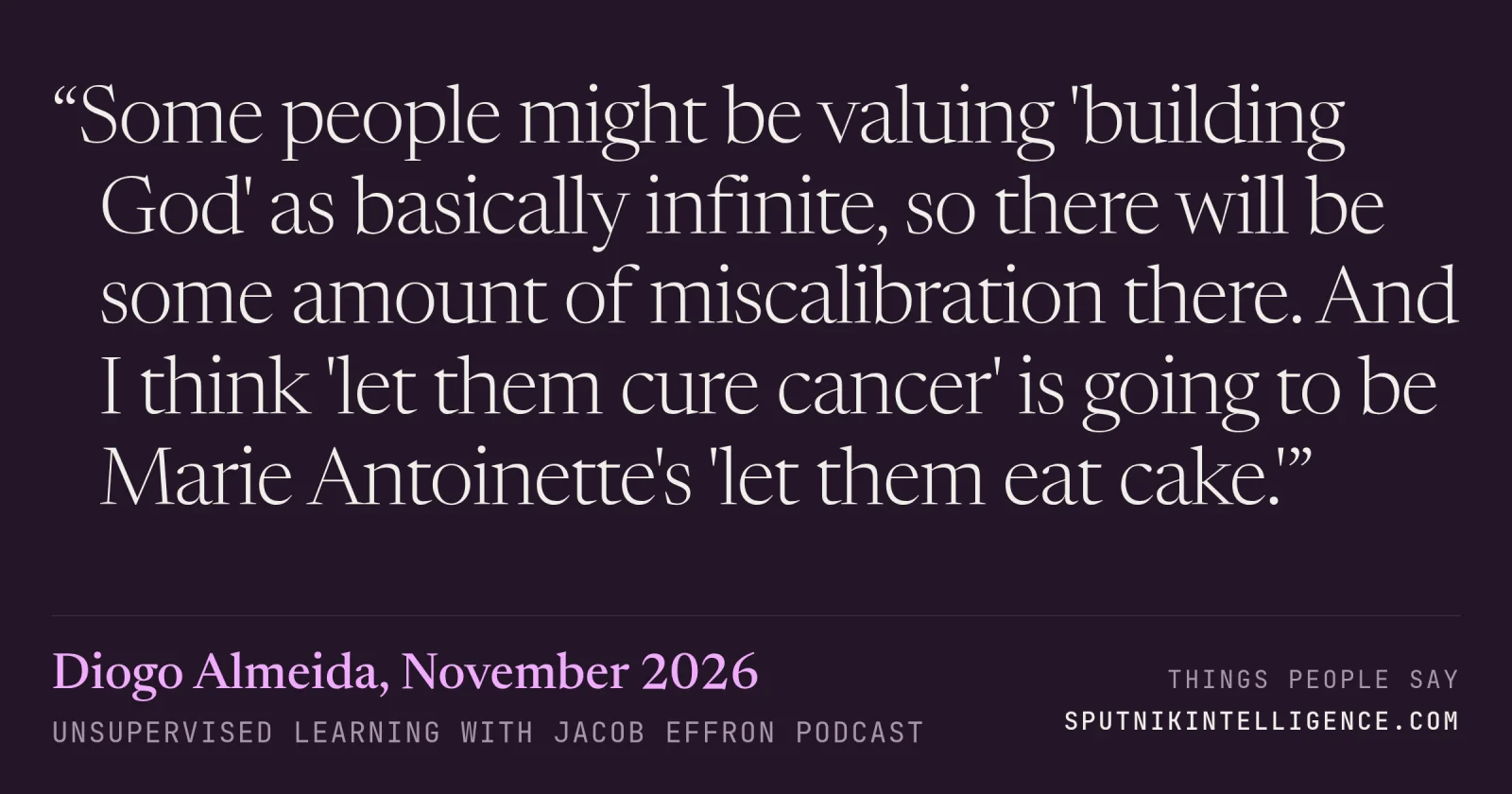
Asked whether Anthropic is undervalued going public at a trillion-plus valuation, Diogo argues lab valuations rest partly on misunderstandings of what AI can do. He warns that grand promises like curing cancer may land with the public the way 'let them eat cake' did.
Unsupervised Learning with Jacob Effron · 2026-11-05
Permalink →
Listen →
Unsupervised Learning with Jacob Effron
Around 49:21 into the episode
Diogo Almeida
…at the labs always talks about, where my understanding is they structure these deals in incredibly beneficial ways to not fuck themselves over, but fuck other people over who are taking the risk and trying to like latch onto the rocket ship and are willing to like accept whatever terms that would
Jacob Effron
on the compute side?
Diogo Almeida
Yes, on all sorts of sides, but especially compute. I think that financial engineering, as far as I've heard, is their greatest strength. And I have no idea how much of a rat's nest that is and how vulnerable they would be to any which direction of the market going. You know, like a bubble can pop just because expectations are not met, not because it's not truly a transformative technology. So I'm a little, I try not to, I try to be calibrated in my predictions. I try not to be overly confident when I have no privy information. And I would, I'm, I'm a more conservative person. I get the sense that a lot of the expectations baked in are ones that are not just product level, but based on like misunderstandings of the future of AI and what it can do. So my guess is that because some people might be valuing like building God as basically infinite, there will be some amount of miscalibration there. And I think that, you know, like the let them cure cancer is going to be like Marie Antoinette's like…
Jacob Effron
That is a that is a good line. I mean, obviously.
Diogo Almeida
Maybe it did end spicy then.
Jacob Effron
That was that was a great line. I feel like the, yeah, I mean, obviously so many people are underwriting, you know, the move into from coding agents to general knowledge work to bio to these other spaces. And obviously like not the perfect use cases for RLVR by any means.
Speaker names come from our own diarization. The position is estimated from where the line sits in the episode.
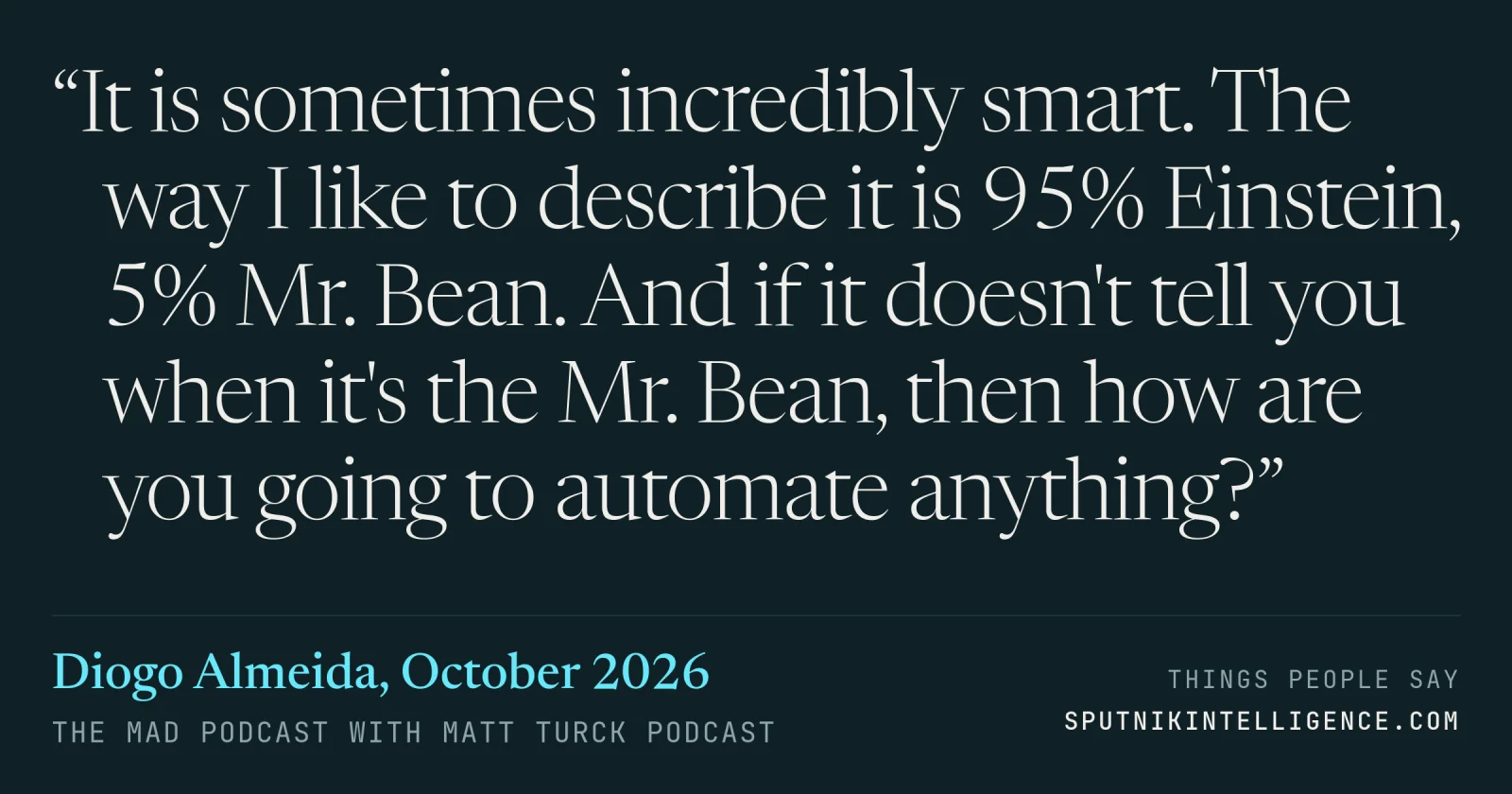
Almeida is explaining why the reinforcement learning that made language models top the benchmarks hasn't made them good at automation. The models are jagged and unreliable, and they are poorly calibrated about when they are wrong, which is the gap his company says it is working on.
The MAD Podcast with Matt Turck · 2026-10-15
Permalink →
Listen →
The MAD Podcast with Matt Turck
Around 36:38 into the episode
Diogo Almeida
…matches the shape of that. And it causes a different type of over promise under deliver. There, RLVR is obviously very, very cool, though. I think, actually, I think RLHF is very cool too. But I just worry about the lack of automation. And empirically, RLVR hasn't really changed automation.
Matt Turck
Yeah. So our RLVR doesn't help us in the problem we're discussing because it focuses on rewarding the final solution, whereas what we're trying to do here is probability and understanding. It's also stochastic.
Diogo Almeida
It's also like unreliable. And like I think people like the word jagged. It is sometimes incredibly smart. Like the way I like to describe it is 95% Einstein, 5% Mr. Bean. And if it doesn't tell you when it's the Mr. Bean, then how are you going to automate anything? So it's jaggedness and non-robustness, I think, is the real issue with it because it's very good at answering simple classifications too. But if it doesn't do it reliably, how do you automate anything in the first place? And that's kind of where calibration comes in. And the models are still not very good at that.
Matt Turck
Okay, great. All right. So RLHF kind of creates the problem. RLVR doesn't help us. So therefore, you guys had to invent a new post-training method that you call RL CD. Is that correct? And if so, just explain as much as you can share what it is. I
Diogo Almeida
don't know if I would call it a post-training method because when we made RLHF, the concept of post-training did not exist. And you could call RLHF a fine-tuning method, but that undersells how much change you did to the whole process. So no one would just call it fine-tuning, even though maybe…
Matt Turck
So to be able to do training, you need to a bunch of data. This is data for. A very specific kind of task in the new paradigm that you're inventing. Where does that data come from?
Speaker names come from our own diarization. The position is estimated from where the line sits in the episode.
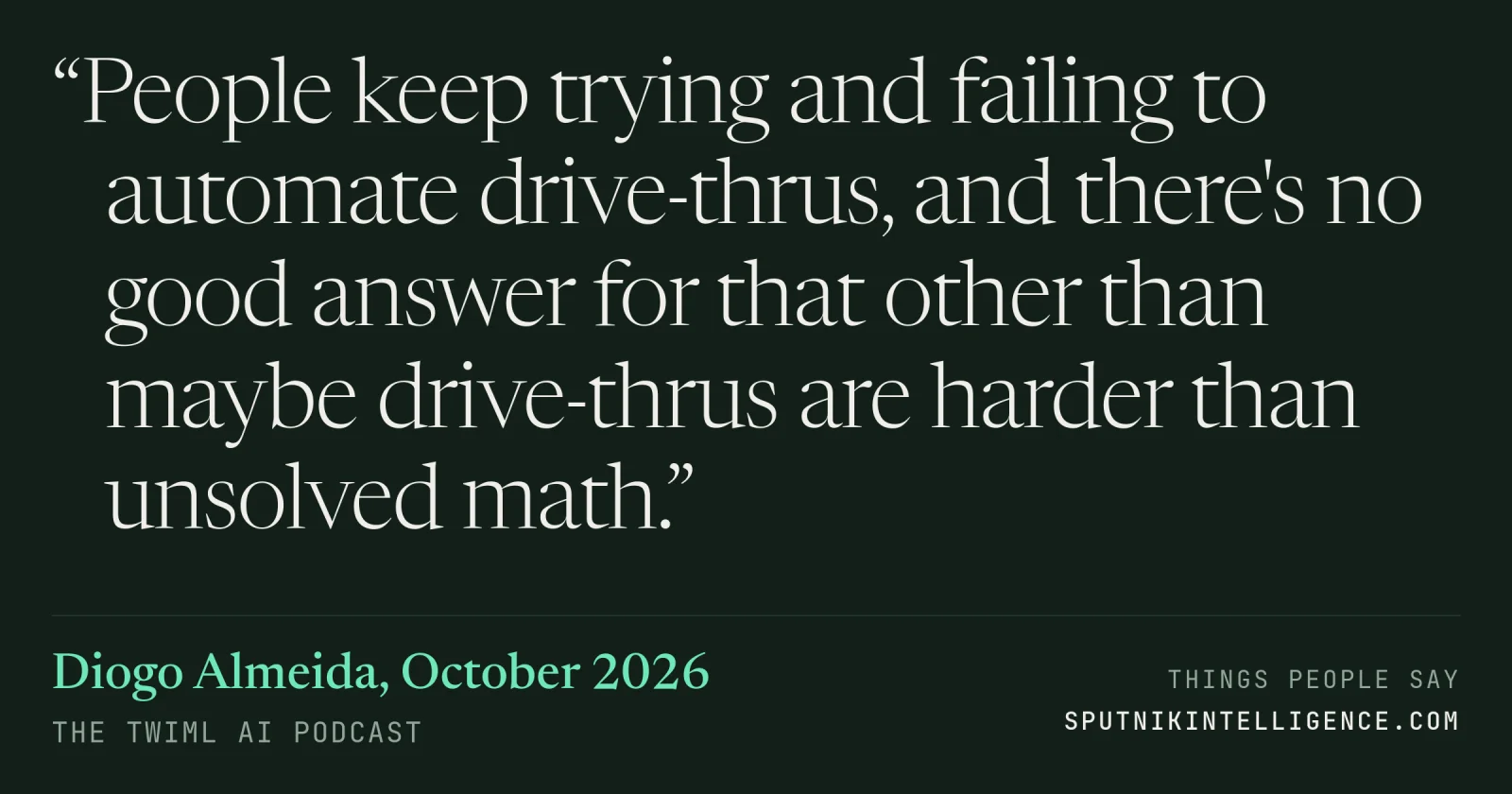
Almeida's point is that AI demos always run far ahead of what works reliably. He noted that customer service demos have been shown for about six years and customer service still isn't solved, even though it looks much easier than the hardest open problems in mathematics.
The TWIML AI Podcast · 2026-10-06
Permalink →
Listen →
The TWIML AI Podcast
Around 19:13 into the episode
Speaker 2
…So I want to focus up on that one. I think a lot of what AI does is super freaking sick. I use coding agents. I don't even code that much anymore, but I use coding agents every day. I use chatbots every day. Holy smokes, would it be a lot harder to run a company without chatbots? But they are.
Speaker 1
In case it wasn't obvious with the Tesla example, I didn't say the punchline, which was the car was driving itself at the time. Oh, right. Yeah.
Speaker 2
Self-driving, actually, I think it's a little bit different. And we can talk about the distinction between self-driving. That was only sci-fi. Oh, cool. My argument with sci-fi is especially related to LLMs, which I think tends to be what people mean by AI these days, because it seems to be like the greatest compression of intelligence while having the least utility. So, and also, it's quite, I wouldn't say it's like universally hated, but there's a lot of dislike for AI, which is tragic. And I think that we would be remiss as a field to not own up to why that is the case. So, there's like a lot of like dark sides to AI too, and I could like name a subset of them, but I think that that's worth talking about. So, number one, I think self-driving is super duper cool. And also, I see self-driving as a ginormous engineering win, not necessarily an AI win. I use Waymo as like the gold standard here. No offense to Tesla fans, but like they…
Speaker 1
It's interesting to me that you call out Waymo versus Tesla in part because in the context of this conversation about like bitter lesson-pilled, right? Because, in one sense, like what differentiates Waymo is that they're not taking a bitter, less and pilled approach to it, whereas Tesla's is more…
Speaker 2
So, I want to emphasize that that is just the MLP. Part of it, but I don't think that's the limit of what we should be building. And I'm actually extremely pro software and software engineering. And I actually think that I hope that, and I want to do everything I can, that Jev will usher in another…
Speaker 1
So where did the idea for Jev come from? Like, was this like, hey, I'm going to set up TypeSafe and I'm running towards this thing that I already knew about? Did it evolve? Did you pivot into it? Like, how did it happen?
Speaker names come from our own diarization. The position is estimated from where the line sits in the episode.
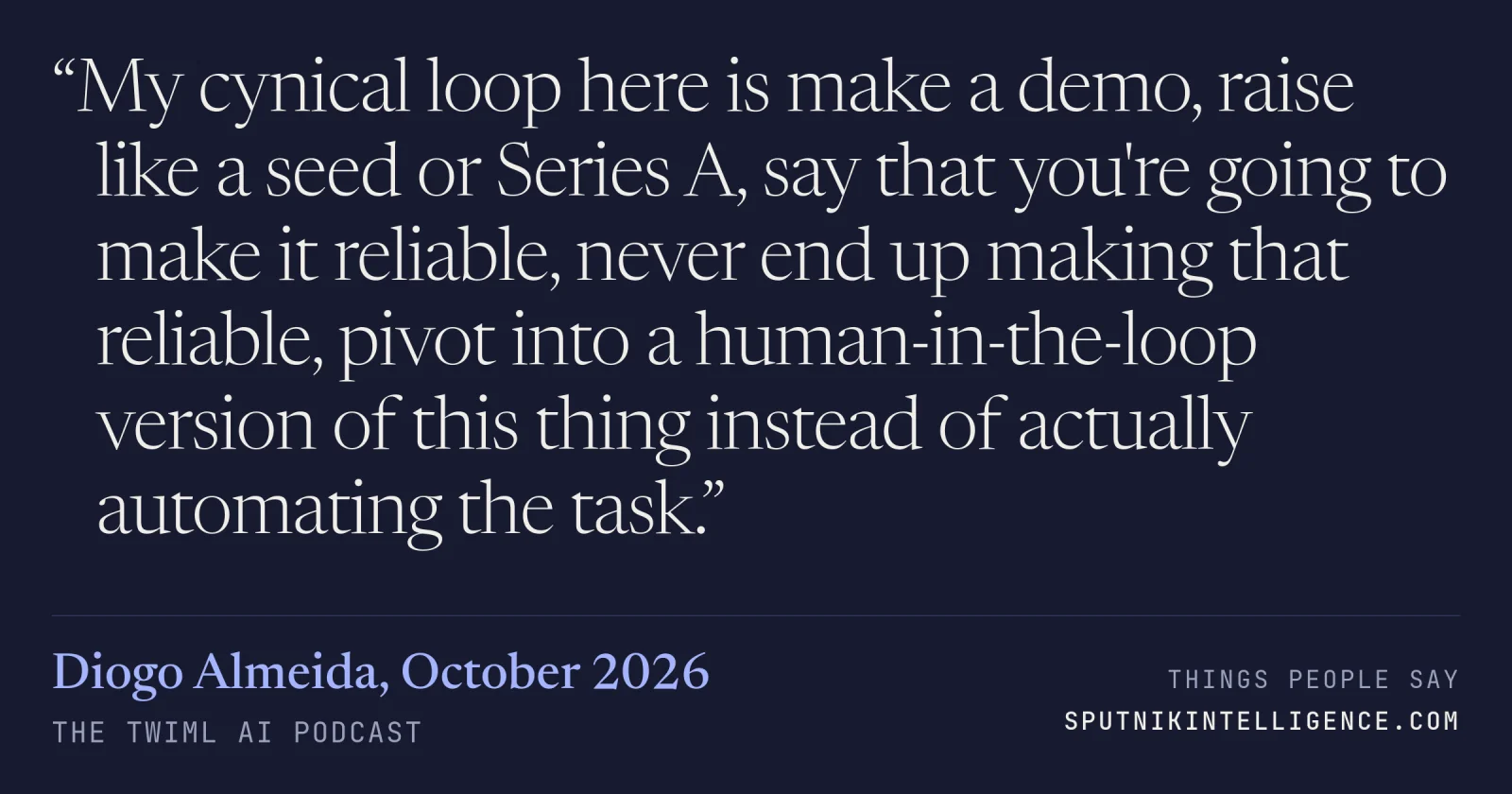
Almeida was contrasting self-driving cars, which he sees as a win for careful engineering of reliable parts, with how most AI products get built. He added straight away that he doesn't mean it as an attack on those startups: with models as unreliable as they are, keeping a human in the loop is the right move.
The TWIML AI Podcast · 2026-10-06
Permalink →
Listen →
The TWIML AI Podcast
Around 19:13 into the episode
Speaker 2
…So I want to focus up on that one. I think a lot of what AI does is super freaking sick. I use coding agents. I don't even code that much anymore, but I use coding agents every day. I use chatbots every day. Holy smokes, would it be a lot harder to run a company without chatbots? But they are.
Speaker 1
In case it wasn't obvious with the Tesla example, I didn't say the punchline, which was the car was driving itself at the time. Oh, right. Yeah.
Speaker 2
Self-driving, actually, I think it's a little bit different. And we can talk about the distinction between self-driving. That was only sci-fi. Oh, cool. My argument with sci-fi is especially related to LLMs, which I think tends to be what people mean by AI these days, because it seems to be like the greatest compression of intelligence while having the least utility. So, and also, it's quite, I wouldn't say it's like universally hated, but there's a lot of dislike for AI, which is tragic. And I think that we would be remiss as a field to not own up to why that is the case. So, there's like a lot of like dark sides to AI too, and I could like name a subset of them, but I think that that's worth talking about. So, number one, I think self-driving is super duper cool. And also, I see self-driving as a ginormous engineering win, not necessarily an AI win. I use Waymo as like the gold standard here. No offense to Tesla fans, but like they seem to be safer. And also, the way they do it is by building a la software and…
Speaker 1
It's interesting to me that you call out Waymo versus Tesla in part because in the context of this conversation about like bitter lesson-pilled, right? Because, in one sense, like what differentiates Waymo is that they're not taking a bitter, less and pilled approach to it, whereas Tesla's is more…
Speaker 2
So, I want to emphasize that that is just the MLP. Part of it, but I don't think that's the limit of what we should be building. And I'm actually extremely pro software and software engineering. And I actually think that I hope that, and I want to do everything I can, that Jev will usher in another…
Speaker 1
So where did the idea for Jev come from? Like, was this like, hey, I'm going to set up TypeSafe and I'm running towards this thing that I already knew about? Did it evolve? Did you pivot into it? Like, how did it happen?
Speaker names come from our own diarization. The position is estimated from where the line sits in the episode.