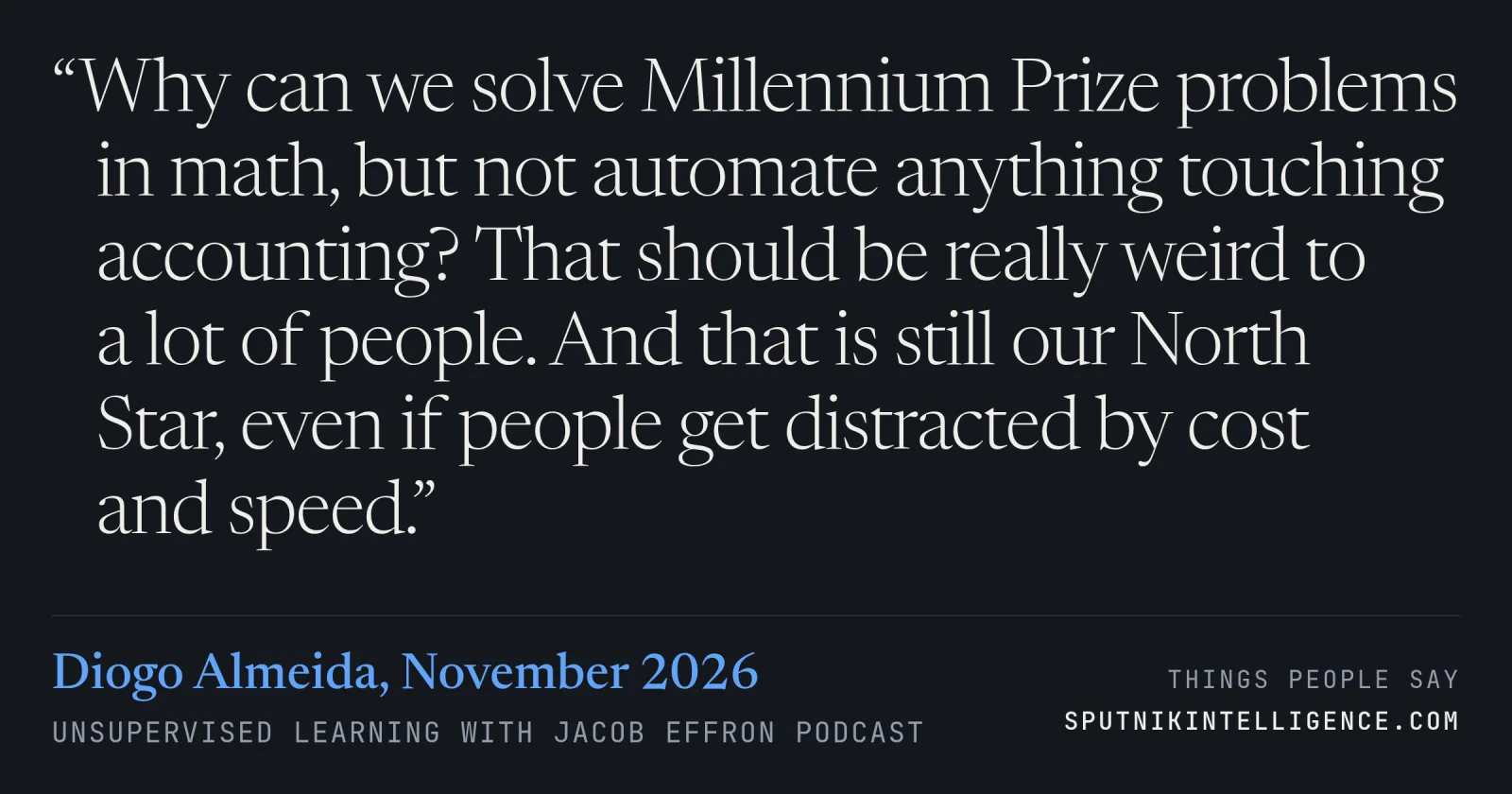
“I wrote a document at OpenAI titled 'We Could Have Had AGI a Year Ago,' at least by OpenAI's definition of AGI. Models from the GPT-3.5 era, possibly even GPT-3, could have met the definition of doing most of the world's economically valuable work. GPQA was surpassing PhD-student level in 2023. How is it that that level of intelligence was not being put to work? That is super tragic.”
Unsupervised Learning with Jacob Effron · AI Builders · November 2026
Context
Asked whether his company's model could have been built five years ago, Diogo recalls an internal OpenAI memo arguing existing models were already smart enough to automate much routine work. His point: the gap is reliability and deployment, not raw intelligence.
Transcript
…stop slop. For me personally, it might be bad for the internet. Like the internet is funded by ads. So like maybe it's a good thing. I don't know. But I would love if I could have some, or someone would make me like a slop stopper where I just don't need to see it anymore. That would be lovely.
…you have just done this five years ago? Like obviously you have a different approach that is like in some ways orthogonal to the rest of the field. Like couldn't you have done this five years ago or how much of what you built like does leverage some of the stuff that's been done on On the LM side?
Five years ago, it would have been harder, but doable. Back when I was more naive, oh man, I sound like an old dude. When I was more naive and I thought that this would take a week of work, what convinced me, I love writing documents. I think it's a great way to think. I wrote a document at OpenAI that was titled, We Could Have Had AGI a Year Ago, at least by OpenAI's definition of AGI, which I don't think that people really listen to the letter of the definition, but I think it's actually a really great letter. I think that models from the starting from GPT 3.5 era, possibly even GPT3 era, could have met the definition of AGI at the time, which is still the same, like doing most of the world's economically valuable work by volume. It doesn't say by volume, but I assume the spirit of that is by volume. Because the models are so unbelievably smart. Like GPT 3.5 level models surpassed median level intelligence at all sorts of things. And shouldn't that be used for tons of automation, at least for the easy work? And so, yes, I think that something like this would have been harder, but it could have been done five years ago. Absolutely. And, you know, like on the people…
Yeah. I mean, speaking of that craziness, I think part of, I imagine there's a lot of noise. You know, I feel there's been a lot of noise in the ecosystem. And I bet many of our listeners will be familiar with, you know, after you guys came with these models, you had OpenAI and Cloudflare and…
Oh boy. It feels like other people are digging our moat for us, which is kind of not how I thought it would go. And I think that that's kind of bad for the field. I think that releasing models that are like kind of more benchmark optimized than real world optimized actually burns that goodwill for…
I mean, speaking of investors, I guess you obviously recently raised a pretty big round. How did you even think about the amount of capital that made sense to raise for this business? I'm sure people were trying to throw money at you. So, you know, how did you even think through that?
More from Unsupervised Learning with Jacob Effron