Hamish McKenzie

Things Hamish Says on Podcasts

Co-founder of Substack and its Chief Writing Officer, the role in which he represents writers' interests inside the company. Earlier a reporter at PandoDaily and lead writer at Tesla, and author of a book about Tesla's push into electric cars. Writes and hosts Disjointed, a Substack newsletter and podcast, and runs the company's On Substack and The Substack Post. Has appeared as a guest on On with Kara Swisher, How I Built This, The Generalist and Mixed Signals.

Where to Find Them

Hamish McKenzie hosts and writes Disjointed , writes The Substack Post , hosts and writes On Substack , writes Chris Best , writes Newcomer , writes Iowa Writers Collaborative Roundup , writes The Elysian , writes Infinite Scroll , writes User Mag , writes Substack Writers at Work with Sarah Fay and writes Uncomfortable Conversations with Josh Szeps . They have also been a guest on Newcomer Pod , The Fifth Column (A Podcast) , The Generalist , On with Kara Swisher , The Weekly Dish , The Dishcast with Andrew Sullivan , How I Built This (Guy Raz) , Recode Media , TED Tech , Sinocism , Mixed Signals from Semafor Media , The Pomp Podcast , Sinocism (Bill Bishop) and The Fifth Column .

Recently: “How to Save the Media (While Drinking Heavily) w/ Hamish McKenzie #584” on The Fifth Column (November 2026); “How to Save the Media (While Drinking Heavily) w/ Hamish McKenzie #584” on The Fifth Column (A Podcast) (November 2026); “Live with Bill Bishop and Hamish McKenzie on his new book How to Save the Media” on Sinocism (November 2026); “Live with Bill Bishop and Hamish McKenzie on his new book How to Save the Media” on Sinocism (Bill Bishop) (November 2026); “Hamish McKenzie On Substack And Journalism” on The Dishcast with Andrew Sullivan (November 2026); “Hamish McKenzie On Substack And Journalism” on The Weekly Dish (November 2026).

What They Said

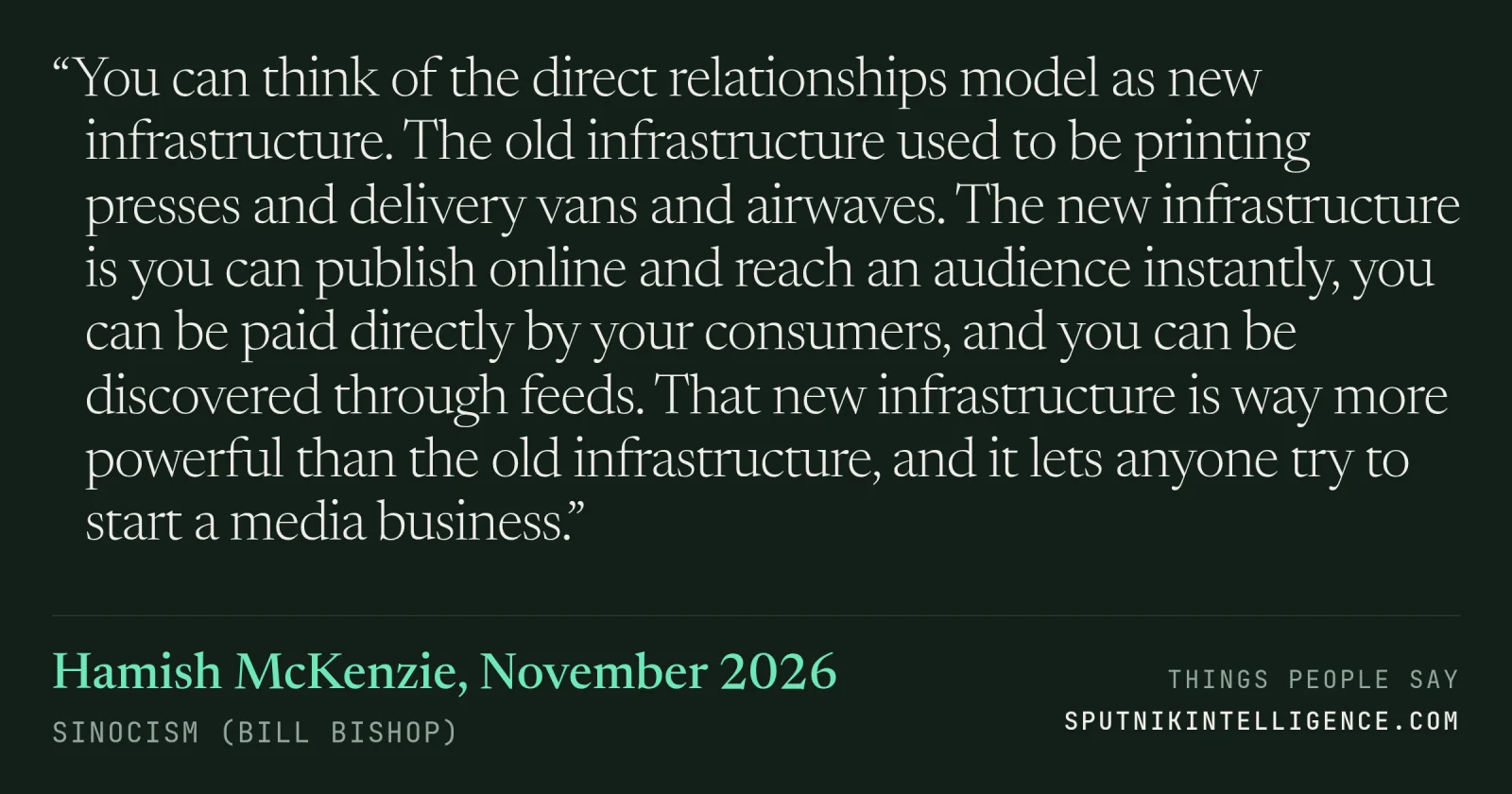
“You can think of the direct relationships model as new infrastructure. The old infrastructure used to be printing presses and delivery vans and airwaves. The new infrastructure is you can publish online and reach an audience instantly, you can be paid directly by your consumers, and you can be discovered through feeds. That new infrastructure is way more powerful than the old infrastructure, and it lets anyone try to start a media business.” — Hamish McKenzie, Sinocism (Bill Bishop)

Asked how Substack helps struggling legacy newsrooms, he says saving the media doesn't mean saving every newspaper in its current form, but creating conditions for new institutions to be born.

Sinocism (Bill Bishop) · 2026-11-13 Permalink → Listen →
Sinocism (Bill Bishop)
Hamish McKenzie

…mid-city, mid-sized city newspapers of the old era be reimagined and flourishing just on the substack rails. But I think we're going to see new journalistic institutions be born based on these new assumptions that will come to do the job that those newspapers used to do in the old context.

Bill Bishop

And you now have a lot more tools to help them do that, right? That's what you're building towards.

Hamish McKenzie

Yeah, you can think of Substack, or you can think of the direct relationships model as new infrastructure. The old infrastructure used to be printing presses and delivery vans and airwaves. And the new infrastructure is you can publish online and reach an audience instantly. And you can be paid directly by your consumers over the internet. And you can be discovered by people through these discovery mechanisms and feeds and stuff. And that new infrastructure is way more powerful than the old infrastructure. And it lets way more people in, lets anyone try to start a media business. And then this new infrastructure and the network effect of Substack, in our case, can help give them tailwinds to maximize the chances that they succeed, if not guarantee that they succeed.

Bill Bishop

And that was one area where I think you guys, you were very smart because you look at, you know, there are other companies say, oh, we can do a publishing platform with email and connect it to Stripe and charge you. But you saw that it was much more about the network. Right. And that, and once that…

Hamish McKenzie

the power is in the network. And you can look at like YouTube. Substack is more like YouTube than any beehive or ghost or something like that. That is thought that the real secret source is paid newsletters. The secret source is the model. And the model has to be attached to something that can help…

Bill Bishop

And that audience relationship, though, it's always about an email address. I mean, the question is, what if in the post, as we get in the AI world, does email become less important?

Speaker names come from our own diarization. The position is estimated from where the line sits in the episode.
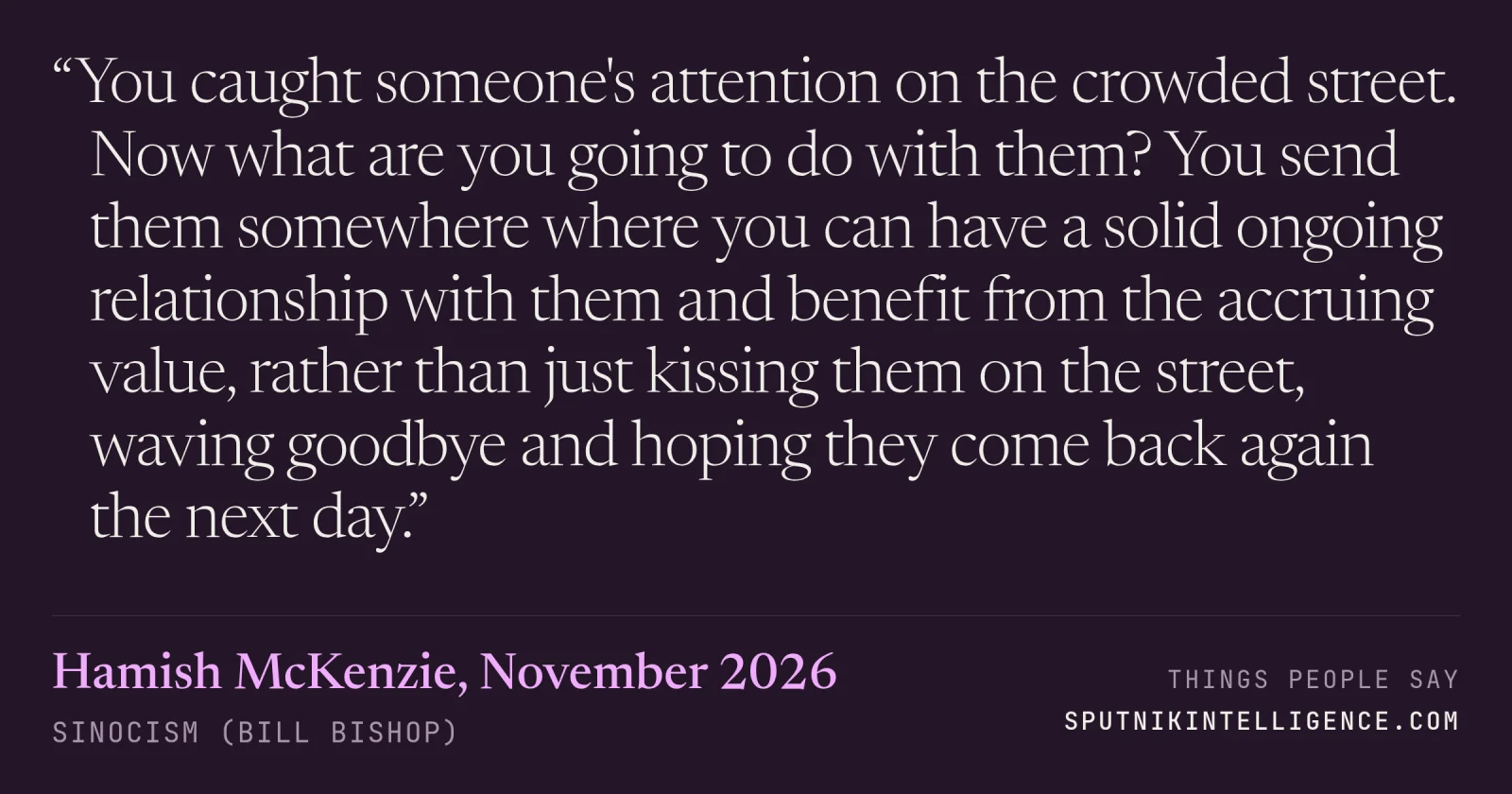
“You caught someone's attention on the crowded street. Now what are you going to do with them? You send them somewhere where you can have a solid ongoing relationship with them and benefit from the accruing value, rather than just kissing them on the street, waving goodbye and hoping they come back again the next day.” — Hamish McKenzie, Sinocism (Bill Bishop)

The host noted big media companies succeed on YouTube yet treat Substack as home base. He uses this image to explain why creators need an owned relationship, like an email list, beyond the social platforms.

Sinocism (Bill Bishop) · 2026-11-13 Permalink → Listen →
Sinocism (Bill Bishop)
Bill Bishop

…No idea how much they're generating in their ad revenue from YouTube. And obviously, YouTube takes a much bigger cut of the ad, a much bigger share of the ad revenue. But it seems like it does seem like more and more companies look at Substack as a place to have that home base, which is where

Speaker 3

you're going to,

Hamish McKenzie

say, you caught someone's attention on the crowded street. Now, what are you going to do with them? Like, you send them somewhere where you've got to like can have a solid ongoing relationship with them and that you can benefit from the accruing value rather than just like kiss them on the street and wave goodbye and hope they come back again the next day.

Bill Bishop

So, so you know, and when I was talking about the, you know, internet 1.0, then, you know, I think Substack is at least two, if not three. I guess three was like crypto. AI. Because I think I think AI look at it on sort of two different perspectives. One is lots of, it's much easier to spin up…

Hamish McKenzie

Yeah, I mentioned before that is I think of Substack not as a content network, but a media relationships network. And those relationships have always been critical, but become only more important in a world where robots increasingly mediate our life experiences and especially our media experiences.…

Bill Bishop

And also, I guess, individual substance, we can write an AI. What do you call it? We're basically talking about how we use AI statement that gets appended to the ethics statement. Yeah, I need to do, I mean, I use AI a lot. I don't use AI to write my newsletter, but I do a lot of translations and…

Speaker names come from our own diarization. The position is estimated from where the line sits in the episode.
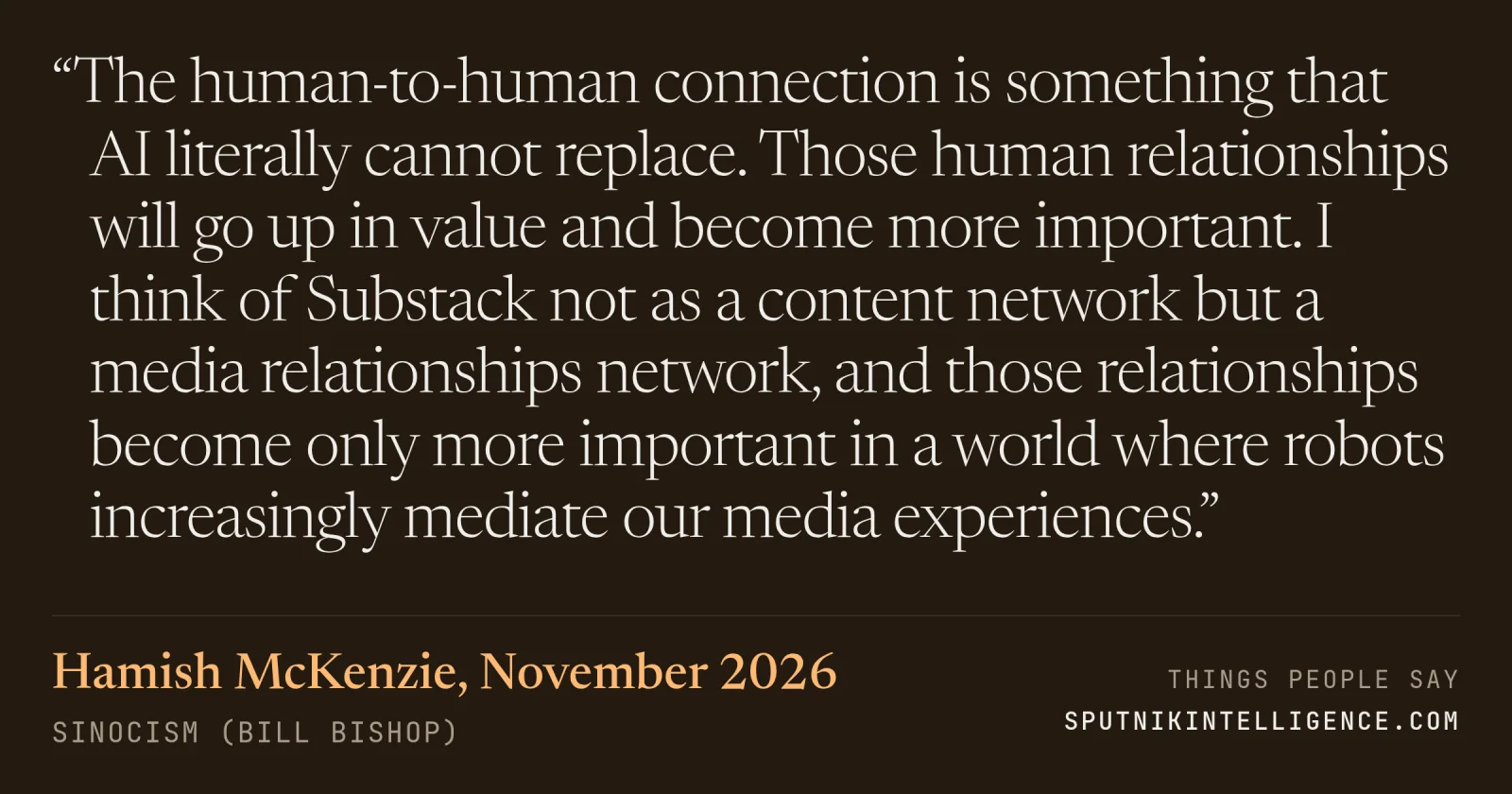
“The human-to-human connection is something that AI literally cannot replace. Those human relationships will go up in value and become more important. I think of Substack not as a content network but a media relationships network, and those relationships become only more important in a world where robots increasingly mediate our media experiences.” — Hamish McKenzie, Sinocism (Bill Bishop)

The host asked where Substack fits in an AI phase of the internet, with more generated content and slop. This is the start of his answer; he goes on to say AI also has a place in the media economy.

Sinocism (Bill Bishop) · 2026-11-13 Permalink → Listen →
Sinocism (Bill Bishop)
Hamish McKenzie

…Now, what are you going to do with them? Like, you send them somewhere where you've got to like can have a solid ongoing relationship with them and that you can benefit from the accruing value rather than just like kiss them on the street and wave goodbye and hope they come back again the next day.

Bill Bishop

…for the people who are starting to use it pretty or integrated pretty well into their lives, AI is clearly changing their relationship with how, with media and with how they consume information. And so where does Substack fit in, say, the AI phase of the internet in terms of media and content?

Hamish McKenzie

Yeah, I mentioned before that is I think of Substack not as a content network, but a media relationships network. And those relationships have always been critical, but become only more important in a world where robots increasingly mediate our life experiences and especially our media experiences. The human-to-human connection thing is something that AI literally cannot replace. And so the human-to-human connection, those human relationships will go up in value and become more important, will become more appreciated. And so being the network of human-to-human connections from Substack's perspective is a very good place to be. And it also helps us give more strength to the human-to-human connection people, the people who are focused on those things. That's not the same thing as saying AI is bad or AI shouldn't have a place in the media economy. AI obviously already does have a place in the media economy. It's just how is it going to be in relation to the human-to-human connection piece? And I think that both are going to be important. I read a lot of stuff that is mediated by robots at the moment and it has a place in my life.…

Bill Bishop

And also, I guess, individual substance, we can write an AI. What do you call it? We're basically talking about how we use AI statement that gets appended to the ethics statement. Yeah, I need to do, I mean, I use AI a lot. I don't use AI to write my newsletter, but I do a lot of translations and…

Hamish McKenzie

ahead. I was just going to say, I think the people who are using it for the lazy shortcuts might not get rewarded by audiences, but the people who use it well to create more thoughtful work should get rewarded by audiences.

Bill Bishop

I think that's right. And to your point, I mean, you'd be crazy not to use AI, especially if, you know, if you're a brilliant, beautiful, creative writer, you're writing wonderful stories, then you don't need AI or doing it. But if you're, you know, my, my newsletter, I'm more, you know, I'm not…

Speaker names come from our own diarization. The position is estimated from where the line sits in the episode.
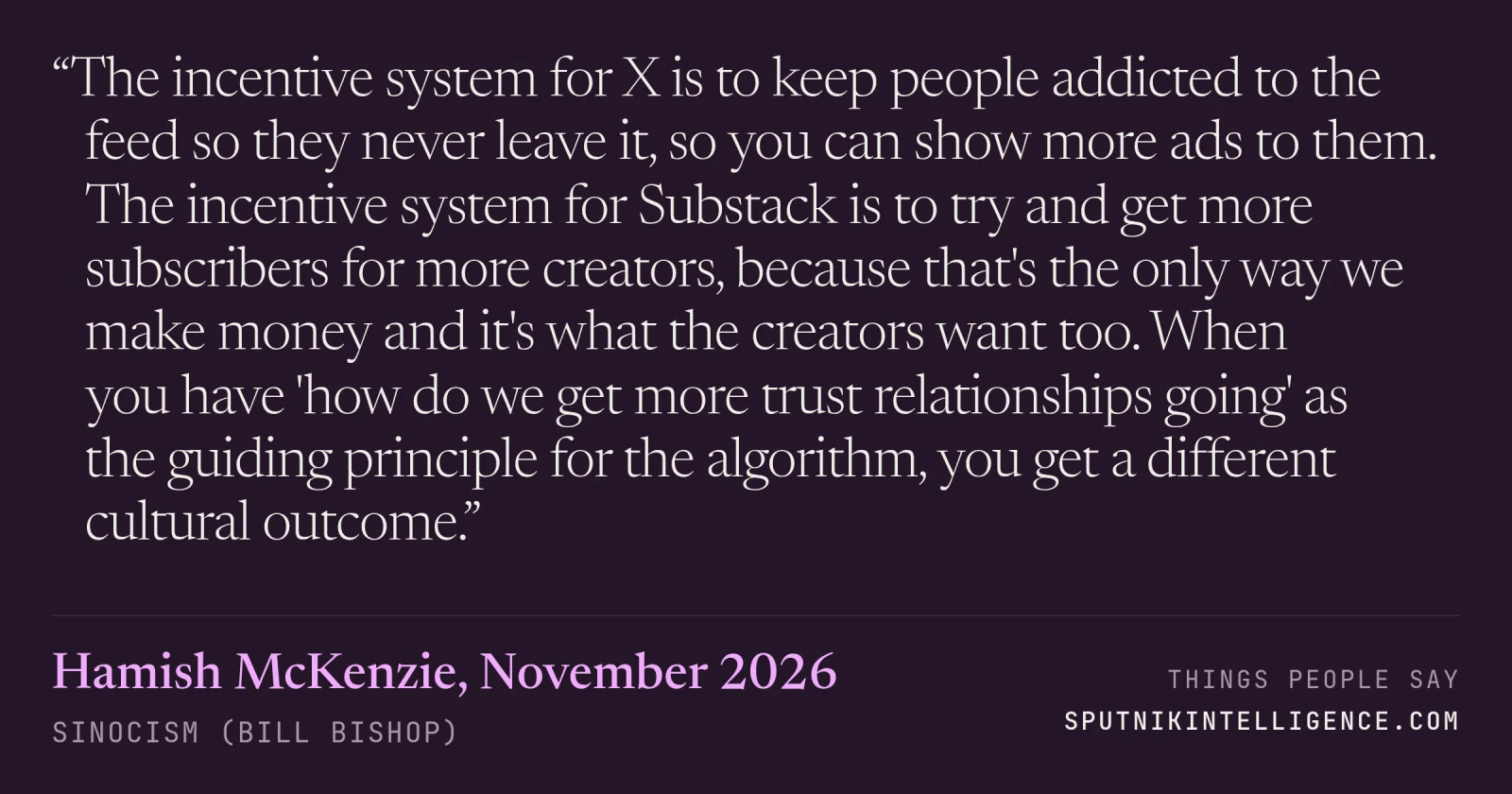
“The incentive system for X is to keep people addicted to the feed so they never leave it, so you can show more ads to them. The incentive system for Substack is to try and get more subscribers for more creators, because that's the only way we make money and it's what the creators want too. When you have 'how do we get more trust relationships going' as the guiding principle for the algorithm, you get a different cultural outcome.” — Hamish McKenzie, Sinocism (Bill Bishop)

The host asked whether Substack Notes is working, saying he is always in a worse mood after time on X. He answers that Notes looks like a feed but behaves differently because the business model is different.

Sinocism (Bill Bishop) · 2026-11-13 Permalink → Listen →
Sinocism (Bill Bishop)
Hamish McKenzie

Notes is the number one growth source. Yeah.

Bill Bishop

It's working for me.

Hamish McKenzie

So yes, it's working for the creators in terms of driving them audiences. And then I think it's working as a product in its own right, as like it's an interesting place to hang out and get a taste of different people's minds. And I think people's relationship with Notes is different from X or Twitter, even though it looks like a feed of short form content. Like it's aesthetically similar, but the cultural effect is different. On Twitter, I'm like mainlining content bits and fights and arguments. And on Notes, I'm getting more of an understanding of the world and engaging with it more as there are real people behind these thoughts and ideas. And this is one way that they're showing us that they're real people and seeking connection and we can choose whether or not to connect. And they're also usually nicer. Usually, yeah. The incentive system changes everything. The incentive system for X is to keep people addicted to the feed so they never leave it so you can show more ads to them. The incentive system for Self Stack is try and get more subscribers for more creators because that's the only way we make money and it's what the creators want too. And when you have how do we get more trust relationships going as the…

Bill Bishop

I mean, it's interesting on X. I mean, I have a couple hundred thousand followers. I've had a blue check since before, you know, before you had to pay. And I occasionally run, you know, I'll post, sometimes I run specials, you know, 30% off whatever, and I'll post a link on X, and sometimes I'll…

Hamish McKenzie

I think it's at least like so much of X is not real. So much of X now is content made by bots posing as humans in the replies, in the top line posts, everything. So much, like a huge percentage of that. But I think the worst, not that, okay, maybe it's not so much a crime, but the more prevalent…

Bill Bishop

So the Bill Ackman long text post is not, I mean, it's true. When I use notes, I mean, again, you get comments and you go see what else this person said, right? And it's so far, at least, notes doesn't have a lot of bots. And I'm sure they've tried. And I think you've cleaned them out over time.…

Speaker names come from our own diarization. The position is estimated from where the line sits in the episode.
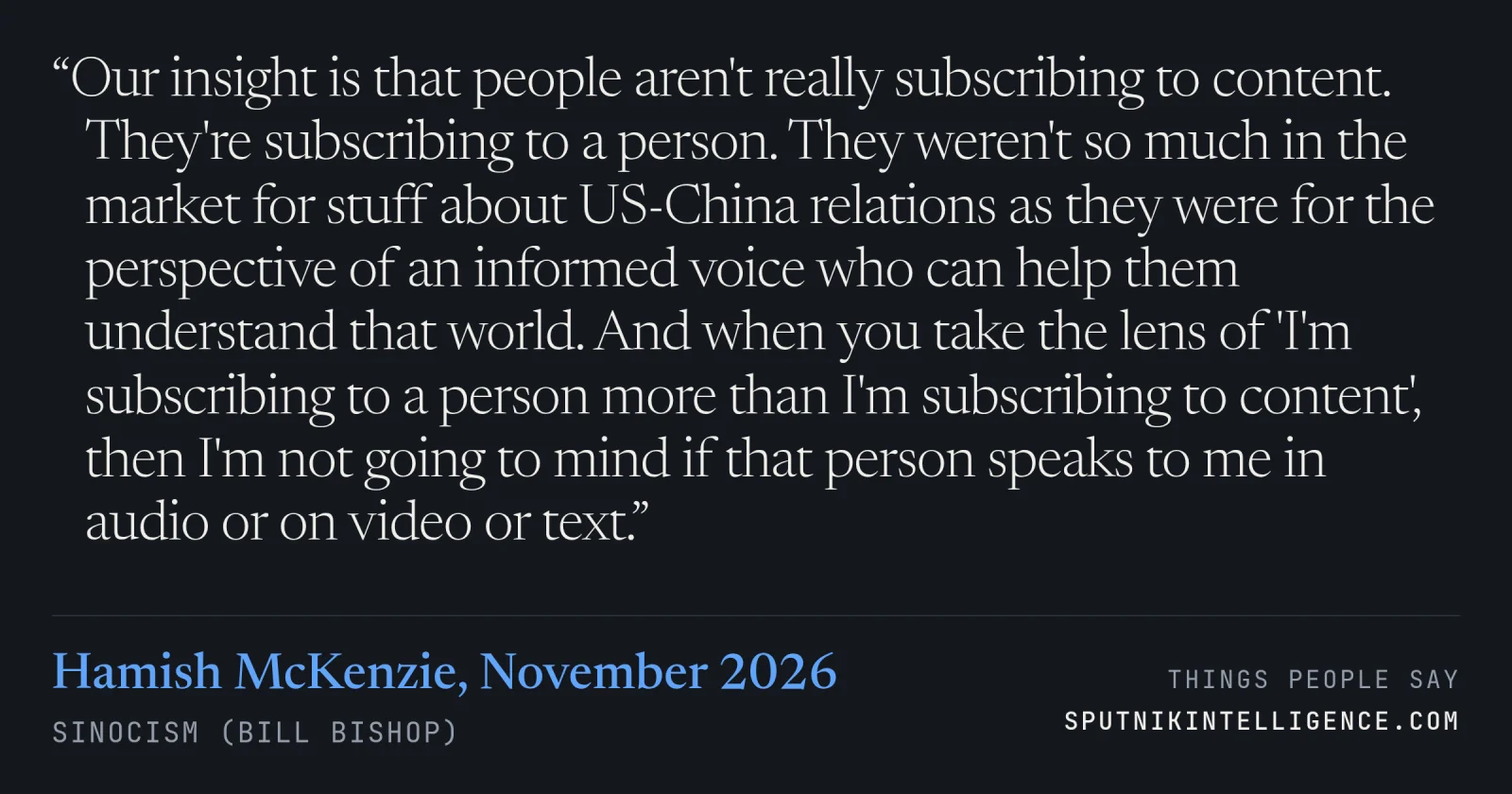
“Our insight is that people aren't really subscribing to content. They're subscribing to a person. They weren't so much in the market for stuff about US-China relations as they were for the perspective of an informed voice who can help them understand that world. And when you take the lens of 'I'm subscribing to a person more than I'm subscribing to content', then I'm not going to mind if that person speaks to me in audio or on video or text.” — Hamish McKenzie, Sinocism (Bill Bishop)

The host asked whether Substack's founders expected it to become more than a text platform. He explains why it could grow into audio and video, using the host's own China newsletter as the example.

Sinocism (Bill Bishop) · 2026-11-13 Permalink → Listen →
Sinocism (Bill Bishop)
Speaker 3

by the Great Firewall. By the Great

Bill Bishop

…Substack. But talk about for the audience. I mean, a lot of people know the origin story, but when you started Substack, I mean, you came, you know, we worked together. It was just text. That was it. Now it's everything, right? When you started it, did you think it was going to be more than text?

Hamish McKenzie

We thought it could well be more than text. We wanted it to be more, but whether or not we actually got to that point was a different question. Turns out we did. But yeah, when we started, we were thinking, who's the perfect type of writer who could make money from an audience that cared about their work and succeed with this paid subscription newsletter option? And that was you. But it turns out that there are lots of people like you or who are just waiting to be like Bill Bishop. And the thing they needed to unlock them was this nice software package and the business model to help them succeed financially. And then what people, our insight is that people aren't really subscribing to content. They're subscribing to a person. They weren't so much in the market for stuff about US-China relations as they were for the perspective of an informed voice who can help them understand that world. And when you take the lens of I'm subscribing to a person more than I'm subscribing to content, then I'm not going to mind if that person speaks to me in audio or on video or text. I'll take, I'm interested in all their formats if they want to. And so Substack could flex over time to support whatever format people wanted to speak in because…

Bill Bishop

I think you're right. I mean, clearly you're right in terms of the success of the business. So how is Substack saving the media? First of all, what's wrong with the media? And I should say, just in the interest of fair disclosure, because we're friends. I love Substack. Your book is excellent. I'm…

Hamish McKenzie

It's an extremely conflicted interview this, but we're not trying to pretend to be too impartial. I don't think Substack is saving the media. I think this new model, the direct relationships model that Substack represents and is kind of the leader of, unlocks something new for the media system. It…

Bill Bishop

And so that and that relationship, originally it was just the individuals would pay the effectively the writer at the time. Now, of course, it's whether the podcaster, the video podcast, the audio podcaster. And I remember early on, you guys, you're pretty adamant that advertising was bad. Even…

Speaker names come from our own diarization. The position is estimated from where the line sits in the episode.

Collections They Appear In