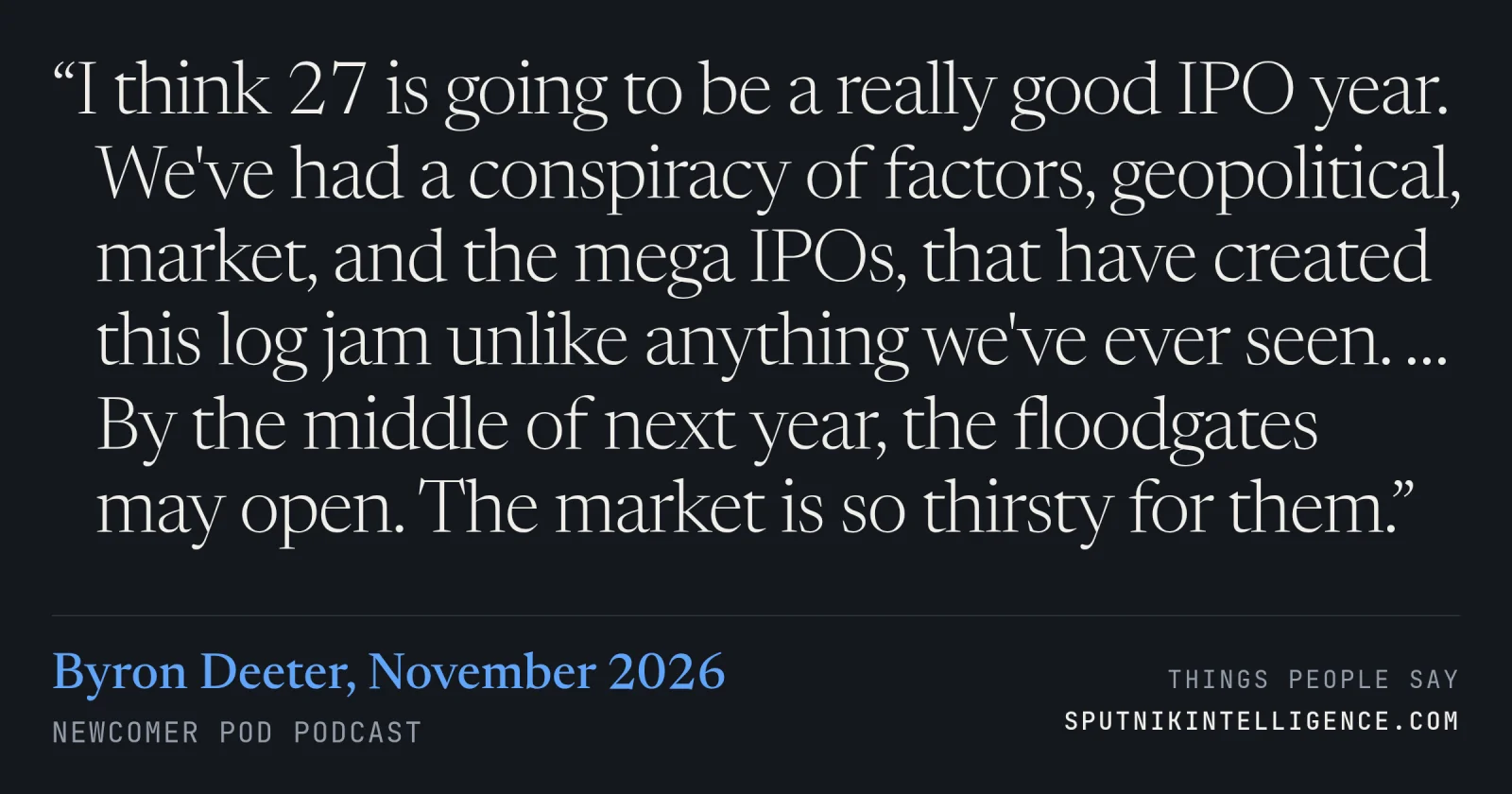
Asked whether big private AI companies will keep staying private as Anthropic goes public, Deeter says the mega-IPOs have created a backlog he expects to clear in 2027, as public investors look for pure-play AI software names.
…revolution ahead. And personally, I think life sciences is the single area of AI I'm most excited about just because of its impact for humanity. I think that lives will be saved, outcomes will be changed. Longevity will be realized because of what's going to happen over the next several years. What
…You know, you have Stripe, Canva, Databricks. I mean, great companies, but also we're talking about this as Anthropic is about to go public. Do you think that trend is going to change? Do you think it's the same thing where there are companies going transforming from one generation to the next?
I think 27 is going to be a really good IPO year. We've had a conspiracy of factors that have with geopolitical, with market, and then with the mega IPOs that have just created this log jam, unlike anything we've ever seen in human history. The fact that we can come up with a list of 100 private companies valued at 3.6 trillion is shocking. And that speaks to the quality of this shadow pipeline. No one wanted to challenge SpaceX or Anthropic. I think OpenAI will have that effect in the early part of next year if they do choose to go public. My hope and sort of my expectation is that by the middle of next year, the floodgates may open and you could see a wave of really high quality companies that say, we're going to do this. And the market is so thirsty for them. They're struggling to buy chip stocks and data centers as their only way to play the AI macro trend. As soon as software companies are out there and there's a chance to do pure play tradable names, the public market's going to love them. And so I think that these companies will give them what the market…
what people can trade right now are the infra companies, the Core Weaves. What, Iron, what do you make of obviously the public benefits? Backlash to data centers in the United States. Does that change the list? I mean, this list was mostly composed before this blue wave. Do you think the signs that…
I mean, the first thing I'd say is I think a lot of the data center backlash is misplaced and that will be litigated over time in public opinion, but part of its marketing, part of its politics. But for regions to turn away economic growth and jobs and vitality, now I think is short-sighted. Of…
some tax, some agreement that's struck. Yes.