FS

Frank Sileo

Things Frank Says on Podcasts

Senior Fixed Income Strategist for the Americas in the UBS Chief Investment Office, covering preferred securities and other fixed income sectors for wealth management clients. Appears on UBS On-Air: Market Moves in the Talking Markets preferreds conversations and the CIO Fixed Income Roundtable series.

Where to Find Them

Frank Sileo hosts UBS On-Air: Market Moves .

Recently: “Top of the Morning: Preferred Securities - Performance & positioning” on UBS On-Air: Market Moves (November 2026); “CIO Fixed Income Roundtable Podcast Series” on UBS On-Air: Market Moves (September 2026); “Talking Markets Podcast Series (Preferreds) with Doug Baker (Nuveen) & Frank Sileo (UBS CIO)” on UBS On-Air: Market Moves (August 2026); “CIO Fixed Income Roundtable Podcast Series - 3Q26 update and outlook” on UBS On-Air: Market Moves (July 2026); “Top of the Morning: Summer rally setup for preferreds” on UBS On-Air: Market Moves (July 2026); “Top of the Morning: Summer rally setup for preferreds” on UBS On-Air: Market Moves (July 2026).

What They Said

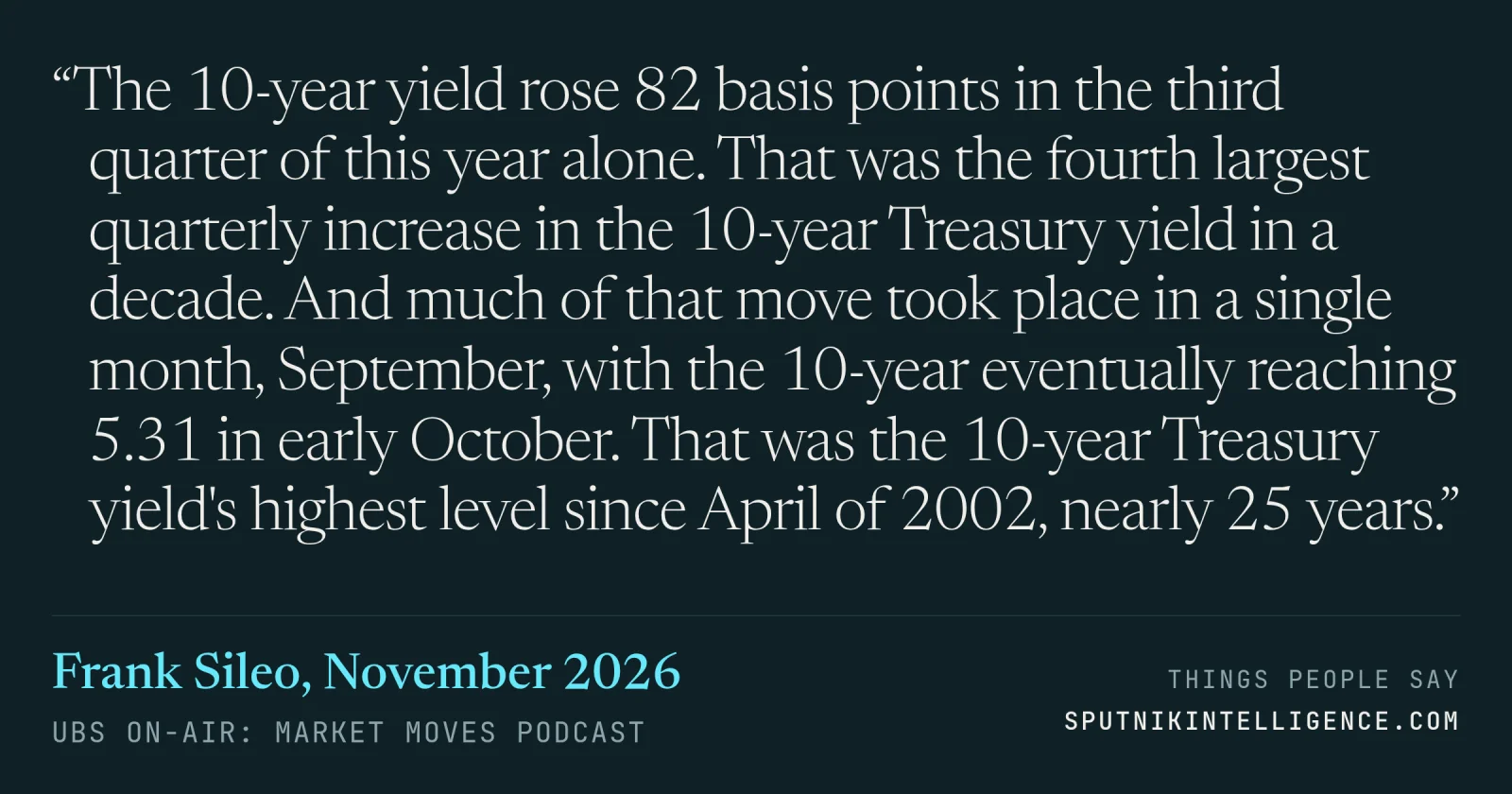
“The 10-year yield rose 82 basis points in the third quarter of this year alone. That was the fourth largest quarterly increase in the 10-year Treasury yield in a decade. And much of that move took place in a single month, September, with the 10-year eventually reaching 5.31 in early October. That was the 10-year Treasury yield's highest level since April of 2002, nearly 25 years.” — Frank Sileo, UBS On-Air: Market Moves

Explaining why preferred securities underperformed recently, he describes the sharp rise in Treasury yields this autumn and says he expects rates to stabilize in 2027.

UBS On-Air: Market Moves · 2026-11-06 Permalink → Listen →
UBS On-Air: Market Moves Around 03:52 into the episode
Frank Sileo

Thanks, Dan. It's always great to be here. I appreciate it.

Daniel Cassidy

…us from a positioning standpoint. I know a few weeks ago, the Chief Investment Office upgraded its view of the preferred securities sector to attractive. So, as a starting point, Frank, can you walk our listeners, our clients, through the thinking behind the upgrade and why the timing? Why now?

Frank Sileo

Sure, definitely. Yeah, we did recently upgrade the sector to attractive with a particular focus on the $25 par retail preferred sub-sector. But before I get to that, I do want to emphasize I'm still very constructive on the institutional $1,000 par preferred sub-sector as well. Those have variable-rate coupons, so they're much less sensitive to interest rates than their $25 par counterparts. And yields today are about 7% in the institutional preferred space versus roughly 7.25 to 730 in the $25 par market. So you're giving up a little bit of yield, but you're getting significantly less interest rate risk. In fact, duration is less than half that of the $25 par sector. So that's why $1,000 par preferreds have been a primary focus of my recommendations in this space for the past several years. What's changed is that we now see an increasingly compelling opportunity in the $25 par preferred space. And I'd point out three things in particular. First, there's a potential tactical rebound after some pretty pronounced underperformance in recent weeks and months. Secondly, yields are now above 7%, closer to 7.25, almost 7.5% in the $25 par space. And that's meaningful…

Daniel Cassidy

Very helpful overview at the start as to the rationale behind CIO's upgrade of preferred securities to attractive. Frank, what is it about the retail $25 par preferred sector that makes it more volatile?

Frank Sileo

Well, first, I think it's important to recognize it wasn't always this way. The $25 par preferred market is much more volatile today than it was just five years ago. And the reason goes back to 2020 and 2021. We had this massive refinancing boom at that time when the Fed had interest rates down…

Daniel Cassidy

So, Frank, that makes sense as you broke it down there for a slow coupon, fixed-rate preferreds have more rate sensitivity. Though, Frank, haven't we seen instances, specifically in October, where the $25 par preferreds have declined even when rates are falling?
Speaker names come from our own diarization. The position is estimated from where the line sits in the episode.
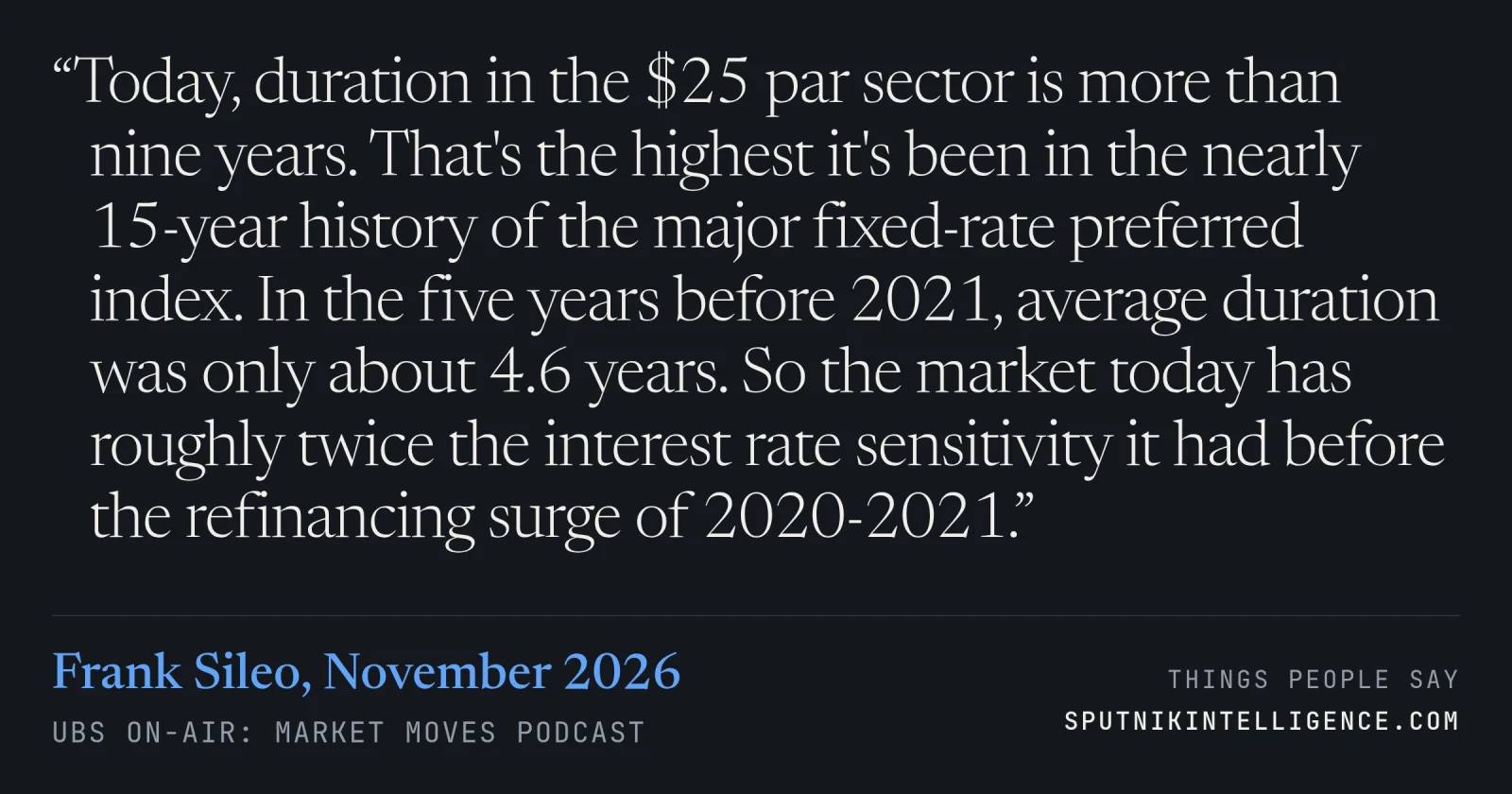
“Today, duration in the $25 par sector is more than nine years. That's the highest it's been in the nearly 15-year history of the major fixed-rate preferred index. In the five years before 2021, average duration was only about 4.6 years. So the market today has roughly twice the interest rate sensitivity it had before the refinancing surge of 2020-2021.” — Frank Sileo, UBS On-Air: Market Moves

Asked why retail $25 par preferreds have become so volatile, he traces it to the 2020-2021 refinancing boom, when issuers locked in record-low coupons on perpetual preferreds.

UBS On-Air: Market Moves · 2026-11-06 Permalink → Listen →
UBS On-Air: Market Moves Around 06:26 into the episode
Frank Sileo

…the bottom line for the $25 par market is this: you've had greater volatility, you've had meaningful underperformance, and you're now being paid more than 7% yields while you wait for a potential rebound. And Dan, I think that combination, in our view, creates a potentially attractive opportunity.

Daniel Cassidy

Very helpful overview at the start as to the rationale behind CIO's upgrade of preferred securities to attractive. Frank, what is it about the retail $25 par preferred sector that makes it more volatile?

Frank Sileo

Well, first, I think it's important to recognize it wasn't always this way. The $25 par preferred market is much more volatile today than it was just five years ago. And the reason goes back to 2020 and 2021. We had this massive refinancing boom at that time when the Fed had interest rates down near zero. As you recall, back in the early COVID days, the Federal Reserve brought interest rates down as a consequence of that challenging time in our economy. And that extremely low rate environment gave issuers the opportunity to lock in historically low coupons on fixed rate perpetual preferreds. And that refinancing boom really fundamentally changed the character of the market. Today, duration in the $25 par sector, interest rate sensitivity measured by what we call duration, it's more than nine years. That's the highest it's been in the near. 15-year history of the major fixed-rate preferred index. And here's the comparison that really puts into perspective. In the five years before 2021, average duration was only about 4.6 years. So the market today has roughly twice the interest rate sensitivity it had before the refinancing surge of…

Daniel Cassidy

So, Frank, that makes sense as you broke it down there for a slow coupon, fixed-rate preferreds have more rate sensitivity. Though, Frank, haven't we seen instances, specifically in October, where the $25 par preferreds have declined even when rates are falling?

Frank Sileo

Excellent point. I get this question a lot, and it is true. But it comes down to market-demanded yield and compensation for risk. So, let's break it down this way: if higher rates on treasuries push yields higher in credit markets, then prices have to come down in those credit markets. Conversely…

Daniel Cassidy

To summarize, you've conveyed that the sector's greater volatility combined with its recent spout of underperformance may provide a setup for a sector rebound. To underscore the opportunities set here, Frank, what are the other parts of the investment case for the $25 per preferred sector? Well,

Speaker names come from our own diarization. The position is estimated from where the line sits in the episode.

Collections They Appear In