Paul Eastwick

Things Paul Says on Podcasts

Paul Eastwick is a Professor of Psychology at UC Davis and the author of BONDED BY EVOLUTION: The New Science of Love and Connection. He also hosts the popular podcast Love Factually with his long-time colleague, Eli Finkel.

Where to Find Them

Paul Eastwick hosts and writes Love Factually and writes The Next Big Idea Club Book of the Day Newsletter . They have also been a guest on Behavioral Grooves (2 times) , Behavioral Grooves Podcast (2 times) , Plain English with Derek Thompson , Hidden Brain , It Has to Be Said. and Huberman Lab . They also write for Love Factually Podcast on Substack.

Recently: “Mean Girls (2004) with Laurie Santos” on Love Factually (November 2026); “How Love Really Works” on Hidden Brain (November 2026); “Les Misérables (2012) with Vanessa Bohns” on Love Factually (November 2026); “Obsession (2026)” on Love Factually (October 2026); “Sense and Sensibility (1995)” on Love Factually (October 2026); “Sense and Sensibility (1995)” on Love Factually (October 2026).

What They Said

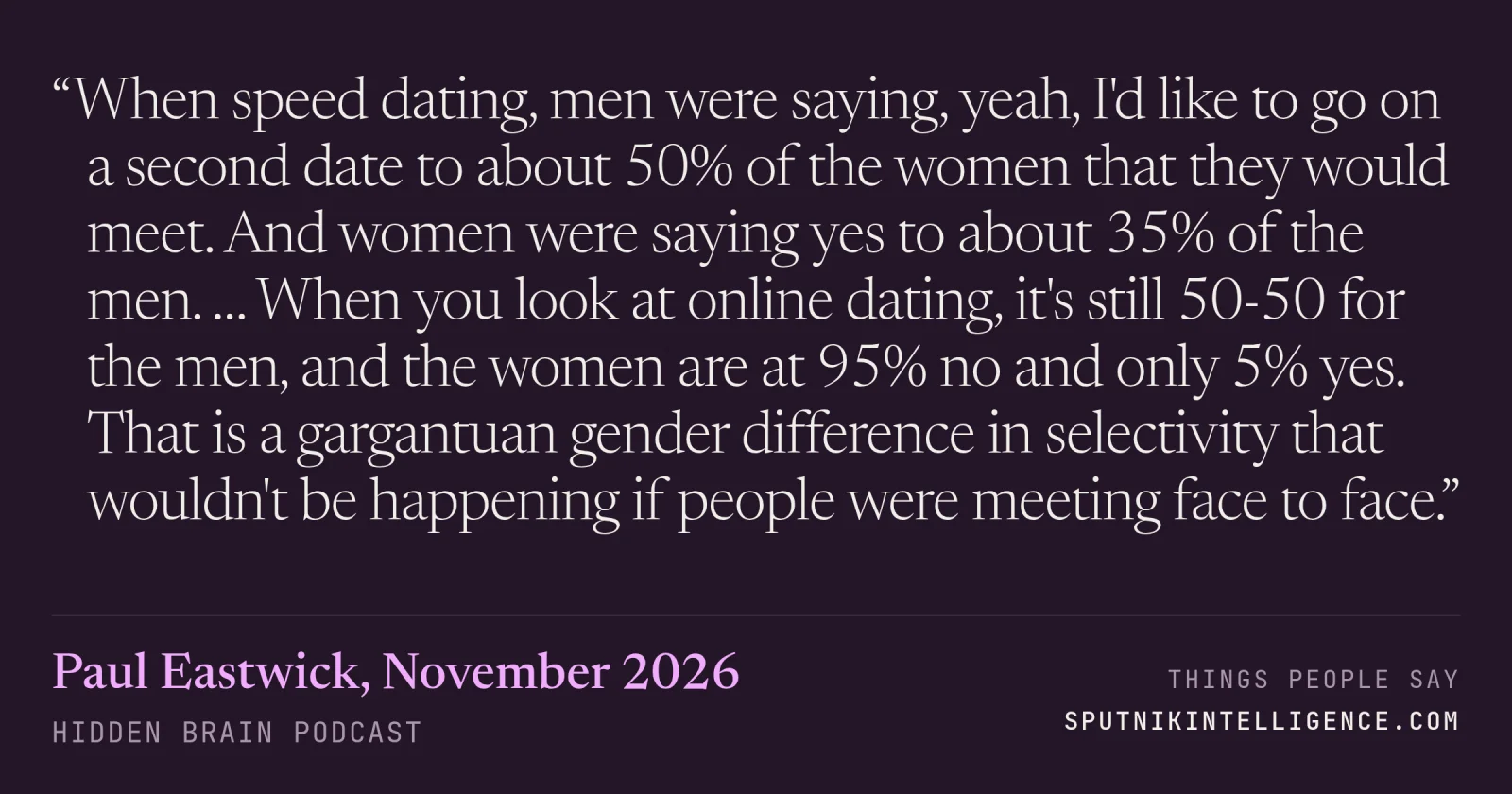
“When speed dating, men were saying, yeah, I'd like to go on a second date to about 50% of the women that they would meet. And women were saying yes to about 35% of the men. … When you look at online dating, it's still 50-50 for the men, and the women are at 95% no and only 5% yes. That is a gargantuan gender difference in selectivity that wouldn't be happening if people were meeting face to face.” — Paul Eastwick, Hidden Brain

Asked how dating apps amplify differences between heterosexual men and women, Eastwick compares in-person speed-dating numbers with app behavior, arguing the apps, not women's standards, create the impression that women are far pickier.

Hidden Brain · 2026-11-02 Permalink → Listen →
Hidden Brain Around 35:40 into the episode
Paul Eastwick

…this for a very long time. So I think this idea is very, very tempting, especially in an online space where people are mainly evaluating looks, but it just doesn't describe real-life interactions between men and women, especially in contexts where they are getting to know each other over time.

Shankar Vedantam

You say that online dating apps unhelpfully amplify differences between heterosexual men and women. How so, Paul?

Paul Eastwick

…to face. Do you find that women are pickier than men? You do. It's not a gigantic effect, but it's there. And to put specific numbers on it, when speed dating, men were saying, yeah, I'd like to go on a second date to about 50% of the women that they would meet. And women were saying yes to about 35% of the men that they would meet. So that's a difference, but it's not a gargantuan difference. When you look at online dating, it's still 50-50 for the men, and the women are at 95% no and only 5% yes. That is a gargantuan gender difference in selectivity that wouldn't be happening if people were meeting face to face. So I think like when men in particular feel frustrated and they feel like women's standards are too high, that is being driven by behavior on the apps. We wouldn't be feeling that way if we were out there socializing in person or, you know, meeting people in groups, meeting people organically. It wouldn't feel quite so demoralizing. And so this is one way that the gender differences online…

Shankar Vedantam

I'm wondering if the rise of online dating is connected with the rise of the manosphere, Paul. If men feel like they're being rejected 95% of the time, it becomes easier to tell a story that women are, you know, drawn only to the guy who has the most money or the guy who has. The corner office.

Paul Eastwick

I think that is unfortunately true, that these things have unintentionally fed each other. And what men who are only using online ways of meeting partners, what they're feeling is that if I'm not in that upper, upper tier of men, I'm not going to get any attention whatsoever. And the insidious part…

Shankar Vedantam

We've been talking here mostly about heterosexual couples. What does the research have to say about same-sex relationships, Paul?
Speaker names come from our own diarization. The position is estimated from where the line sits in the episode.
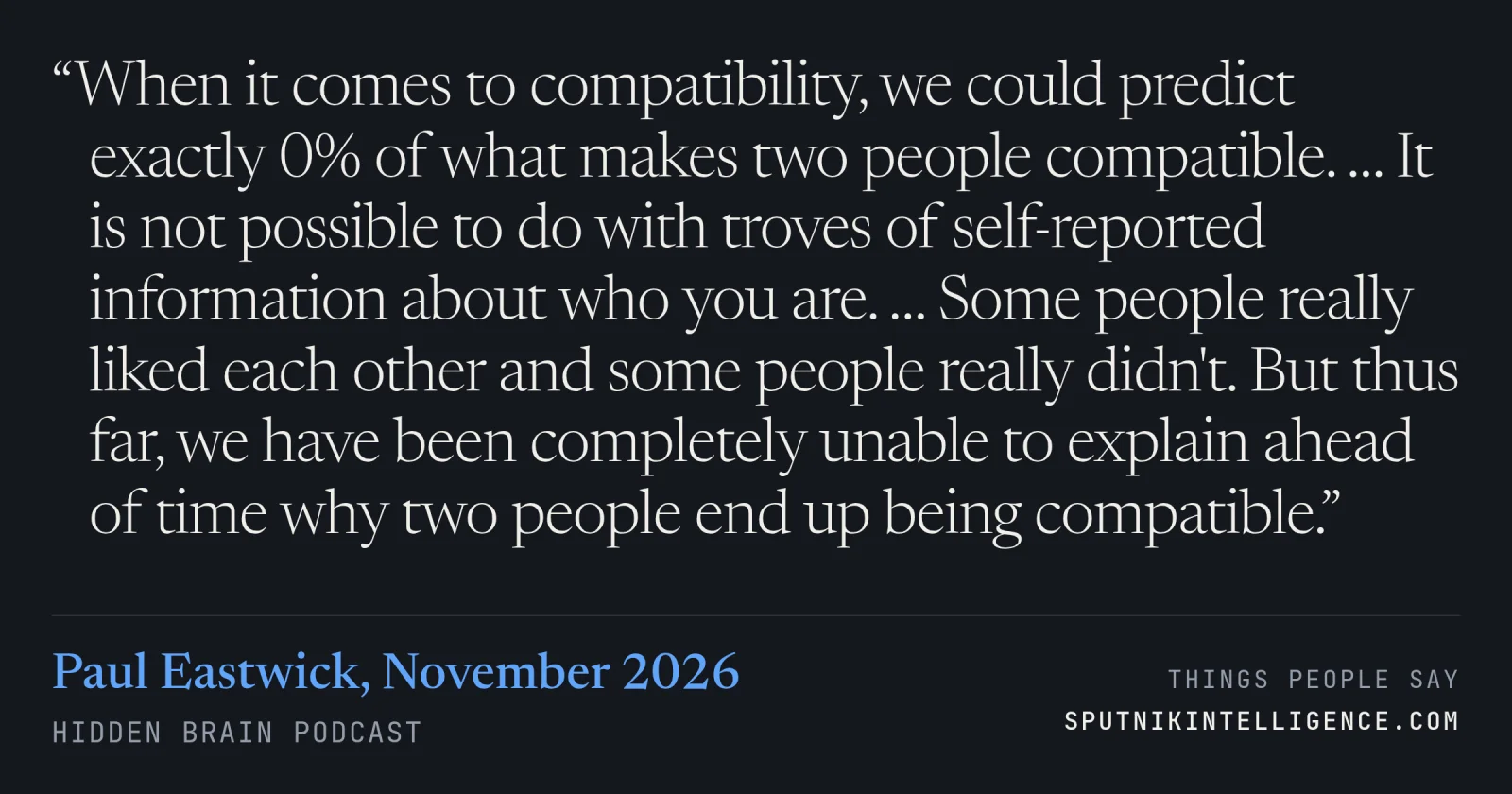
“When it comes to compatibility, we could predict exactly 0% of what makes two people compatible. … It is not possible to do with troves of self-reported information about who you are. … Some people really liked each other and some people really didn't. But thus far, we have been completely unable to explain ahead of time why two people end up being compatible.” — Paul Eastwick, Hidden Brain

Eastwick describes studies in which machine learning was fed everything speed daters reported about themselves, to see whether it could predict who would click. The result undercuts the logic of matching algorithms and checklists.

Hidden Brain · 2026-11-02 Permalink → Listen →
Hidden Brain Around 41:10 into the episode
Paul Eastwick

…but they also like these men more when they seem ambitious, when they seem smart and supportive and funny and kind and all of those great qualities. So generally speaking, we see more or less the same thing, but the research on this, looking at live attraction, is actually still pretty limited.

Shankar Vedantam

You and your colleagues, notably the psychologist Samantha Joel, have looked for evidence that compatibility between two people can be predicted in advance by knowing a lot about the people involved. What have she and others found on this, Paul?

Paul Eastwick

…reported about themselves and use machine learning to match up who's going to be especially compatible when they meet at these speed dating events. And what we found was that when it comes to compatibility, we could predict exactly 0% of what makes two people compatible. Wow. It is not possible to do with troves of self-reported information about who you are, that there was compatibility there. Some people really liked each other and some people really didn't. But thus far, we have been completely unable to explain ahead of time why two people end up being compatible.

Shankar Vedantam

If compatibility is hard to predict in advance, how do we know when we have found the one? When we come back, what science can teach you about finding your soulmate? You may also want to check out our companion story about online dating on Hidden Brain Plus. We examine how dating apps mislead us…

Paul Eastwick

I think compatibility is tightly tied to history, the story that you have with a particular person and how that story evolves and changes over time. I think this is easiest for people to intuit when they think about an ongoing relationship. That if this is somebody that you've had in your life for…

Shankar Vedantam

It's almost like a gardening metaphor here. You have these two saplings and they basically are growing together and they're entwining and intertwining and supporting one another. And, you know, 10 years later, we say, of course, well, you know, they're clearly supporting each other. They're…

Speaker names come from our own diarization. The position is estimated from where the line sits in the episode.

Collections They Appear In