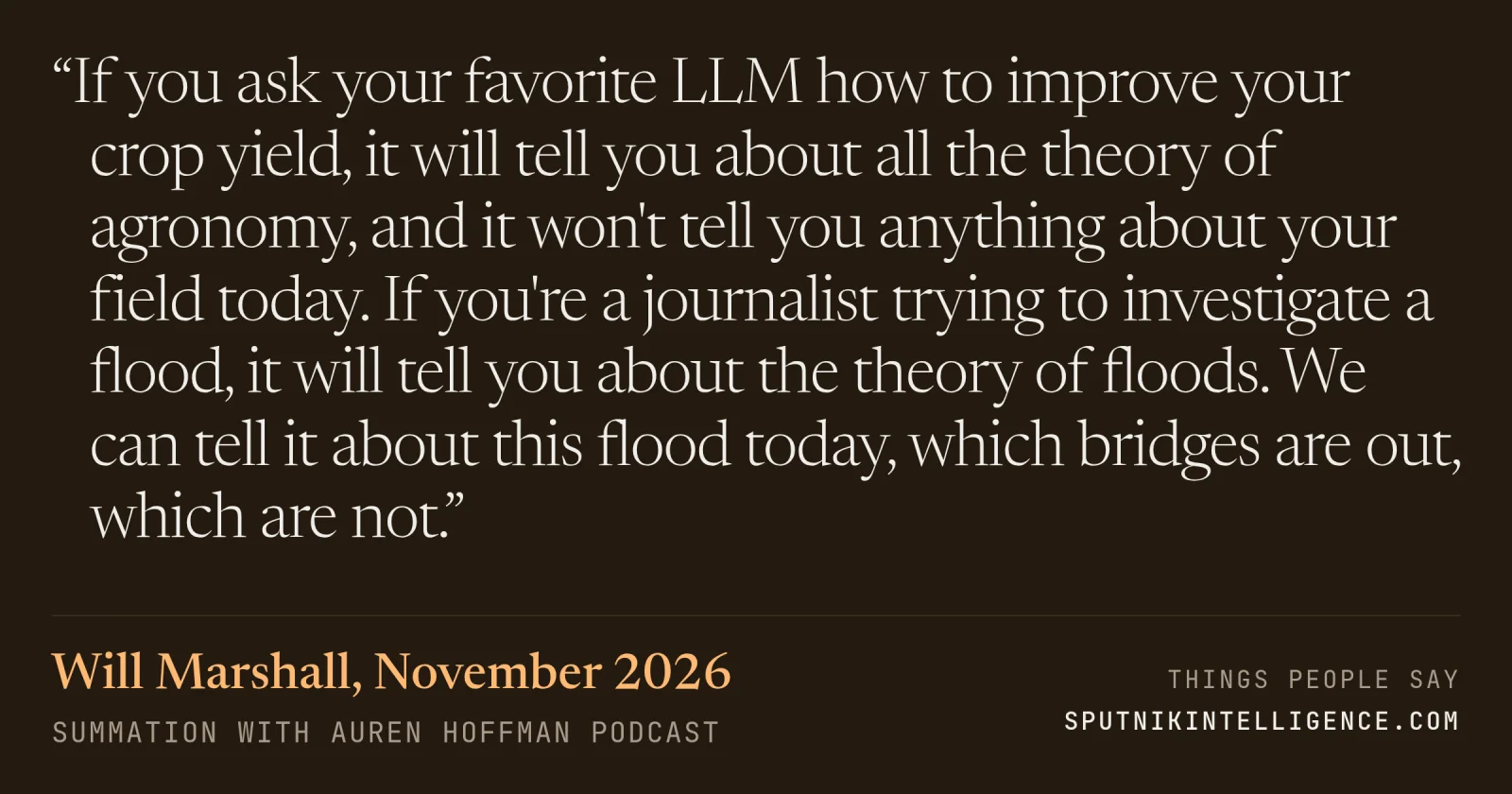
Marshall was describing Planet's app that pairs daily satellite imagery with language models so anyone can ask questions about the Earth. His point is what current imagery adds that text-trained models lack.
…are doing geospatial analysis. Whereas most of the people that could get value, that small county trying to do disaster response, the little insurance company, what have you, they still haven't got a solution. But AI is racing along at being able to build quick solutions for a lot of these users.
…so hard to take, like, I mean, if you have a photo a day of, I don't know, what is it, like a square kilometer or something like that, or whatever you have? Like, if you have a photo a day, okay, well, it's only 365 photos per year, right? I mean, how hard is it to process these photos? Yes, yeah.
Well, it really depends. I mean, like, yes, for a farmer looking at his or her field, yes, it's only a picture a day, but then they tend to be the even least able to do that sort of analysis. So, and they don't want the imagery. They just want the analysis in a way. And so it's, look, it's just a matter of getting it easy enough to use. Again, the big ag companies already use our stuff. It's all the little guys that don't, right? So, I know, I think we're basically there. And I can say a little bit more about our AI applications during this podcast, but I think we're there. Our AI capabilities are filling out the ability for anyone with zero geospatial expertise to be able to get some value out of our data. Our systems already do that at some level, and we're just making it easier and easier for people to get that value out of it. So, in fact, we just have an app, ai.planet.com that anyone could go to and sign up and they can start just chatting with the earth. So, it's basically we've merged all of our satellite imagery with LLMs, with all of human knowledge, and that gives you the ability to, it both upgrades AI to what I…
And how do you like you? You mentioned, like, okay, you want to work with all these analytics companies. Like, where do you like? How far do you want to go down the stack? How much do you want them to look? So, I'm an insurance company. Let's say I want to, ideally, I want to upload, let's say, I'm…
We think of ourselves doing the satellites, the data, the core data processing that gets it to geo-rectified imagery that people can use, and analytics that's horizontal that enables lots of different application areas. As it happens, that analytics is getting easier and easier because of all these…
the analytics layer on top of it.