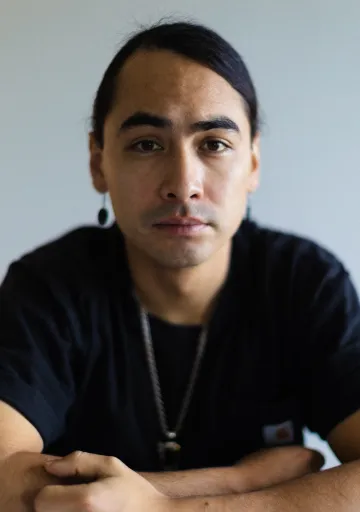
Julian Brave NoiseCat

Things Julian Says on Podcasts

The first Indigenous North American filmmaker nominated for an Academy Award and the first Indigenous North American author to write about healing from intergenerational trauma by getting stoned with his dad for The New York Times Magazine.

Where to Find Them

Julian Brave NoiseCat writes The Walrus , writes The.Ink , writes How I Make Money Writing and writes Pioneer Works Broadcast . They have also been a guest on Heatmap News (2 times) , A Matter of Degrees (2 times) , Climate One and Temperature Check . They also write for Coyote Stories on Substack.

Recently: “How Tribes Became Power Players on Permitting Reform” on Heatmap News (November 2026); “Interview #113: How Julian Brave NoiseCat Makes Money Writing” on How I Make Money Writing (March 2026); “Mr. Carney, about That Pipeline Deal—We Need to Talk” on The Walrus (December 2025); “WATCH: Remythologizing America” on The.Ink (December 2025); “WATCH: Julian Brave NoiseCat on coyote stories, coincidences, and telling the biggest stories” on The.Ink (November 2025); “My Father Was Found in a Residential School Incinerator When He Was an Infant” on The Walrus (October 2025).

What They Said

“Unless there is an opportunity for tribes to go to court and stop something, then tribal consultation just becomes a rubber stamp. And that is not in keeping with the nation-to-nation relationship. That is not in keeping with the federal government's trust responsibility to tribes.” — Julian Brave NoiseCat, Heatmap News

The host asked what a new Senate amendment would change in the permitting bill's historic preservation rules. NoiseCat says that, as he understands it, it keeps tribes' ability to sue, and explains why that matters.

Heatmap News · 2026-11-17 Permalink → Listen →
Heatmap News Around 30:18 into the episode
Julian Brave NoiseCat

…of whether there was that amendment to the NHPA that I mentioned, that the kind of choice facing tribes right now appears to be take this deal that you don't love or potentially gamble even more and try to stop the deal from happening at all, in which case you could get an even worse deal.

Robinson Meyer

…it to move forward. But what would this amendment do? Because it does have the support of a number of Democrats who voted to advance the permitting bill and some who said they wanted to vote to advance, except but for these NHPA changes. So it's significant that they're all putting it out together.

Julian Brave NoiseCat

…exactly the legal language about this stuff, the lawyers probably all go, the kid is not a lawyer. Nonetheless, my understanding is basically that the Padilla Amendment makes it possible for tribes to still go to court to try to stop a development. That might be in the form of revoking the permits or something of that nature. That part I don't fully understand. And the basic point here is that unless there is an opportunity for tribes to go to court and stop something, then tribal consultation just becomes a rubber stamp. And that is not in keeping with the nation-to-nation relationship. That is not in keeping with the federal government's trust responsibility to tribes. I think here it's useful to bring in a comparative context. So I am a First Nations person whose people are from Canada. I was born and raised in the U.S. I now live in Canada. It's a very interesting moment in time for issues related to Indigenous rights and development because both the United States and Canada really want to build. The U.S. has the need to build for the energy transition, for…

Robinson Meyer

well, it's interesting because that has seemed to be another fault line running through this here in the U.S., this Purbank Bill discussion, too, which is that there's a broad and kind of racializing assumption that Indigenous people will always be on the side of not developing. On the receiving…

Julian Brave NoiseCat

Trevor Burrus, Jr.: That is correct. I think it's important here to point out that there are tribes who are developing energy, like the Crow Nation, who have explicitly come out in favor of the bill. We mentioned the Coalition of Large Tribes. There, in general, I would say, are benefits to this…

Robinson Meyer

are trying to develop data centers now on the North Slope. I could be wrong. I'm
Speaker names come from our own diarization. The position is estimated from where the line sits in the episode.
“There's this kind of assumption that tribes are kind of like the first environmentalists or that they're kind of like the Indigenous face of the environmental movement in Washington. … In reality, for many of these issues that have often been classed as native environmental concerns, there are actually even in many of them tribes on the opposite side of the issue.” — Julian Brave NoiseCat, Heatmap News

The host noted that many Indigenous communities want development, fossil fuels included. NoiseCat agrees, pointing to tribes that support the permitting bill and to tribes on both sides of the Arctic refuge fight.

Heatmap News · 2026-11-17 Permalink → Listen →
Heatmap News Around 32:33 into the episode
Julian Brave NoiseCat

…that does not appear to have been a winning strategy anymore. But a version of a federal system wherein tribes are consulted and then also potentially use that position of power to become increasing parts of the economy in their region. That I think is a real potential path forward. Aaron Powell,

Robinson Meyer

…communities that would love to develop. And there's actually a lot of Indigenous communities that would love to develop slash are already developing fossil fuels. And so the fossil fuel trade-offs in this bill are trade-offs they would accept because they want to be doing development too.

Julian Brave NoiseCat

…explicitly come out in favor of the bill. We mentioned the Coalition of Large Tribes. There, in general, I would say, are benefits to this bill. If you are interested in developing energy on your homelands and you're a tribe, there's actually a lot of red tape involved with that from the Interior Department. And this bill makes it easier to do that development if you're a tribe. I think that there's this kind of assumption that tribes are kind of like the first environmentalists or that they're kind of like the indigenous face of the environmental movement in Washington. I think that there's been the overwhelming way in which the left of center part of the conversation has engaged with tribes. And in reality, for many of these issues that have often been classed as like native environmental concerns, there are actually even in many of them tribes on the opposite side of the issue. So like the Wilderness Society approached me with some money to be part of their…

Robinson Meyer

are trying to develop data centers now on the North Slope. I could be wrong. I'm

Julian Brave NoiseCat

sure. So, you know, I think my broad point here is that it's very interesting that tribal concerns remain central to this bill, despite the fact that that's being undercovered because very few newspapers, magazines cover tribal concerns. They are the kind of issue, interestingly, that when you move…

Robinson Meyer

What do you wish was different about the coverage here/slash the whole discussion? Because I think one aspect that I would observe is that the degree to which these tribal issues were initially covered as I realize I'm repeating something you just said, but the degree to which tribal issues were…

Speaker names come from our own diarization. The position is estimated from where the line sits in the episode.

Collections They Appear In