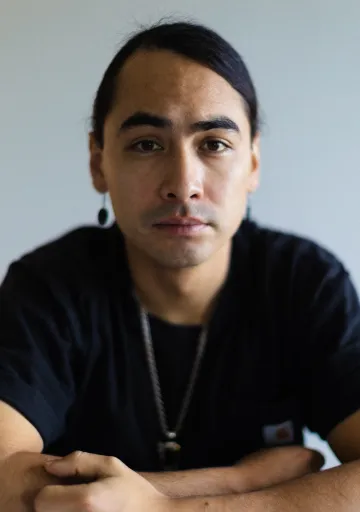
 Julian Brave NoiseCat
The first Indigenous North American filmmaker nominated for an Academy Award and the first Indigenous North American author to write about healing from intergen...
“Unless there is an opportunity for tribes to go to court and stop something, then tribal consultation just becomes a rubber stamp. And that is not in keeping with the nation-to-nation relationship. That is not in keeping with the federal government's trust responsibility to tribes.”
Heatmap News · Climate & Energy · November 2026
Context
The host asked what a new Senate amendment would change in the permitting bill's historic preservation rules. NoiseCat says that, as he understands it, it keeps tribes' ability to sue, and explains why that matters.
Transcript
…of whether there was that amendment to the NHPA that I mentioned, that the kind of choice facing tribes right now appears to be take this deal that you don't love or potentially gamble even more and try to stop the deal from happening at all, in which case you could get an even worse deal.
…it to move forward. But what would this amendment do? Because it does have the support of a number of Democrats who voted to advance the permitting bill and some who said they wanted to vote to advance, except but for these NHPA changes. So it's significant that they're all putting it out together.
…exactly the legal language about this stuff, the lawyers probably all go, the kid is not a lawyer. Nonetheless, my understanding is basically that the Padilla Amendment makes it possible for tribes to still go to court to try to stop a development. That might be in the form of revoking the permits or something of that nature. That part I don't fully understand. And the basic point here is that unless there is an opportunity for tribes to go to court and stop something, then tribal consultation just becomes a rubber stamp. And that is not in keeping with the nation-to-nation relationship. That is not in keeping with the federal government's trust responsibility to tribes. I think here it's useful to bring in a comparative context. So I am a First Nations person whose people are from Canada. I was born and raised in the U.S. I now live in Canada. It's a very interesting moment in time for issues related to Indigenous rights and development because both the United States and Canada really want to build. The U.S. has the need to build for the energy transition, for…
well, it's interesting because that has seemed to be another fault line running through this here in the U.S., this Purbank Bill discussion, too, which is that there's a broad and kind of racializing assumption that Indigenous people will always be on the side of not developing. On the receiving…
Trevor Burrus, Jr.: That is correct. I think it's important here to point out that there are tribes who are developing energy, like the Crow Nation, who have explicitly come out in favor of the bill. We mentioned the Coalition of Large Tribes. There, in general, I would say, are benefits to this…
are trying to develop data centers now on the North Slope. I could be wrong. I'm
More from Heatmap News