
Teddy Schleifer

Things Teddy Says on Podcasts

Reporter at The New York Times who covers money in politics: billionaire donors, super PACs, dark money and campaign finance, including Elon Musk's spending on the 2026 midterms. Appears as a guest on The Inside Elections Podcast, Money, Power, Politics with Stephanie Ruhle, What Next: TBD, Decoder with Nilay Patel, Squawk Pod and On with Kara Swisher.

Where to Find Them

Teddy Schleifer hosts Decoder with Nilay Patel and writes The Beat with Ari Melber . They have also been a guest on Newcomer Pod (3 times) , Money, Power, Politics with Stephanie Ruhle (3 times) , Squawk Pod (3 times) , What Next: TBD | Tech, power, and the future (3 times) , Big Technology (2 times) , Philanthropisms , On with Kara Swisher , The Pomp Podcast , The Inside Elections Podcast and Pivot (Kara Swisher & Scott Galloway) .

Recently: “Will the Democrats’ Big Win Stop the AI Buildout? — With Teddy Schleifer” on Big Technology (November 2026); “Election Day, and the most expensive Senate race ever run” on Money, Power, Politics with Stephanie Ruhle (November 2026); “Elon Musk’s record spending on the midterms, and the impact it could have now and after Election Day.” on Money, Power, Politics with Stephanie Ruhle (October 2026); “Episode 80: The $400 Million Elephant w/ Teddy Schleifer of the New York Times” on The Inside Elections Podcast (September 2026); “Breaking News at the Supreme Court” on Money, Power, Politics with Stephanie Ruhle (June 2026); “U.S. Economy Shrinks Under Trump” on The Beat with Ari Melber (April 2025).

What They Said

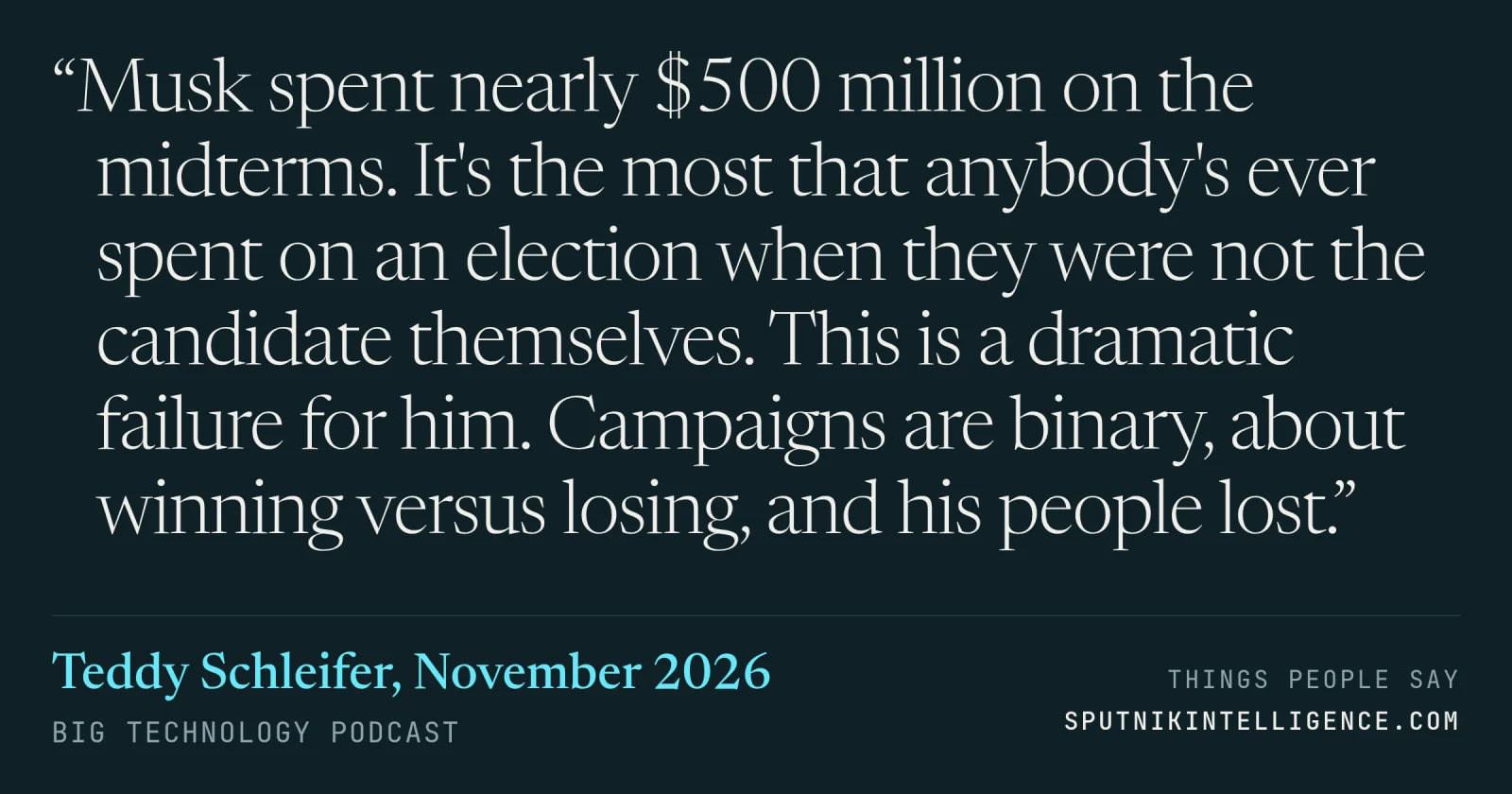
“Musk spent nearly $500 million on the midterms. It's the most that anybody's ever spent on an election when they were not the candidate themselves. This is a dramatic failure for him. Campaigns are binary, about winning versus losing, and his people lost.” — Teddy Schleifer, Big Technology

The host noted Schleifer's post-election scorecard, which said Musk, big Republican donors and crypto lost. This is Schleifer's assessment of what the result means for Musk's political spending.

Big Technology · 2026-11-05 Permalink → Listen →
Big Technology Around 19:19 into the episode
Teddy Schleifer

Yeah. I don't know what to say.

Alex Kantrowitz

…card for big money tonight. Elon Musk lost. Republican donors lost. Crypto lost. Billionaires tax DBD. You also pointed out that Elon Musk had a post on X Tuesday morning, said vote read today. And then that disappeared from his profile. What do you think the impact of this is going to be on Musk?

Teddy Schleifer

Musk spent nearly $500 million. It's the most that anybody's ever spent on an election ever when they were not running. On the midterms themselves. Yeah. Yeah. It's the most everyone's ever spent on an election ever when they were not the candidate themselves. $500 million in the midterms. Probably more, but we'll see. You know, this is a dramatic failure for him. I mean, even though I do think it is true that there's a lot of reasons why, you know, Ken Paxton did not win Texas, for instance. Politics is a binary. It's about, you know, campaigns are a binary. It's about winning versus losing. And his people lost. You know, Republicans lost. So everybody affiliated with the Republican spending operation lost. And, you know, it just happens that Musk did more than anyone else. So it's a tough day to be that the Musk team. I mean, I think they're ultimately going to have to assess what they want to do politically going forward. You know, Musk has basically been saying that he wants to play a big role in 2028. He wants to play, you know, that…

Alex Kantrowitz

I am anticipating the hearing where the Democrats call big balls to testify.

Teddy Schleifer

Yeah.

Alex Kantrowitz

That's not. I think

Speaker names come from our own diarization. The position is estimated from where the line sits in the episode.
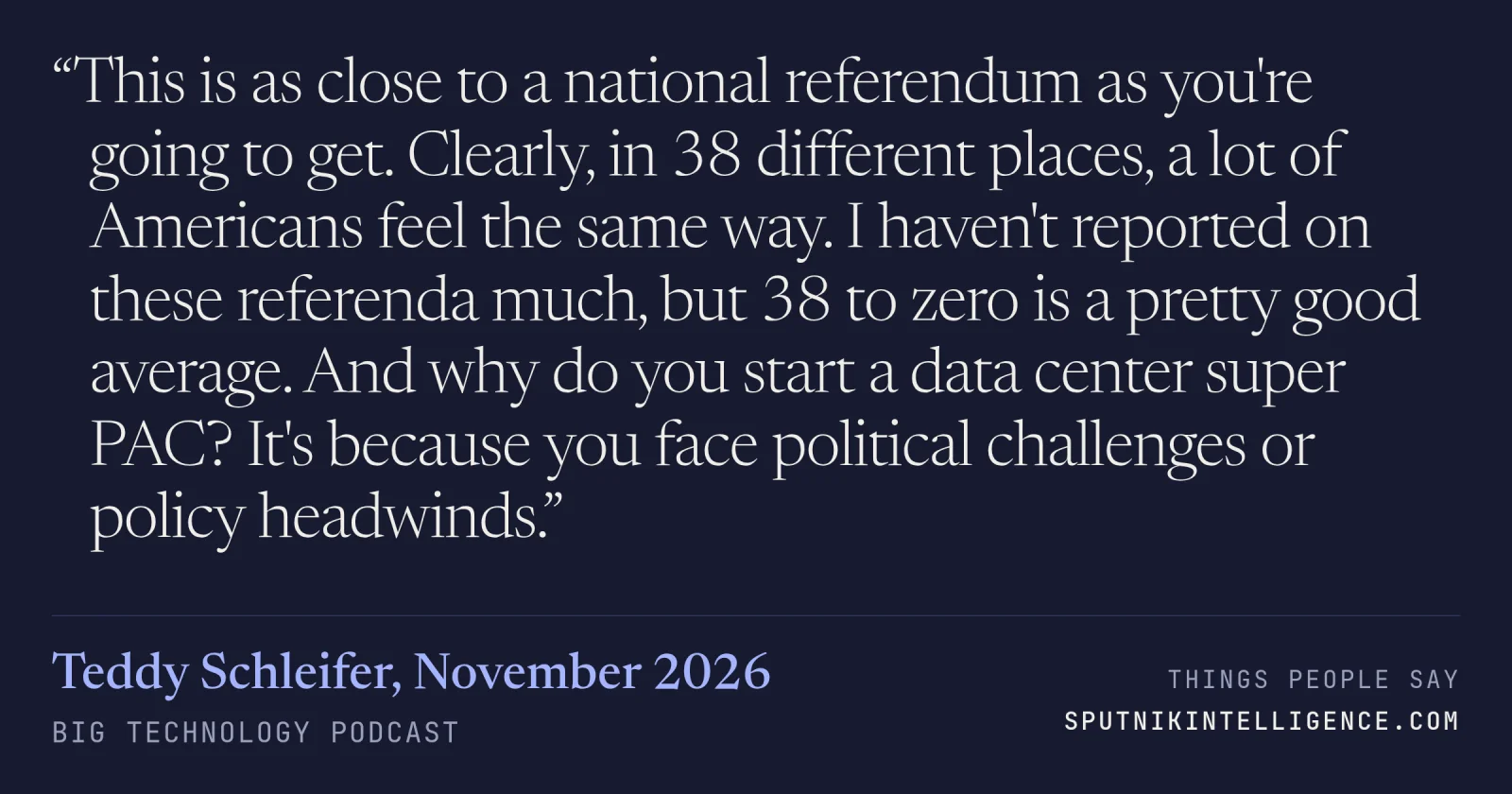
“This is as close to a national referendum as you're going to get. Clearly, in 38 different places, a lot of Americans feel the same way. I haven't reported on these referenda much, but 38 to zero is a pretty good average. And why do you start a data center super PAC? It's because you face political challenges or policy headwinds.” — Teddy Schleifer, Big Technology

The host had read a headline saying voters in at least 38 jurisdictions passed bans or restrictions on data centers. Schleifer reads it as a sign the political fight over AI is narrowing to data centers.

Big Technology · 2026-11-05 Permalink → Listen →
Big Technology Around 03:07 into the episode
Teddy Schleifer

…as the Republican majorities that this industry has enjoyed for the last two years. And, you know, just how bad it is, I don't totally know yet. But I think we're going to look back on the last year and a half as a bygone era when it was so unencumbered that we didn't appreciate it in the moment.

Alex Kantrowitz

…for bans or restrictions on data centers. So, on top of this wave, where by the way, they're probably going to be reading the tea leaves here, you have a massive amount of voters coming out and saying, we don't want data centers in our backyard. So, what do you think the implications are there?

Teddy Schleifer

Yeah, I mean, this is as close to a national referendum as you're going to get. I mean, this is obviously a brand new industry with where the politics are still being sorted out in real time. And clearly, a lot of Americans in 38 different places, at least, feel the same way. I haven't reported a ton on these different or at all on these referendum or referenda, but clearly 38 to zero is a pretty good average. I mean, we also saw for the first time this election, the data center industry do their own super PAC, which is kind of, I think, speaks to the ways in which the political winds are blowing here, which is that all of this political energy around AI Buildout? think, is going to be channeled much more narrowly into the next battle around data centers specifically, where why do you start a data center super PAC? It's because you face political challenges or policy headwinds. And the data center super PAC spent a bunch of money to try to help elect Darlene Graham in South Carolina. She did not win. And I think going forward, a lot of as a lot of these fights kind of take off, there's going to need to be money…

Alex Kantrowitz

Now, you're the world's preeminent reporter on how tech money influences politics. And thank you. It's true. It's true. Okay, folks, for those listening, Teddy and I are friends in case you can't figure it out, but it's really true. No one does it like you, Teddy. And I just want to hear your…

Teddy Schleifer

now. Yeah, I mean, look, the comeuppance here for the tech industry, I think, is still TBD. But clearly, like, I don't think we're appreciating just how good they had it. You know, on AI in particular, I mean, this was an administration that was very pliant to the industry. Trump is still going to…

Alex Kantrowitz

Okay. And as much as you can say, is the vibe around the people that you speak with, like, this is not going to be a big deal, or, or, oh, goodness, we're in trouble. Like, what is their basically condition state today?

Speaker names come from our own diarization. The position is estimated from where the line sits in the episode.
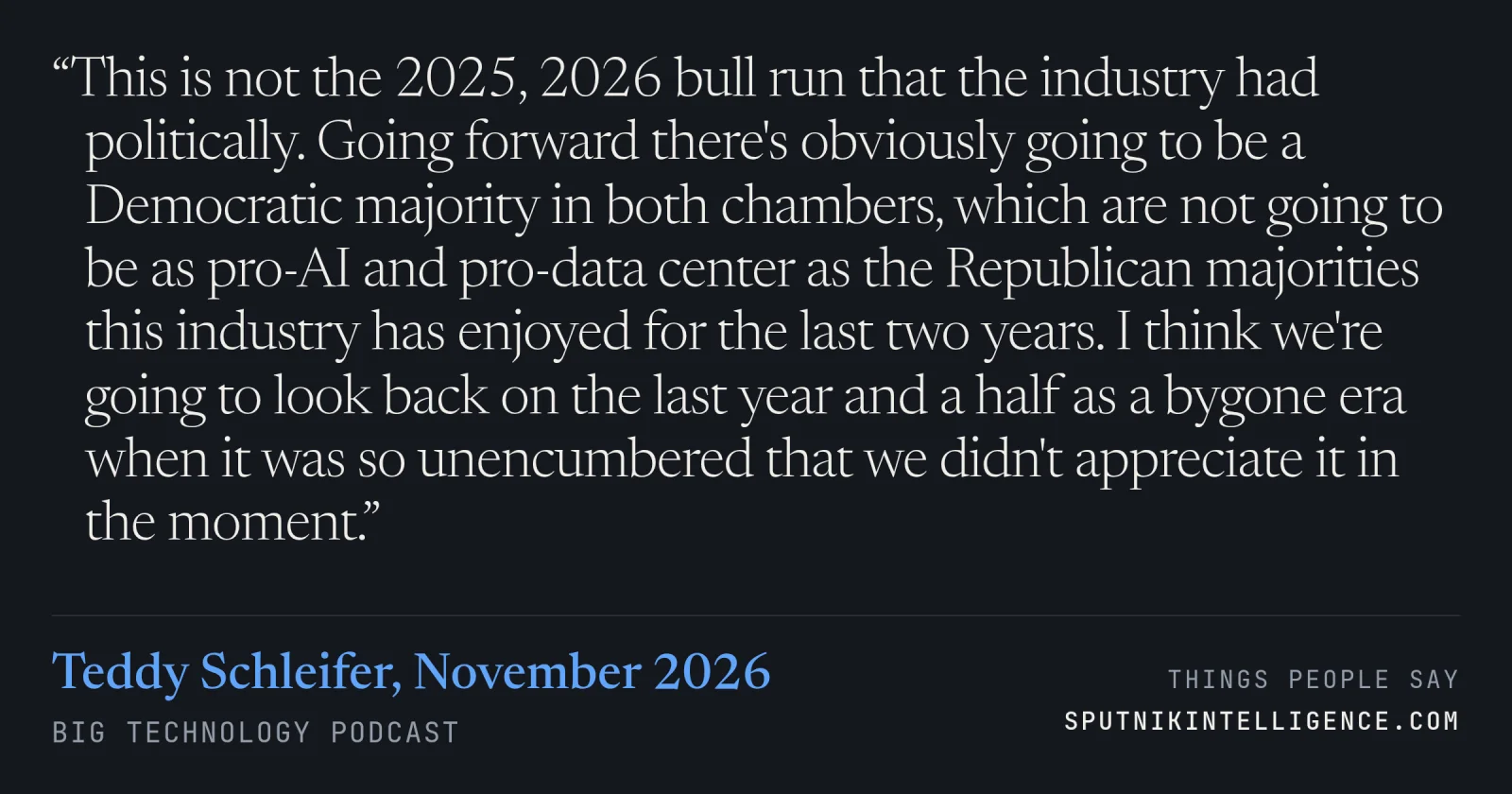
“This is not the 2025, 2026 bull run that the industry had politically. Going forward there's obviously going to be a Democratic majority in both chambers, which are not going to be as pro-AI and pro-data center as the Republican majorities this industry has enjoyed for the last two years. I think we're going to look back on the last year and a half as a bygone era when it was so unencumbered that we didn't appreciate it in the moment.” — Teddy Schleifer, Big Technology

Asked for his first reaction to the midterm results, the New York Times reporter on money in politics says the AI industry's friendly political climate is over.

Big Technology · 2026-11-05 Permalink → Listen →
Big Technology Around 01:52 into the episode
Teddy Schleifer

Thanks for having me.

Alex Kantrowitz

…lot of these candidates were talking about data centers. They're talking about AI safety in their victory speeches, like John Assof did, the Georgia senator, when he won on Tuesday. So what are the implications for the AI Buildout? out? And what's your broader reaction to what happened off the bat?

Teddy Schleifer

Yeah, I mean, it's clearly going to be a new time for the tech industry. I mean, this is not the 2025, 2026 bull run that the industry had politically. I mean, going forward, there is going to be obviously a Democratic majority in both chambers, which are going to be not as pro-AI and non-judge pro-data center as the Republican majorities that this industry has enjoyed for the last two years. And, you know, just how bad it is, I don't totally know yet. But I think we're going to look back on the last year and a half as a bygone era when it was so unencumbered that we didn't appreciate it in the moment.

Alex Kantrowitz

Now, for me, when I think about U.S. politics, I always think, well, the bark is typically louder than the bite, and especially regarding their regulation of tech and the rules they've applied to tech, they haven't really done much, even though there've been like clear excesses. Like all these…

Teddy Schleifer

Yeah, I mean, this is as close to a national referendum as you're going to get. I mean, this is obviously a brand new industry with where the politics are still being sorted out in real time. And clearly, a lot of Americans in 38 different places, at least, feel the same way. I haven't reported a…

Alex Kantrowitz

Now, you're the world's preeminent reporter on how tech money influences politics. And thank you. It's true. It's true. Okay, folks, for those listening, Teddy and I are friends in case you can't figure it out, but it's really true. No one does it like you, Teddy. And I just want to hear your…

Speaker names come from our own diarization. The position is estimated from where the line sits in the episode.

Collections They Appear In