 Steven Sinofsky
Ran Microsoft's Windows division for years before leaving the company in 2012, and now serves as a board partner at the venture firm Andreessen Horowitz (a16z).
Steven Sinofsky
Ran Microsoft's Windows division for years before leaving the company in 2012, and now serves as a board partner at the venture firm Andreessen Horowitz (a16z).
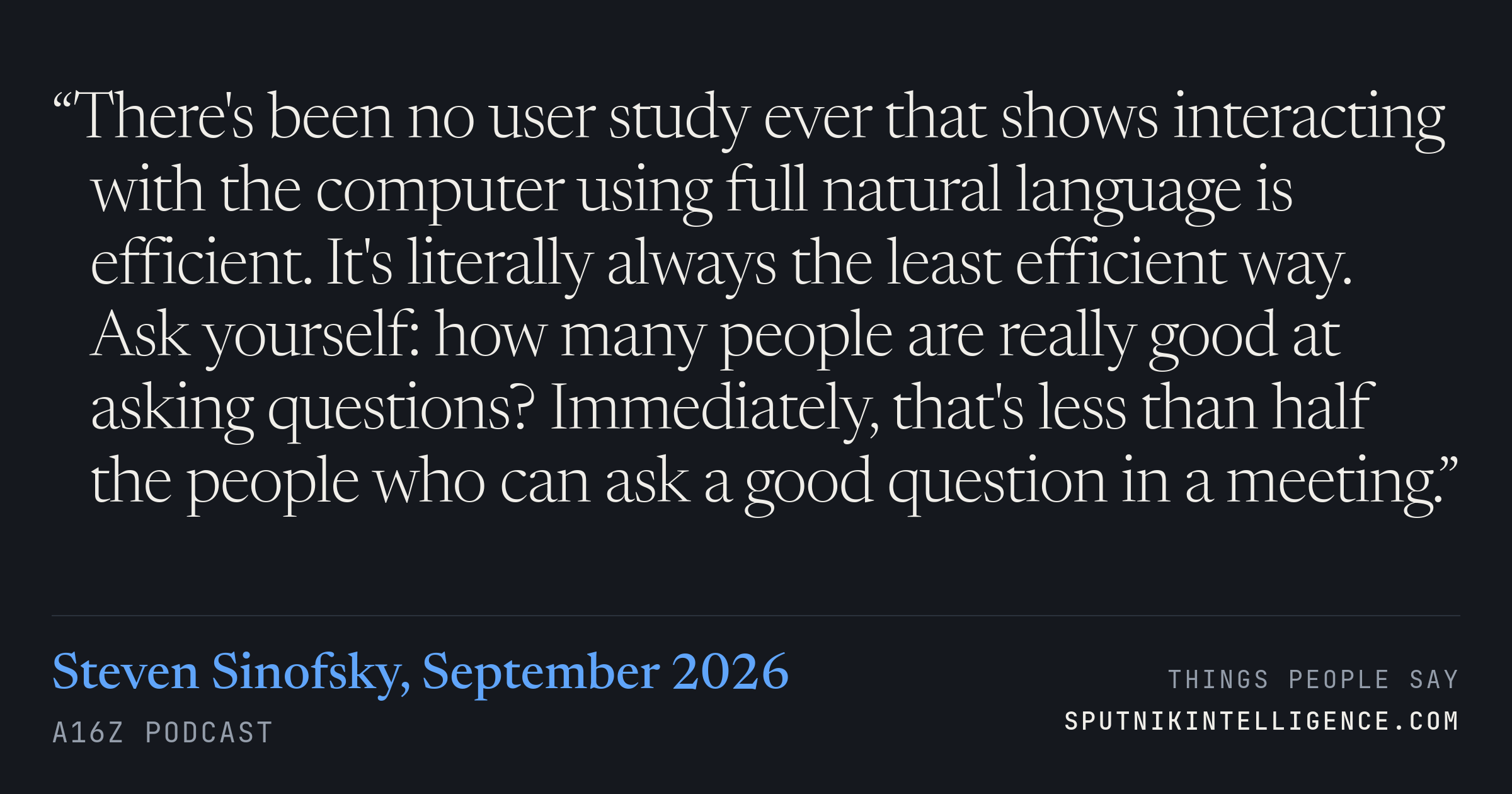
“There's been no user study ever that shows interacting with the computer using full natural language is efficient. It's literally always the least efficient way. Ask yourself: how many people are really good at asking questions? Immediately, that's less than half the people who can ask a good question in a meeting.”
a16z Podcast · Startups & Venture · September 2026
Sinofsky, who ran Windows at Microsoft, is enthusing about Vercel's Jev — a model that reads text but returns a choice from a set of options rather than generating prose, which makes it cheap to embed in ordinary software. His point is that chat was always the wrong default interface, and that what's coming back is probabilistic programming, which he notes was most of computer science before 1970.
Transcript
remarkable. Yeah.
Well, okay. So the way I think about it is, so, okay, so LLMs were kind of text in text out, right? They generate text. And they came from chat, right? It was to communicate with a human. And we've spent the last few years trying to take this thing that spits out text and cram it into a traditional program, right? And but traditional programs don't really speak text, right? And so then you end up doing this janky thing where you're like in the prompt, you're like, here's this demon, here's the schema. But the thing is generating text and it kind of ignores it. And it's just been super janky. And so what Jeff basically said is that, listen, you know, generating the text on the outside is a very expensive thing, but it's also kind of, you know, it's more complicated than you need. So why don't we, we, will, we'll, we'll read text and we'll have all of that kind of knowledge to read the text. But then rather than generating text, which is very expensive, we will just, if you give us a set of options, we'll choose the best option. We can do that incredibly, we can do it incredibly fast, incredibly cheaply, but also we can do it with much more accuracy because we can train just for this. And so for all of the use cases that are not talking to like a chat bot, but are actually trying to put it in traditional software, this is a great fit. And so this has probably been the fastest adoption of an AI model since ChatGPT. It's just been remarkable because we're all primed for this. I
just want to pile on this one because I. I can't tell you how much I love seeing this exact form of innovation. And because what it does is it does the thing that's bugged me from the very beginning, which is there's been no user study ever that shows like interacting with the computer using full natural language is efficient. It's like literally always the least efficient way. And it's very simple. And it's just like, ask yourself, how many people are asked, are really, really good at asking questions? And immediately that's like less than half the people can ask a good question in a meeting. And then how often do you look at the answer and get really frustrated before it's finished, but you have to pay all this money to watch the seven paragraphs come out and then apologize that it's only a little. And so that's one, like having a different model. And then the other, of course, is my favorite, which is the output of it is designed for probabilistic programming. And so instead of saying, like, is this a customer service question, then route to customer service, otherwise route to general help desk or whatever, it's like, well, this is 80% customer service. And that's exactly simulation. And it turns out there's like 50 years of computer science research in literally like probabilistic if statements. And so suddenly the coolest place to be in computer science is going to be in probabilistic programming, which was like all of computer science in the 1960s and 70s. So it was basically how do we, because all of computers started with doing math and it was all simulation. So it was like, let's launch the missile and hit that target, but it's windy, but wind isn't constant. So like, let's model the wind and decide where to put the thrusters in order to do the art. And so most programming through like, say, 1970, before it got to accounting, was probabilistic. And then we ruined everything. No, in accounting, there's no probability in accounting. But most programming was basically this modeling kind of thing. And so most programming language design was trying to figure out how to put probability into if statements or into while loops, like do this until something happens, maybe most of the time. And like, so my first CS class, like the very second assignment or so was a simulation about like waiting online at a store. And I didn't know it at the time. I actually looked all this up when I was reading about Jeb, which was like the whole thing was my professor was like wrote the book called the Theory of Simulation in like 1960. And I just didn't know that because it was kind of died by the 80s because it was all replaced by hyper. And so this notion of probabilistic and that slide deck you shared about the future of what's different about language models and stuff that you said was super good. Oh,
Halper Flanks one. That was phenomenal, Thomas. But the
part that
I felt was missing was that like, oh, wait, this is not all new. Like all of computer science was this probabilistic stuff. And so it's going to be very interesting to dust off all of that work because it's exactly what's going on. Like it's not an if statement now is if X percent, not if always. And so the way that Jev worked is just to like, you, you basically, it's a custom programming language almost, which is here's the prompt, come back with a percentage. Yeah,
More from a16z Podcast