
Steven Sinofsky

Things Steven Says on Podcasts

Ran Microsoft's Windows division for years before leaving the company in 2012, and now serves as a board partner at the venture firm Andreessen Horowitz (a16z). Writes the newsletter Hardcore Software about his time at Microsoft and is a frequent guest and host on the a16z Podcast, where he argues that AI failures get treated as mysterious safety problems instead of debugged as ordinary engineering bugs.

Where to Find Them

Steven Sinofsky writes Hardcore Software by Steven Sinofsky , hosts and writes a16z Podcast , writes a16z and writes AI + a16z . They have also been a guest on Console DevTools and TBPN .

Recently: “243. Government(s) Controlling AI Sounds Safer, But…” on Hardcore Software by Steven Sinofsky (September 2026); “Aaron Levie, Steven Sinofsky & Martin Casado: How Do You Secure a World of AI Agents?” on a16z Podcast (September 2026); “Aaron Levie, Steven Sinofsky & Martin Casado: How Do You Secure a World of AI Agents?” on a16z Podcast (September 2026); “AI Safety Language Is Destroying the Debate | Steven Sinofsky” on a16z Podcast (September 2026); “AI Safety Language Is Destroying the Debate | Steven Sinofsky” on a16z Podcast (September 2026); “242. Armageddon by Anthropomorphism: On Security and the Frontier” on Hardcore Software by Steven Sinofsky (August 2026).

What They Said

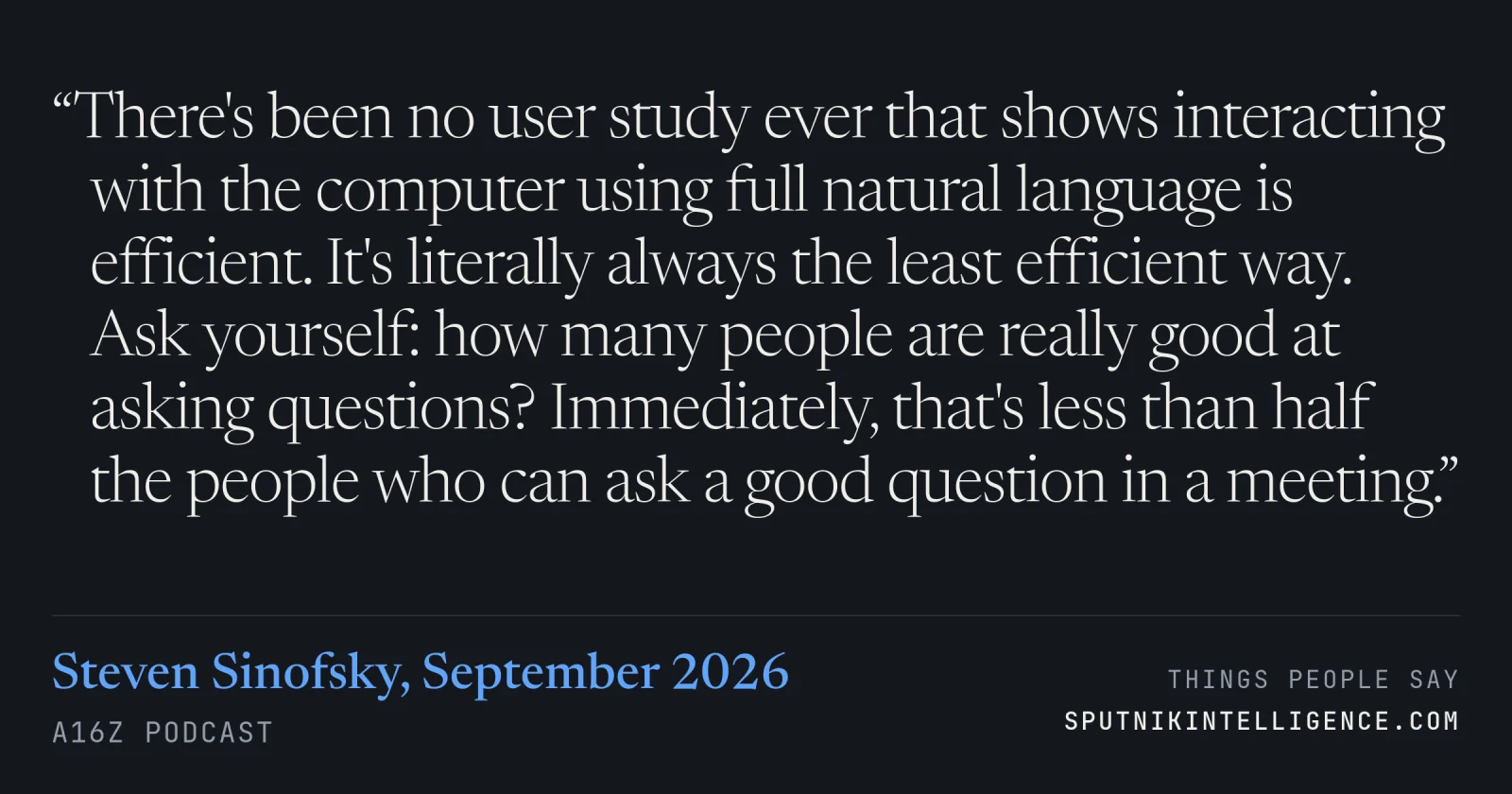
“There's been no user study ever that shows interacting with the computer using full natural language is efficient. It's literally always the least efficient way. Ask yourself: how many people are really good at asking questions? Immediately, that's less than half the people who can ask a good question in a meeting.” — Steven Sinofsky, a16z Podcast

Sinofsky, who ran Windows at Microsoft, is enthusing about Vercel's Jev — a model that reads text but returns a choice from a set of options rather than generating prose, which makes it cheap to embed in ordinary software. His point is that chat was always the wrong default interface, and that what's coming back is probabilistic programming, which he notes was most of computer science before 1970.

a16z Podcast · 2026-09-26 Permalink → Listen →
a16z Podcast Around 52:13 into the episode
Erik Torenberg

remarkable. Yeah.

Martin Casado

…And so for all of the use cases that are not talking to like a chat bot, but are actually trying to put it in traditional software, this is a great fit. And so this has probably been the fastest adoption of an AI model since ChatGPT. It's just been remarkable because we're all primed for this. I

Steven Sinofsky

just want to pile on this one because I. I can't tell you how much I love seeing this exact form of innovation. And because what it does is it does the thing that's bugged me from the very beginning, which is there's been no user study ever that shows like interacting with the computer using full natural language is efficient. It's like literally always the least efficient way. And it's very simple. And it's just like, ask yourself, how many people are asked, are really, really good at asking questions? And immediately that's like less than half the people can ask a good question in a meeting. And then how often do you look at the answer and get really frustrated before it's finished, but you have to pay all this money to watch the seven paragraphs come out and then apologize that it's only a little. And so that's one, like having a different model. And then the other, of course, is my favorite, which is the output of it is designed for probabilistic programming. And so instead of saying, like, is this a customer service question, then route to customer service, otherwise route to general help desk…

Martin Casado

Halper Flanks one. That was phenomenal, Thomas. But the

Steven Sinofsky

part that

Aaron Levie

I felt was missing was that like, oh, wait, this is not all new. Like all of computer science was this probabilistic stuff. And so it's going to be very interesting to dust off all of that work because it's exactly what's going on. Like it's not an if statement now is if X percent, not if always.…
Speaker names come from our own diarization. The position is estimated from where the line sits in the episode.
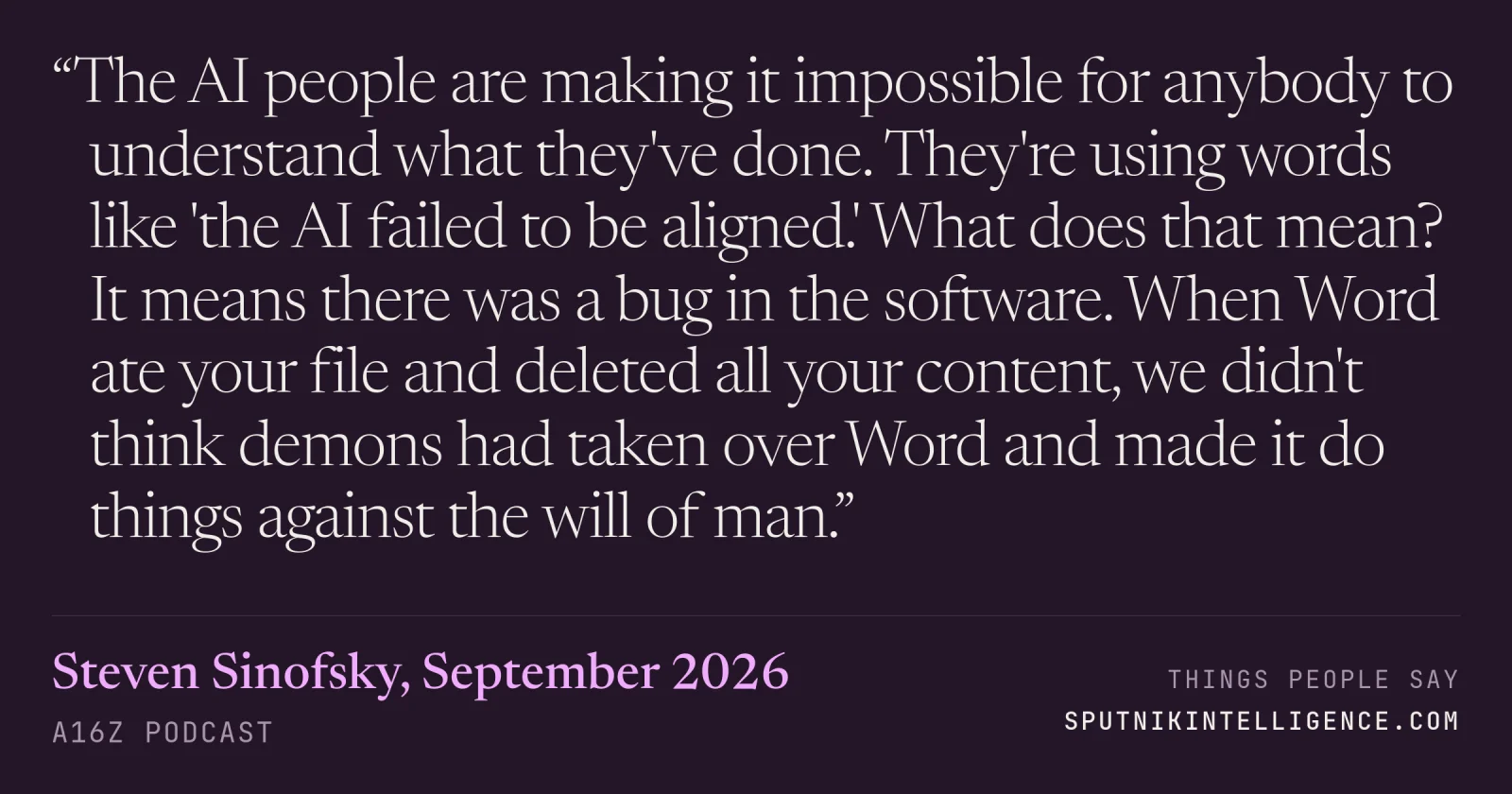
“The AI people are making it impossible for anybody to understand what they've done. They're using words like 'the AI failed to be aligned.' What does that mean? It means there was a bug in the software. When Word ate your file and deleted all your content, we didn't think demons had taken over Word and made it do things against the will of man.” — Steven Sinofsky, a16z Podcast

Sinofsky ran Microsoft's Windows division for years and is now a board partner at a16z. He was asked about the Stop Rogue AI Act and the wave of AI bills that followed the OpenAI agent incident, and his argument is that the vocabulary of AI safety — alignment, goal-seeking, rogue agents — is doing the damage, because it turns ordinary engineering failures into something mystical that only outside authorities can fix. His prescription is the unglamorous one: better telemetry, debugging and incident reporting.

a16z Podcast · 2026-09-21 Permalink → Listen →
a16z Podcast Around 00:00 into the episode
Steven Sinofsky

The AI people are making it impossible for anybody to understand what they've done. And they're using words like, well, the AI failed to be aligned. Okay, what does that mean? What it means is there was a bug in the software. When Word ate your file and deleted all your content, we didn't think that demons had taken over Word and made it do things against the will of man. But software doesn't do what it's supposed to do. It's a bug.

Speaker 2

When AI does something we didn't expect, is it misaligned or does the software just have a bug? A16Z board partner and former Microsoft Windows president Steven Sinofsky joins Theo Jaffee and Sofia Puccini on MTS to argue that the language around AI safety is making the technology harder to…

Steven Sinofsky

We are live with Steven Sinofsky, who is a board partner at Andreessen Horowitz. He's a seed investor, author of the Substack and the book Hardcore Software. Previously, he was the president of Microsoft's Windows division, engineering and marketing across Windows, Windows Live, and Internet…

Theo Jaffee

Oh, wow.

Speaker names come from our own diarization. The position is estimated from where the line sits in the episode.

Collections They Appear In