 Jay Van Bavel
Psychology Professor and Director of the Center for Conflict & Cooperation at New York University | Author of "The Power Of Us" book & newsletter @powerofus
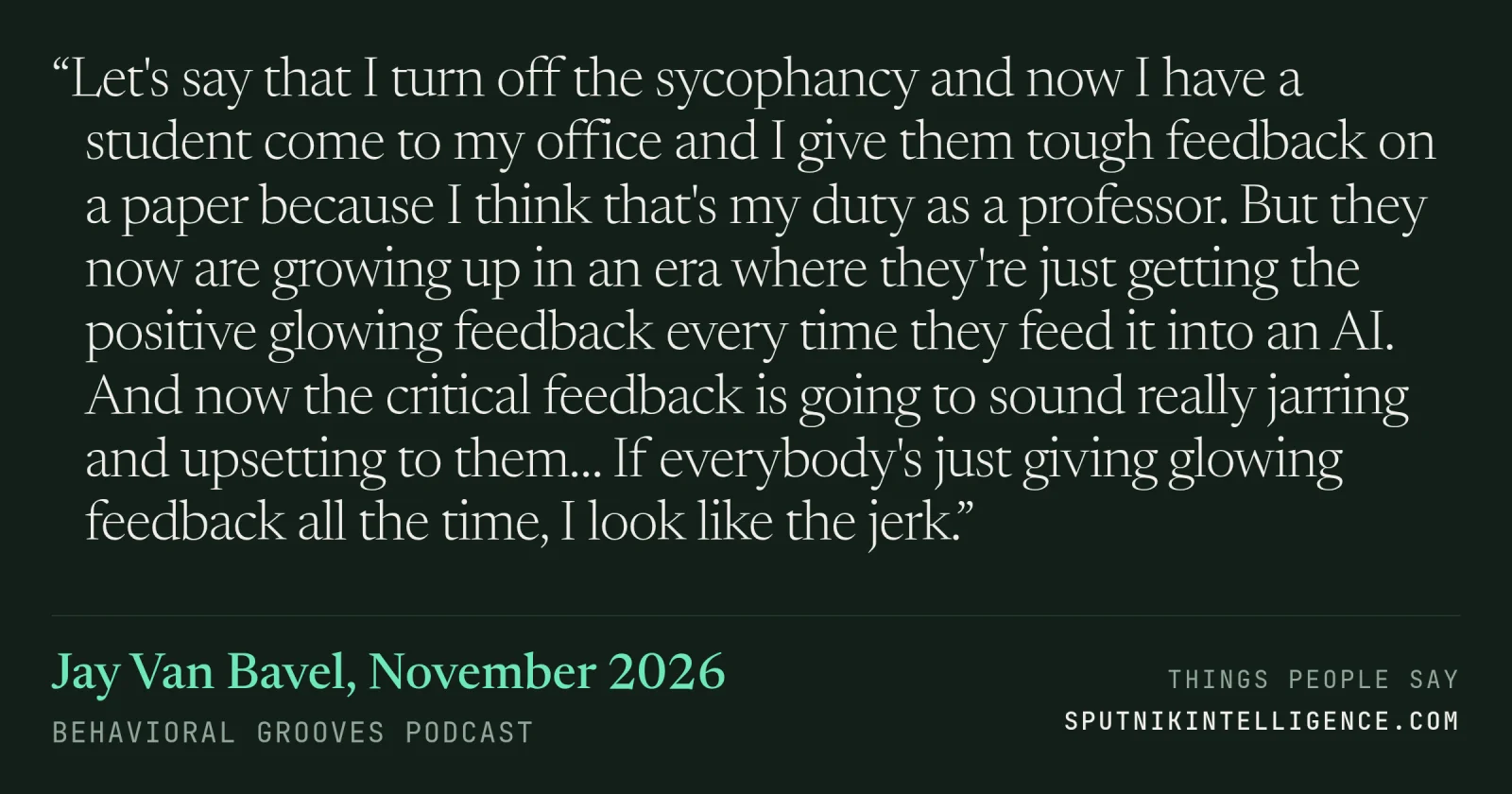
“Let's say that I turn off the sycophancy and now I have a student come to my office and I give them tough feedback on a paper because I think that's my duty as a professor. But they now are growing up in an era where they're just getting the positive glowing feedback every time they feed it into an AI. And now the critical feedback is going to sound really jarring and upsetting to them… If everybody's just giving glowing feedback all the time, I look like the jerk.”
Behavioral Grooves Podcast · November 2026
Context
Asked whether pushing back individually is just holding back the tide, Jay calls AI sycophancy a collective action problem, like grade inflation, where the honest person gets punished.
Transcript
I don't know. It feels like a tsunami, or the metaphor I often use is like trying to bail out the Titanic with a bucket.
But a really nice bucket.
So that's why I say, like, okay, so let's go to like a single design feature like sycophancy. Yeah. I can fix it for myself. But if I'm the only one at my workplace or my university that does that, I'm going to be drowned by a bunch of people who are being told that they're brilliant. And when I challenge, here's the other downside of sycophancy. Okay, so let's say now it's collect, I like to think in terms of group dynamics. So let's say that I turn off the sycophancy and now I have a student come to my office and I give them tough feedback on a paper or a project because I think that's my duty as a professor. And it might be something I've been doing for 16 years, but they now are growing up in an era where they're just getting the positive glowing feedback every time they feed it into an AI. And now the critical feedback is going to sound really jarring and upsetting to them. And so it, and then they're going to be mad at me. This happens with teaching evaluations. Students, and we have mass grade inflation. It's a collective action problem because now if everybody's giving grade inflation and I give accurate, tough grades, I'll get punished on my teaching evaluations and that they'll post those online on Rate My Professor and my reputation will…
Okay. If we're not going to fix it on our own, where do you think we end up? What's the trajectory on social norms around this stuff?
I mean, this is, that's what I worry about: the norms change. So if the norms are. Dude, we get to
a point where like there's nobody has roommates, nobody's having sex, everybody's living alone, everybody's working from home. Well, I'll just tell you,
More from Behavioral Grooves Podcast