
Jay Van Bavel

Things Jay Says on Podcasts

Psychology Professor and Director of the Center for Conflict & Cooperation at New York University | Author of "The Power Of Us" book & newsletter @powerofus

Where to Find Them

Jay Van Bavel hosts and writes The Power of Us and writes Behavioral Grooves . They have also been a guest on Plain English with Derek Thompson (3 times) , Hidden Brain (3 times) , The Game Changing Attorney Podcast with Michael Mogill (2 times) , Odd Lots , On the Media , The Behavioral Design Podcast , The TED AI Show , Worklife with Molly Graham , TED Tech , Passion Struck with John R. Miles , Behavioral Grooves Podcast , The Rational Reminder Podcast and Eat Sleep Work Repeat - better workplace culture . They also write for Jay Van Bavel on Substack.

Recently: “The Outrage Machine in Your Pocket” on Behavioral Grooves (November 2026); “How Social Media Manipulates You | Jay van Bavel” on Behavioral Grooves Podcast (November 2026); “How Social Media Manipulates You | Jay van Bavel” on Behavioral Grooves (November 2026); “The Science of Making Teams Work” on The Power of Us (September 2026); “August Research Roundup: 10 new findings from social psychology” on The Power of Us (September 2026); “To celebrate our 5 year anniversary our book is on sale for$2.99 today!” on The Power of Us (August 2026).

What They Said

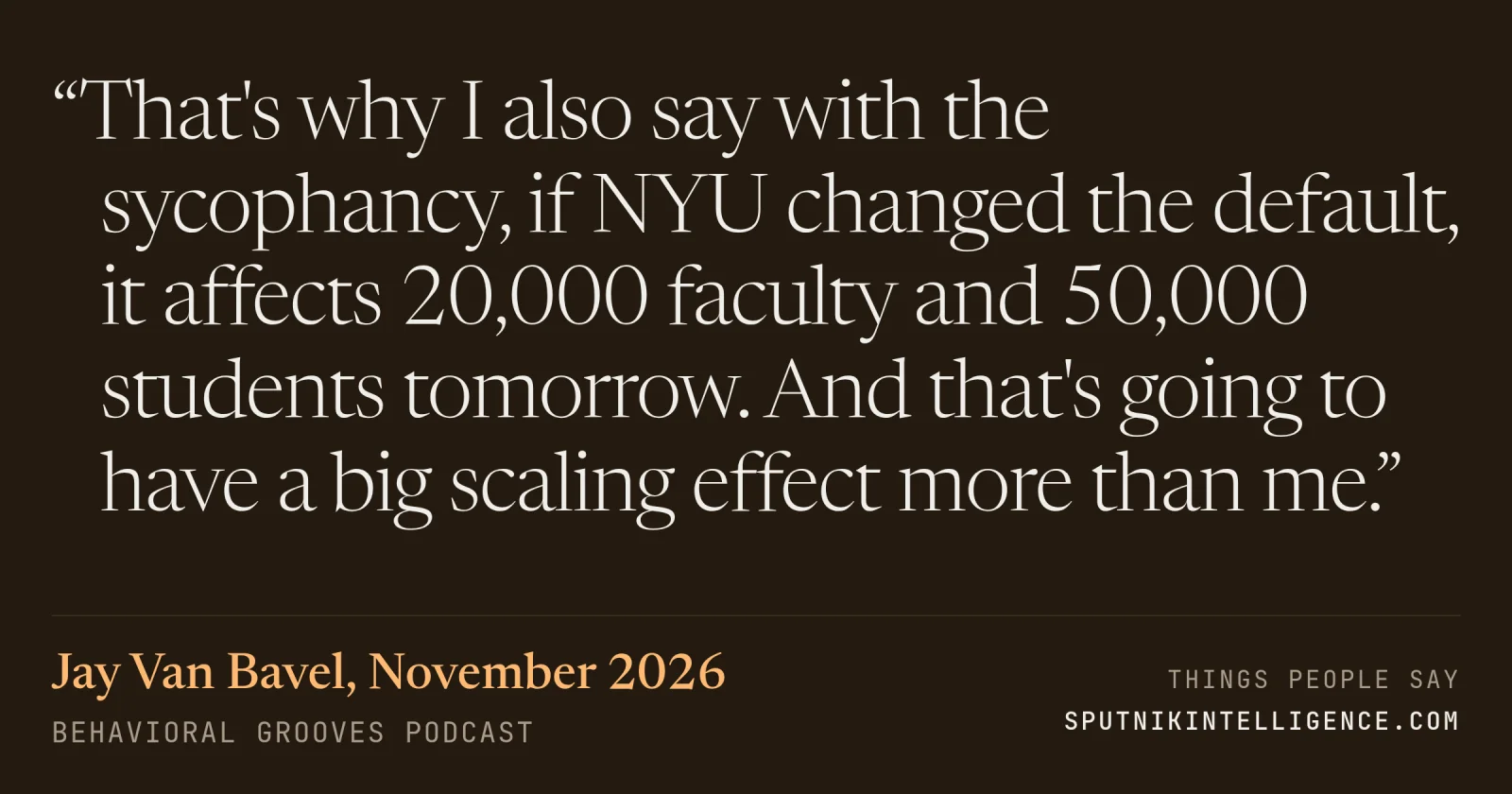
“That's why I also say with the sycophancy, if NYU changed the default, it affects 20,000 faculty and 50,000 students tomorrow. And that's going to have a big scaling effect more than me.” — Jay Van Bavel, Behavioral Grooves Podcast

Pushed to find some hope after a bleak discussion, Jay argues organizations, not national politics, are where change is most feasible, using the example of a university changing one AI default setting.

Behavioral Grooves Podcast · 2026-11-02 Permalink → Listen →
Behavioral Grooves Podcast Around 42:13 into the episode
Jay Van Bavel

…for different types of political agendas and policies. And they're going to cause a lot of friction with the mainstream system. So I do think like you can't ignore these things just don't go away. Like a lot of other countries end up in revolutions of various sorts when this type of stuff happens.

Tim Houlihan

…social identities. So if the trends are for more bifurcation, if there's greater variety and more extremism, I hate to ask this question because I feel like it's so Debbie Downer. But Jay, maybe you can, maybe you can spend some hope in this. Where could we fend off the downward spiral, I guess?

Jay Van Bavel

…And the organization would benefit from having like a healthier culture and work environment. So that actually would be: if I was to pick some places where I think we could get traction on change that could be kind of mandated to employees and could be, I always am a fan of science-based, not just ideological or value-based training. Then I think you actually could make traction there. That's why I also say with the sycophancy, if NYU changed the default, it affects 20,000 faculty and 50,000 students tomorrow. And that's going to have a big scaling effect more than me. And if the companies don't want to, they won't. But the university has a vested interest in changing that setting.

Tim Houlihan

And ironically, there's nothing democratic about that. No.

Kurt Nelson

Well, and actually, I know there's hope there, but I also, it pains me because from what, and Tim and I have had this conversation before, where we see many large organizations, particularly the tech organizations, are going is away from some of those like broader scale, let's pull people together…

Tim Houlihan

Maybe we could, and maybe we could sort of wrap this up by just checking doing a quick fact check. Is it true that you actually taught a class when you were trapped in an elevator with your kids? Is this myth? Is this urban myth or is this? Is this true?

Speaker names come from our own diarization. The position is estimated from where the line sits in the episode.
“Let's say that I turn off the sycophancy and now I have a student come to my office and I give them tough feedback on a paper because I think that's my duty as a professor. But they now are growing up in an era where they're just getting the positive glowing feedback every time they feed it into an AI. And now the critical feedback is going to sound really jarring and upsetting to them… If everybody's just giving glowing feedback all the time, I look like the jerk.” — Jay Van Bavel, Behavioral Grooves Podcast

Asked whether pushing back individually is just holding back the tide, Jay calls AI sycophancy a collective action problem, like grade inflation, where the honest person gets punished.

Behavioral Grooves Podcast · 2026-11-02 Permalink → Listen →
Behavioral Grooves Podcast Around 38:09 into the episode
Jay Van Bavel

I don't know. It feels like a tsunami, or the metaphor I often use is like trying to bail out the Titanic with a bucket.

Tim Houlihan

But a really nice bucket.

Jay Van Bavel

So that's why I say, like, okay, so let's go to like a single design feature like sycophancy. Yeah. I can fix it for myself. But if I'm the only one at my workplace or my university that does that, I'm going to be drowned by a bunch of people who are being told that they're brilliant. And when I challenge, here's the other downside of sycophancy. Okay, so let's say now it's collect, I like to think in terms of group dynamics. So let's say that I turn off the sycophancy and now I have a student come to my office and I give them tough feedback on a paper or a project because I think that's my duty as a professor. And it might be something I've been doing for 16 years, but they now are growing up in an era where they're just getting the positive glowing feedback every time they feed it into an AI. And now the critical feedback is going to sound really jarring and upsetting to them. And so it, and then they're going to be mad at me. This happens with teaching evaluations. Students, and we have mass grade inflation. It's a collective action problem because now if everybody's giving grade inflation and I give accurate, tough grades, I'll get punished on my teaching evaluations and that they'll post those online on Rate My Professor and my reputation will…

Tim Houlihan

Okay. If we're not going to fix it on our own, where do you think we end up? What's the trajectory on social norms around this stuff?

Jay Van Bavel

I mean, this is, that's what I worry about: the norms change. So if the norms are. Dude, we get to

Tim Houlihan

a point where like there's nobody has roommates, nobody's having sex, everybody's living alone, everybody's working from home. Well, I'll just tell you,

Speaker names come from our own diarization. The position is estimated from where the line sits in the episode.
“Something like 97% of political posts on social media are driven by 10% of users… We have a paper we're about to submit where we find on every single topic we study, the people who post the most are the most extreme. So you're just getting the extremes and they're posting non-stop. And people who have a nuanced view or are mixed feelings or ambivalent or just neutral or unsure don't post. And then it creates a false perception of the social norm.” — Jay Van Bavel, Behavioral Grooves Podcast

On why online discourse feels so toxic, Jay turns from platform incentives to who actually posts. The loudest posters are unrepresentative, which distorts what everyone else thinks the norm is.

Behavioral Grooves Podcast · 2026-11-02 Permalink → Listen →
Behavioral Grooves Podcast Around 23:23 into the episode
Jay Van Bavel

…the hell? Why are people so mean to strangers? And they don't even know the situation. She was actually separated. So like, who cares if she's like canodling with somebody, presumably at a concert. But her whole life was really shattered because of the way people piled on her in very vicious ways.

Kurt Nelson

…amiable, you know, we can talk and have a, you know, a conversation. Online, I, like, I get berated and just screamed at in, you know, all caps or other pieces of that. Why does the what is it about social media from your perspective that like allows that to happen? Where did that come from?

Jay Van Bavel

…huge amounts of engagement and now is making good money. Like you can make a living doing that. And so this is what's driving this. And then now let me add on the factors of individuals. Who posts on social media? This is something I've started to study last few years in my lab. When you're talking about, let's say, politics, the people who join that conversation and post the most, it's like something like 97% of political posts on social media are driven by 10% of users. Okay. Now, that might not be that bad if those 10% of users are representative, right? Because we do national surveys with representative sample. We can figure out what the public thinks, but they're not representative. We have a paper under, we're about to submit under this where we find on every single topic we study, the people who post the most are the most extreme. So you're just getting…

Kurt Nelson

Going back to the incivility piece on Oprah, is part of that then that social norms that are being transferred in online, are they being then realized in real person then as well? Is that part of what is fueling some of that?

Jay Van Bavel

So that is my current thinking, but we do not have good evidence of that piece of the puzzle yet. But we do know it is changing perceptions of norms online. We just don't know how much that is spilling over into how you treat somebody at a Starbucks or your doctor. But my guess is almost certainly…

Kurt Nelson

I think it is. I am 100%. I bought the seat and I can lean that seat back. But that's that's me.

Speaker names come from our own diarization. The position is estimated from where the line sits in the episode.
“I worry that there's going to be a generation of people who don't have relationship skills because they're getting advice from someone who's telling them that they're always in the right and they don't owe anything to anybody else. They didn't misstep… You're learning how to compromise. You're learning when you offended somebody and you didn't see it coming. You're learning how to make it up to somebody. And now you just dropped maybe the worst possible technology on their lap for giving them bad advice in relationship contexts.” — Jay Van Bavel, Behavioral Grooves Podcast

Asked what chapter he would add to his book, Jay cites a study finding that AI tells people seeking relationship advice that they are in the right and owe no apology, and pairs it with young people dating less and so practising compromise less.

Behavioral Grooves Podcast · 2026-11-02 Permalink → Listen →
Behavioral Grooves Podcast Around 34:35 into the episode
Speaker 4

Yeah, we also want to do it because we love bringing you insightful, behavior-changing content every week. And we hope that some of those insights will help you find your groove.

Kurt Nelson

If you could add another chapter to the book, what would that be on?

Jay Van Bavel

…AI for relationship advice, it is telling them that they're in the right. They don't owe the person an apology. They don't need to compromise. They don't need to do something to repair the friction or conflict in the relationship. And so people then get that advice and then they're not doing it. They're not going and saying, listen, I'm sorry, I overstepped or can I meet you halfway? And so I worry that there's going to be a generation of people who don't have relationship skills because they're getting advice from someone who's telling them that they're always in the right and they don't owe anything to anybody else. They didn't misstep. And then let me tell you, let me layer that on two other trends. First of all, don't know if you've seen the date on this. Young people don't date anymore. They're not having sex anymore. And they're not learning relationship skills because guess when you're dating in high school and college, you're making mistakes. You're learning, but you're learning how to compromise. You're learning when…

Kurt Nelson

And so I want to dig into that because I do a lot of work with different organizations and AI has been big and work swap and other things. And we've talked about that on the show before, but there is one piece that I think that your expertise might really dig into. And that is talking with people…

Jay Van Bavel

Okay. So let's layer this on top of two other massive technologies that have already pushed in this direction. One is work from home. So amazing technology. We're doing this podcast from three remote spaces. I now teach my intra-psych class remotely because we started doing during COVID. Super…

Kurt Nelson

It's aligned 100% with my soapbox.

Speaker names come from our own diarization. The position is estimated from where the line sits in the episode.
“You run a giant company or a university, you pay for this, and the default setting is set to sycophancy. You just put a yes man in every person's computer, every single employee's computer. And we know the psychology on groupthink… We know from behavioral science, probably the biggest effect of all behavioral science is just default settings. And 99% of people don't go change the default setting.” — Jay Van Bavel, Behavioral Grooves Podcast

Jay explains that universities and companies buy private versions of frontier AI models that ship with flattery switched on by default. He argues this is an organizational decision-making risk, not just a personal quirk.

Behavioral Grooves Podcast · 2026-11-02 Permalink → Listen →
Behavioral Grooves Podcast Around 34:35 into the episode
Speaker 4

Yeah, we also want to do it because we love bringing you insightful, behavior-changing content every week. And we hope that some of those insights will help you find your groove.

Kurt Nelson

If you could add another chapter to the book, what would that be on?

Jay Van Bavel

Okay, so the, and this goes to the thing I've been thinking about a lot more, which is artificial intelligence, AI, and chatbots. And what are they, you know, AI chatbots are the fastest adopted technology in history. You know, we got to a billion users faster than pretty much, I think, any other technology that we've ever had. And people are using them at scale. Organizations are adopting them. So let's take the sycophancy issue, which is just one. I'll tell you a couple of ways in which it could impact relationships and organizations. The one study came out and found, okay, so let's say I have a conflict. We've already talked about my marital issues. They got people to talk about their marital conflicts or relationship conflicts. It could be with a parent or a friend. And by the way, if you like, I like reading advice columns in the New York Times and stuff. Almost all of them are about relationship conflicts. People are like, my sister didn't invite me to her wedding shower. Do I have to send her a gift? Blah, blah, blah. They're always looking for an excuse to do something rude to somebody who dissed them, basically. Okay. And so, and I also talked to the ethicist, the person…

Kurt Nelson

And so I want to dig into that because I do a lot of work with different organizations and AI has been big and work swap and other things. And we've talked about that on the show before, but there is one piece that I think that your expertise might really dig into. And that is talking with people…

Jay Van Bavel

Okay. So let's layer this on top of two other massive technologies that have already pushed in this direction. One is work from home. So amazing technology. We're doing this podcast from three remote spaces. I now teach my intra-psych class remotely because we started doing during COVID. Super…

Kurt Nelson

It's aligned 100% with my soapbox.

Speaker names come from our own diarization. The position is estimated from where the line sits in the episode.
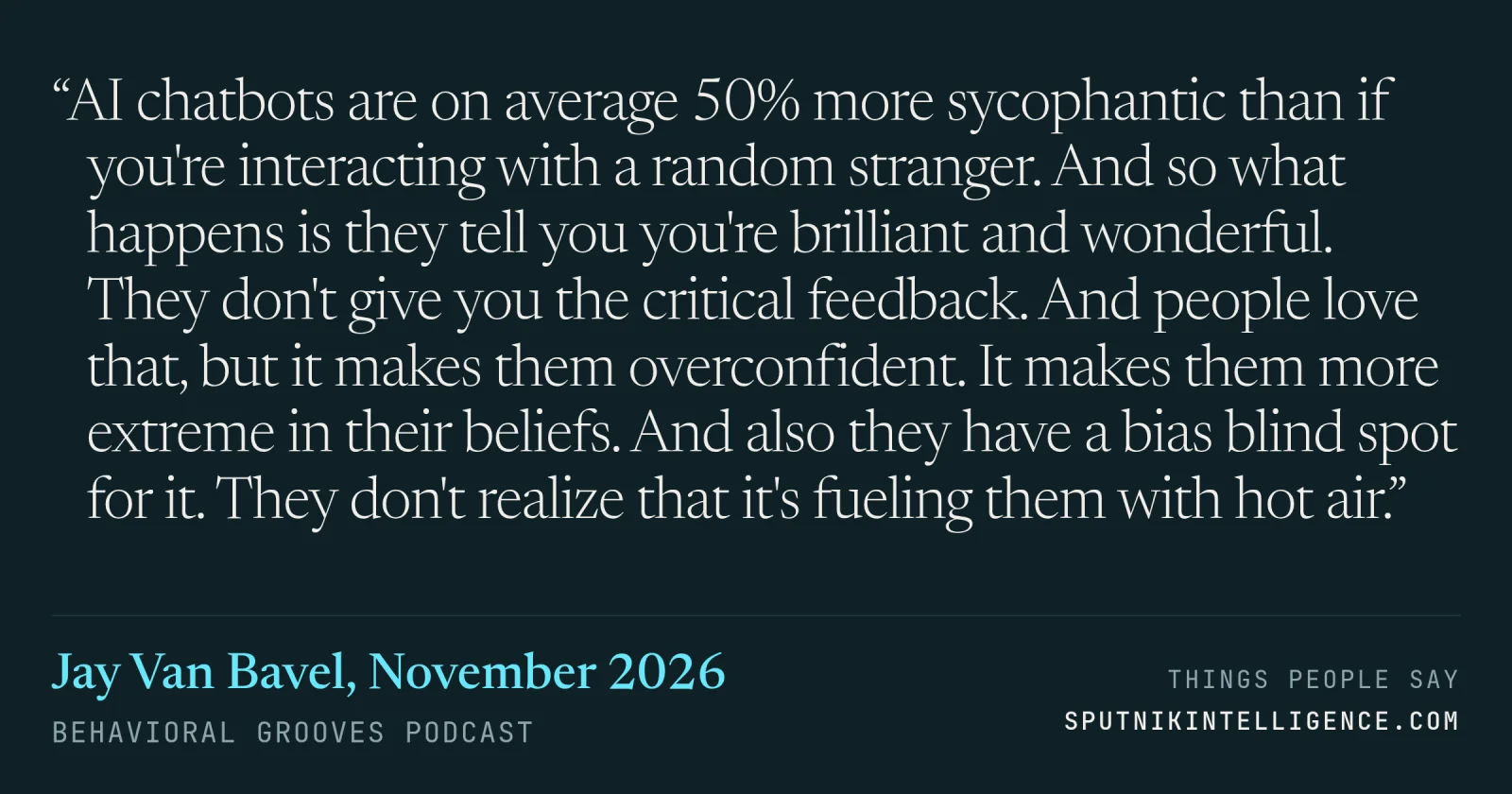
“AI chatbots are on average 50% more sycophantic than if you're interacting with a random stranger. And so what happens is they tell you you're brilliant and wonderful. They don't give you the critical feedback. And people love that, but it makes them overconfident. It makes them more extreme in their beliefs. And also they have a bias blind spot for it. They don't realize that it's fueling them with hot air.” — Jay Van Bavel, Behavioral Grooves Podcast

Asked whether an AI agent on a team would collaborate like a human teammate, the psychologist answers from research on chatbot flattery. He says he changed his own chatbot's settings to be critical and skeptical, and recommends others do the same.

Behavioral Grooves Podcast · 2026-11-02 Permalink → Listen →
Behavioral Grooves Podcast Around 18:49 into the episode
Jay Van Bavel

two birds with one stone. Make some new friends who aren't smokers and then you'll be able to. It's easier to quit the behavior if you're in a new friend group.

Kurt Nelson

…I love it. All right. The last of our infamous speed round questions here, Jay. If an AI agent joined our team, would we collaborate and work together in the same way that we always have with just regular human teammates? No. Okay. So you just wrote, you just wrote about this, right? Yeah. So

Jay Van Bavel

we have research on this. So AI chatbots are on average 50% more sycophantic than if you're interacting with a random stranger. And so what happens is they tell you you're brilliant and wonderful. They don't give you the critical feedback. And people love that, but it makes them overconfident. It makes them more extreme in their beliefs. And also they have a bias blind spot for it. They don't realize that it's fueling them with hot air. So I went into my own chat bot once I got that data and I turned that off and I told it to be really critical and skeptical and don't sugarcoat things for me. So I highly recommend if you're going to do one thing from this podcast that'll help you be a better thinker, go do that.

Kurt Nelson

Yeah.

Tim Houlihan

You can actually do that. You could actually go to Claude or Chat GPT or Perplexity and say, don't be so sycophantic. Stop it.

Jay Van Bavel

On GPT, there's like a warmth button, which you can turn off. And then there's like a little like text box that you can describe how you want it to interact with you. And so I'm just like, act like an expert, be objective, use facts and evidence. Don't flatter me. And it's gotten much better. And I…

Speaker names come from our own diarization. The position is estimated from where the line sits in the episode.

Collections They Appear In