 Jay Van Bavel
Psychology Professor and Director of the Center for Conflict & Cooperation at New York University | Author of "The Power Of Us" book & newsletter @powerofus
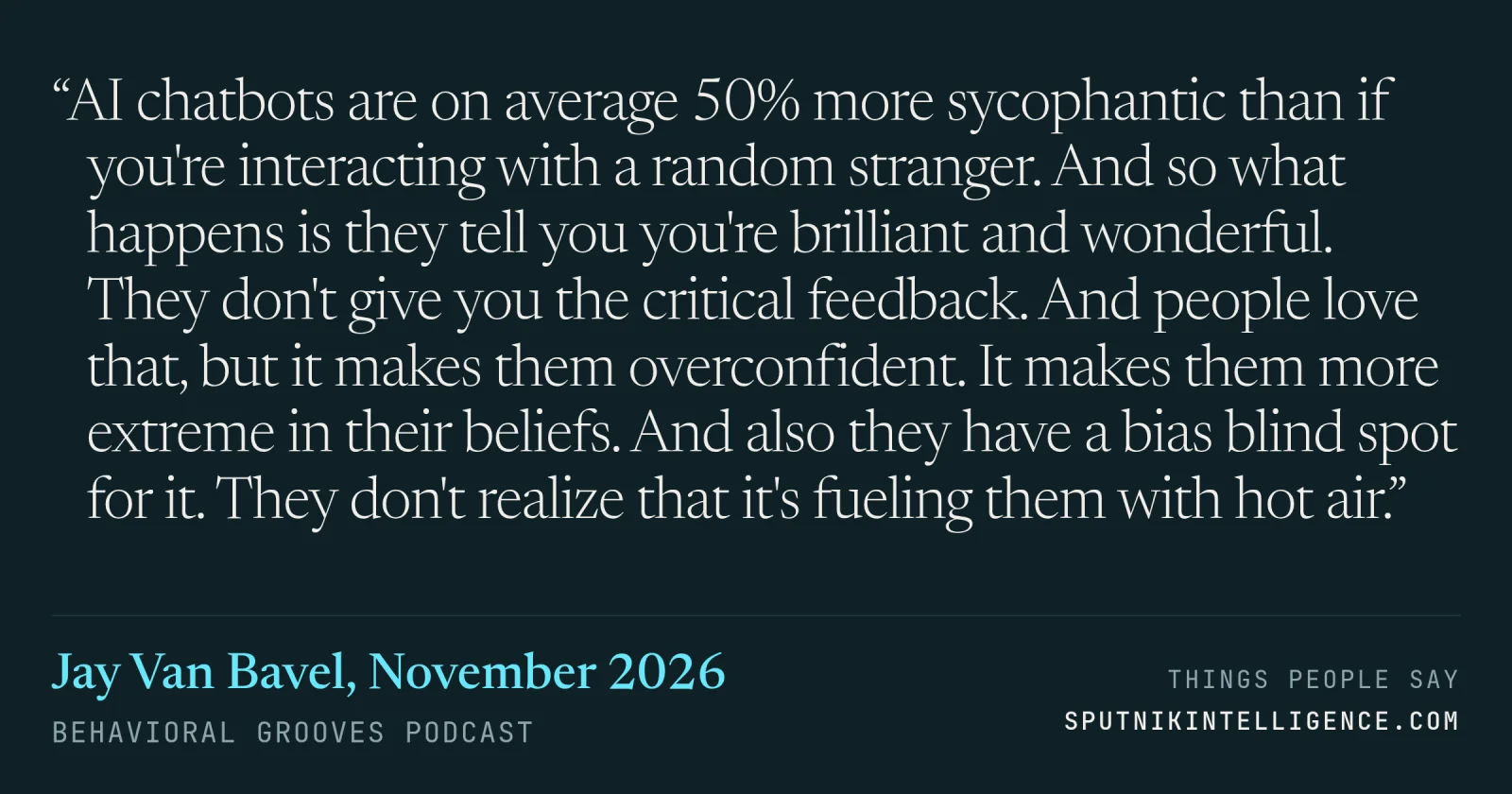
“AI chatbots are on average 50% more sycophantic than if you're interacting with a random stranger. And so what happens is they tell you you're brilliant and wonderful. They don't give you the critical feedback. And people love that, but it makes them overconfident. It makes them more extreme in their beliefs. And also they have a bias blind spot for it. They don't realize that it's fueling them with hot air.”
Behavioral Grooves Podcast · November 2026
Context
Asked whether an AI agent on a team would collaborate like a human teammate, the psychologist answers from research on chatbot flattery. He says he changed his own chatbot's settings to be critical and skeptical, and recommends others do the same.
Transcript
two birds with one stone. Make some new friends who aren't smokers and then you'll be able to. It's easier to quit the behavior if you're in a new friend group.
…I love it. All right. The last of our infamous speed round questions here, Jay. If an AI agent joined our team, would we collaborate and work together in the same way that we always have with just regular human teammates? No. Okay. So you just wrote, you just wrote about this, right? Yeah. So
we have research on this. So AI chatbots are on average 50% more sycophantic than if you're interacting with a random stranger. And so what happens is they tell you you're brilliant and wonderful. They don't give you the critical feedback. And people love that, but it makes them overconfident. It makes them more extreme in their beliefs. And also they have a bias blind spot for it. They don't realize that it's fueling them with hot air. So I went into my own chat bot once I got that data and I turned that off and I told it to be really critical and skeptical and don't sugarcoat things for me. So I highly recommend if you're going to do one thing from this podcast that'll help you be a better thinker, go do that.
Yeah.
You can actually do that. You could actually go to Claude or Chat GPT or Perplexity and say, don't be so sycophantic. Stop it.
On GPT, there's like a warmth button, which you can turn off. And then there's like a little like text box that you can describe how you want it to interact with you. And so I'm just like, act like an expert, be objective, use facts and evidence. Don't flatter me. And it's gotten much better. And I…
More from Behavioral Grooves Podcast