“Sometimes I wish it was a bit easier because the problem with fusion is getting it turned on, not turning it off, right? It's very easy to turn the fusion reaction off. Almost everything is trying to turn it off. Turning it on and keeping it on is the hard bit.”
Everything Electric Podcast · Climate & Energy · October 2026
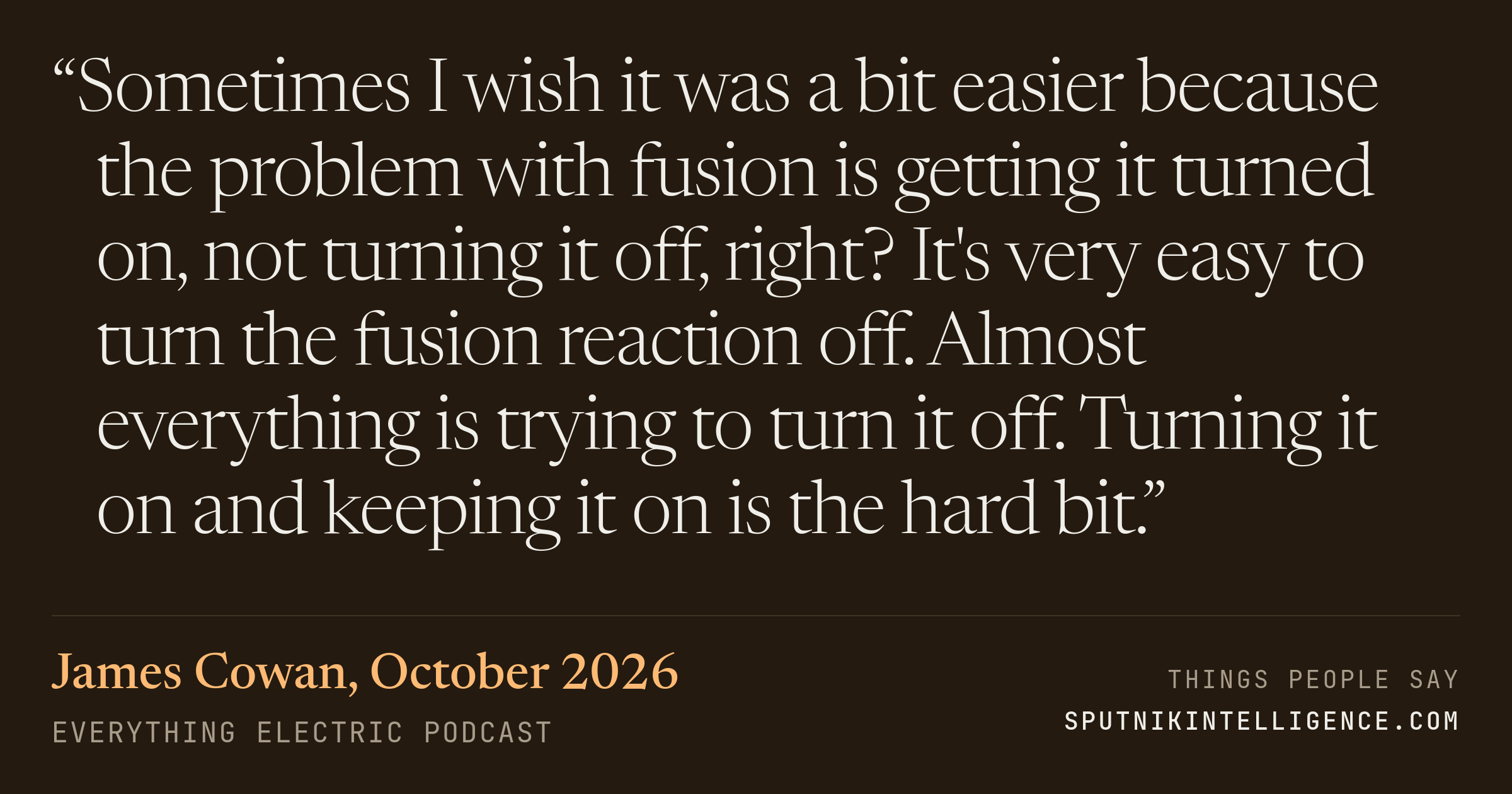
Cowan, who works on the UK's fusion programme, responding to Robert Llewellyn's point that runaway reactions can't happen in fusion. He says that's why fusion in the UK is regulated by the Environment Agency and the Health and Safety Executive rather than the nuclear regulator.
Transcript
But if you compare it, if you compare it to the similar sorts of things that we have, we think we're going to be broadly there or thereabouts. And we're doing that work now to make sure that we are because it's no good progressing with a design that's not, because then it's not credible.
But then the point is, you also have the fuel available locally, and there's less the concerns about radioactive waste are much lower, much lower, all of that stuff. Much lower than that. Runaway reactions and stuff don't happen with can't
happen. Yeah, there's no, there's no, there's no, there's no, um, there's no critical chain of events that run through. I mean, sometimes I wish it was a bit easier because the problem with fusion is getting it turned on, not turning it off, right? It's very easy to turn the fusion reaction off. Almost everything is trying to turn it off, turning it on and keep it onto the hard bit, whereas fission is slightly different. But yeah, there's, there's, you know, the waste challenge is very different. The safety challenge is very different. It's why we're regulated differently. Fusion in the UK is not regulated by the Office of Nuclear Regulation like Fission. We're regulated by the Environment Agency and the Health and Safety Executive using basically the same regulation that's already out there. And we're working really closely with the regulators to understand, to help them understand the challenges of fusion. And then they're doing their work to understand how they will regulate us. So we're already helping to understand that regulatory…
it's also in sort of potentially a UK export is what you're saying. It's actually develop the technology here, we can then export that
100%. I mean, you asked earlier about the size of the size of the prize. So our estimates and estimates of other. Organizations is that for the second half of this century, commercial fusion power could be worth upwards of 10 trillion pounds. That's a large number. It's
a very big number. That's
More from Everything Electric Podcast