 Aalok Mehta
Director of the Wadhwani AI Center at CSIS, where he leads research on AI policy.
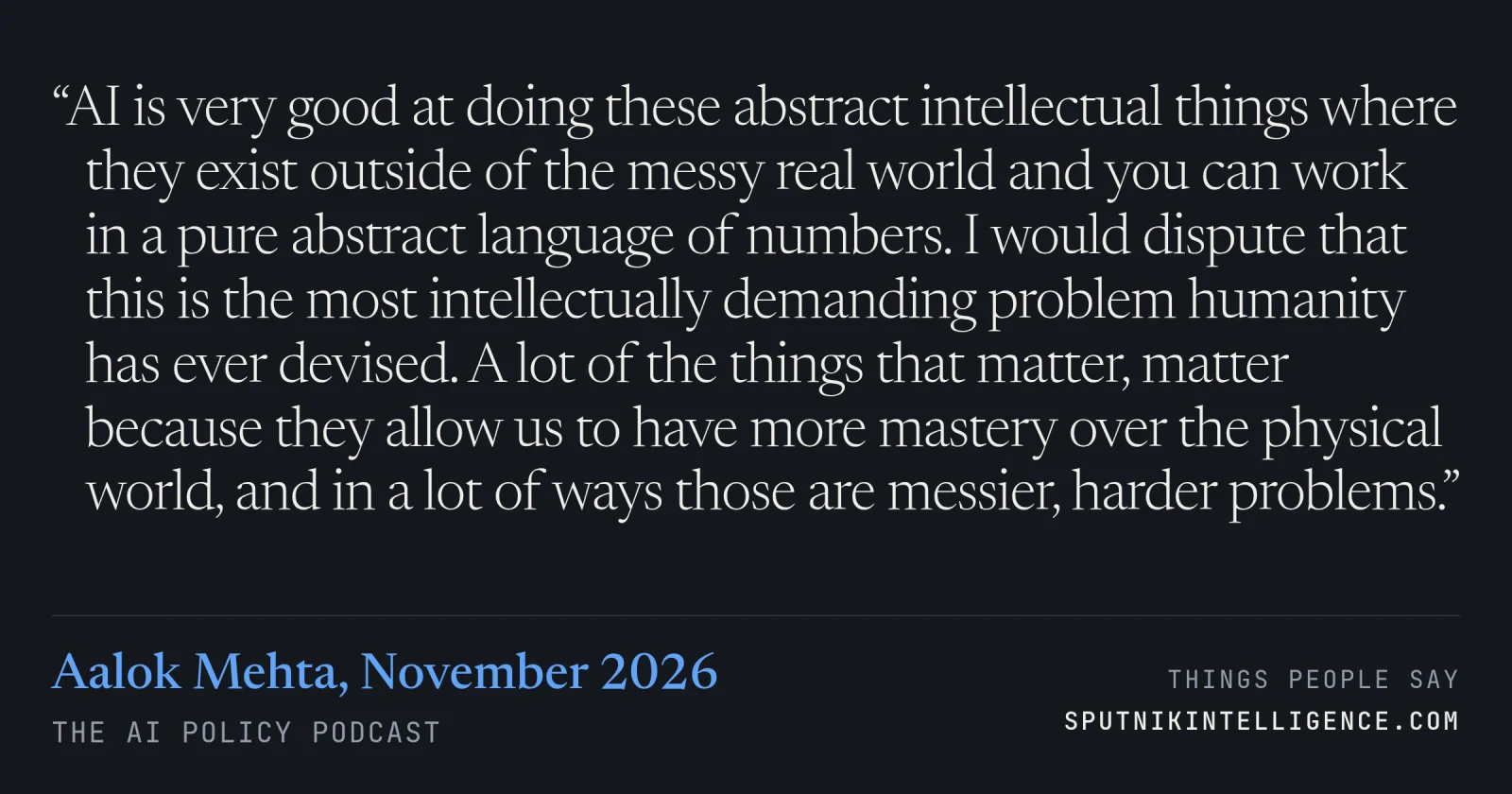
“AI is very good at doing these abstract intellectual things where they exist outside of the messy real world and you can work in a pure abstract language of numbers. I would dispute that this is the most intellectually demanding problem humanity has ever devised. A lot of the things that matter, matter because they allow us to have more mastery over the physical world, and in a lot of ways those are messier, harder problems.”
The AI Policy Podcast · Geopolitics & World Affairs · November 2026
Context
His co-host had read from an essay calling the Riemann hypothesis, reportedly proved with AI's help, perhaps the hardest problem ever devised. He pushes back on what the proof says about AI's reach in the real world.
Transcript
…And it's unclear, you know, when push comes to shove, how much of Anthropic's governance structure that's established on paper will allow it to continue to prioritize safety, even in the face of market pressures and various other pressures that come from being public. So we'll just have to see.
…with other challenges such as experimentation, data, and feedback loops. The remaining gaps for models to greatly surpass humanity in every field are no longer intelligence. They are domain-specific know-how, plumbing, and experimentation. End quote. So, Alok, what's your reaction to that take?
I mean, in some ways, I think there's a clear trend here that AI is very good at doing these sort of abstract intellectual things where they sort of exist outside of the messy real world and sort of you can work in a pure sort of abstract language of numbers. I think I would dispute this idea that that means that it's the most intellectually demanding problem humanity has ever devised. I think that is true in a very narrow sense, but I think. A lot of the things that matter matter because they allow us to have more mastery over the physical world. And so, in a lot of ways, I think those are messier, harder problems. You really have to, you know, account for a lot more things. And so, I wouldn't, I still think that those things are important, right? Ultimately, solving this particular hypothesis has very little practical application. We're not going to suddenly see new inventions as a result of it, at least to the best of my knowledge. And so, I think this is a trend that, yes, it looks like AI is going to be very good at math. We've already had other domains where we think now that the best AIs are always going to beat or nearly always going to beat the best humans. A lot of those have been in games. And so…
Yeah, and turning now to news from the White House AI Trump traveled to China for the APEC meeting last week. And while he was there, he met with Chinese and Russian leaders, Xi Jinping and Vladimir Putin. So, can you tell us about that meeting? Did anything significant come out of that trip?
Yeah, there are signs that there was some discussion about AI Policy. We are awaiting details. We're still awaiting details on some of the stuff that the U.S. and China had previously agreed on. For example, this AI Policy where the U.S. and Chinese officials could discuss AI incidents. In this…
Before we fully wrap up, I think there are a few stories we wanted to briefly mention. So, I'll let you start off with.
More from The AI Policy Podcast