 Mihail Eric
On Latent Space
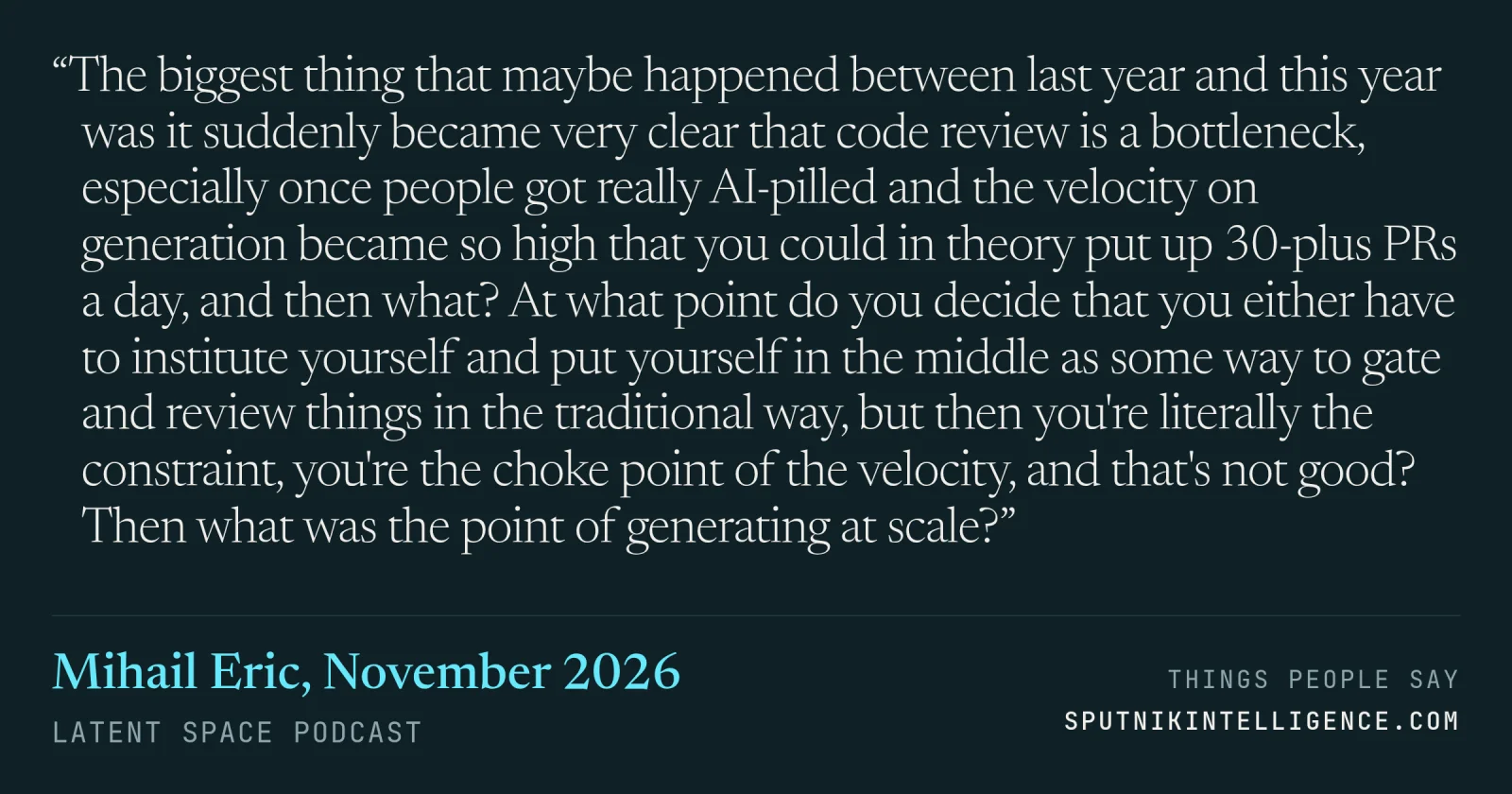
“The biggest thing that maybe happened between last year and this year was it suddenly became very clear that code review is a bottleneck, especially once people got really AI-pilled and the velocity on generation became so high that you could in theory put up 30-plus PRs a day, and then what? At what point do you decide that you either have to institute yourself and put yourself in the middle as some way to gate and review things in the traditional way, but then you're literally the constraint, you're the choke point of the velocity, and that's not good? Then what was the point of generating at scale?”
Latent Space · AI Builders · November 2026
Context
Introducing the code-review week of his Stanford course on AI-native engineering. Eric lays out the dilemma that once agents generate code this fast, human review becomes the limiting step, then discusses which kinds of change can safely be auto-approved.
Transcript
…backed up. It takes too long to stand up an app. There's just actually more foundational things that have almost nothing to do with that throwing in one more SRE bot or a law a bot wouldn't be the answer to the problem because there's like more systemic things that they need to figure out and so
that brings us to the week stage yeah exactly right so that's that's where we get into
yeah exactly right yeah there we go to the merge queue and beyond um yeah this is a yeah a love letter of sorts to modern gen tech code review um yeah i think that the the the biggest thing that maybe happened between last year and this year was just it suddenly became very clear that code review is a bottleneck especially once you people got really AI pilled and the velocity on generation became so high that you could in theory like put up 30 plus PRs a day and then what? At what point do you decide that you either have to institute yourself and put yourself in the middle as some way to gate and review things in the traditional way, but then you're literally the constraint, you're the choke point of the velocity and that's not good, right? Then what was the point of generating at scale? Or you say, well, how do we maybe get the best of both worlds where we're instituting ourselves enough that we have trust in what's getting merged, but we're also able to kind of like merge it scale, but we're also not kind of freewheeling it here and anything goes. So a lot of, I think what I want to touch on here is just that middle ground, right? Which is like, there is a class of problems that if you've put in thoughtful design into your agent readiness, you've put in thoughtful design around your verifiability, there's a class of problems that you can feel comfortable, you know, some percentage…
One of our hottest topics of this year, we have a guest writer program for Latin Space. This is from Ankit from Aviator. Yes. And he has a whole thing on killing the code review. Because that is maybe the final boss of that's a bottleneck. He has a few gates by which he does this. I don't know if…
I've read this post. I haven't spoken to him personally, but I've definitely read this. Mostly right.
Any criticisms? No, I think this
More from Latent Space