 Paul Ford
Writer and co-founder of Aboard, who has published essays and stories on Ftrain.com since 1997 and writes about software, AI and vibe coding.
Paul Ford
Writer and co-founder of Aboard, who has published essays and stories on Ftrain.com since 1997 and writes about software, AI and vibe coding.
“When it gets into that weird social relationship where it's telling you that was a good idea, that's actually where my alarm bells go off... The native buttering up of these technologies, I think is really dangerous.”
Rosenfeld Review Podcast · User Experience · May 2026
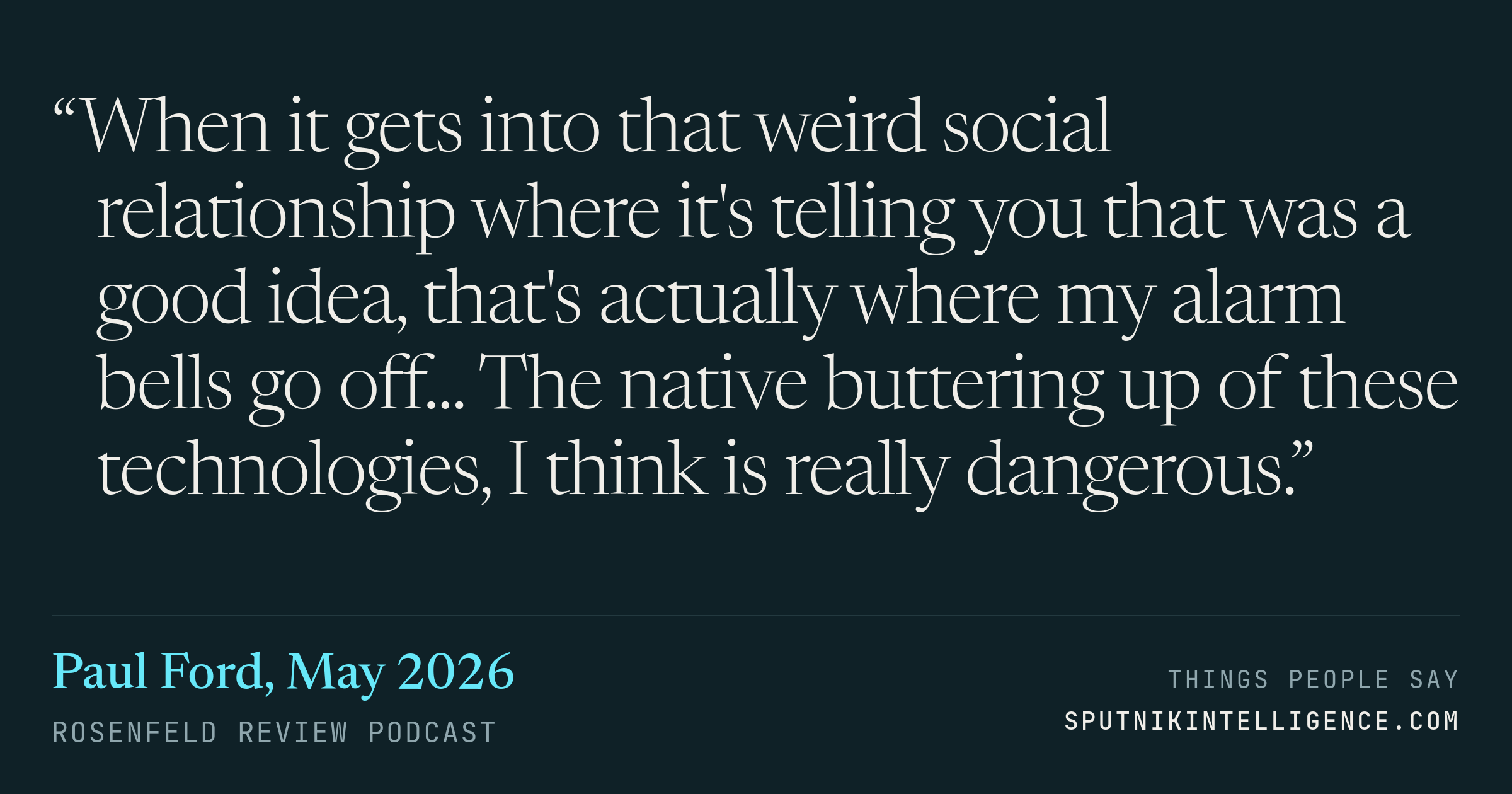
Paul has described a system he built that runs business models and reports the numbers back. Its side effect, he says, is that it cannot flatter him: a bad idea that loses $500,000 a year gets reported as losing $500,000 a year. He compares AI praise to employees telling the boss an idea is good.
Transcript
What if we spend another $2 million on marketing directly to doctors? And it'll kind of move the sliders around in its weird brain because it's just running a program. The outputs show up and it's like, here's what I think. And you can kind of get it to narrate that back to you. But you also get the stats. And so to me, these are ways of using this stuff where you never, I don't want to get far away from the process, the thinking process. It's my thinking process, not its. But boy, is it nice. I have it summarize the news every morning. And sometimes I have it just make up a weird product idea, run the business model and report back on how it did. It's never something I want to build. It's never good. But it's a way for me to keep thinking about the client and about their business, right? So there's ways to mess with this stuff where I think you get to move forward and you get to think your thoughts without letting it kind of take over. But
there is a rule in there, right? The rule is you are not looking for it to do shortcuts for you. You're looking for it to be productive for you, but you're still doing the primary thinking. You're looking at it to create framework. I mean, a business model is just a framework like it is a program. Those are things that you've selected if you haven't come up with yourself. But I think most of us, I'll put my hand up here as guilty as charge is we are doing the shortcuts. We are okay with mediocre when, I mean, like, all right, I'll put it to you this way. There's, I do a lot of writing and I hate doing a lot of that writing. It's boring, it's tedious, and it's throwaway. And I use Gen AI to bring shitty shards of idea and information up to a mediocre average level. I wouldn't do that with important writing, but man, I'm so happy to do it with stuff that would take me an hour. Now takes me five minutes. Great. Is that the kind of shortcut that we should be avoiding because there's the slippery slope? Or what you think?
I can't tell you what to do. I don't know. Like, I know what for me, I know what I feel comfortable doing for clients, right? Like, that's, I mean, I'll play with, I'll have it make a stupid image and drop it in the group chat or like I've explored all this stuff. But there's just like, for me, it's, you know, one of the number one tells for me. And this is where if we want to turn this to a rule, the system I just described to you, it's pretty abstract. Not everybody's going to want to build this way. Not everybody's going to work this way, but it has one amazing side effect is it's not sycophantic. It said, if I give it a bad business idea that generates negative 500. thousand dollars a year it says that generated negative five hundred thousand dollars a year and it can't be like wow what a good boy are you it has to acknowledge that right because the number is there that's what it's summarizing from so i would say that if you understand what it's generating and you know the context that you're using it it's a tool like any other it's a weird database But when it gets into that weird social relationship where it's telling you that was a good idea, that's actually where my alarm bells go off. Because anyone, you've been a boss, when anybody tells you it's a good idea and they work for you, you got to be careful because they might just be buttering you up. They might also think it's a good idea, but they might just be buttering you up. The native buttering up of these technologies, I think is really dangerous because, God, you always want to hear it, especially when you're a boss. When you're a boss, you just want somebody to say good job. And they're never going to say good job because you're the boss. Or you
can't believe them.
Yeah, you can't, right? And so, like, and it just kind of is a sucky thing about life that you have to kind of always keep a kind of neutral affect and be like, well, maybe it is good, but we're going to have to verify that, right? You have a successful publishing company because you have a metric for what is good. And somebody might come up to you and be like, it's the best book on XYZ I ever read, but you might know that it didn't sell as well as something else. And you have to kind of factor that in as you're processing all that information. You got this thing telling you you're smart all day long. And smart people want to hear that all day long. It's very dangerous. That part to me, having it generate, having it fill in a blank page that you kind of don't want to deal with. And then you go and you're like, all right, this is okay. Let's get it over the line. You know, talking to you guys do you publish a lot of stuff, like talking to the companies that print, right? Like having it like just sort of draft an email for you. I don't give
me a quote. Give
More from Rosenfeld Review Podcast