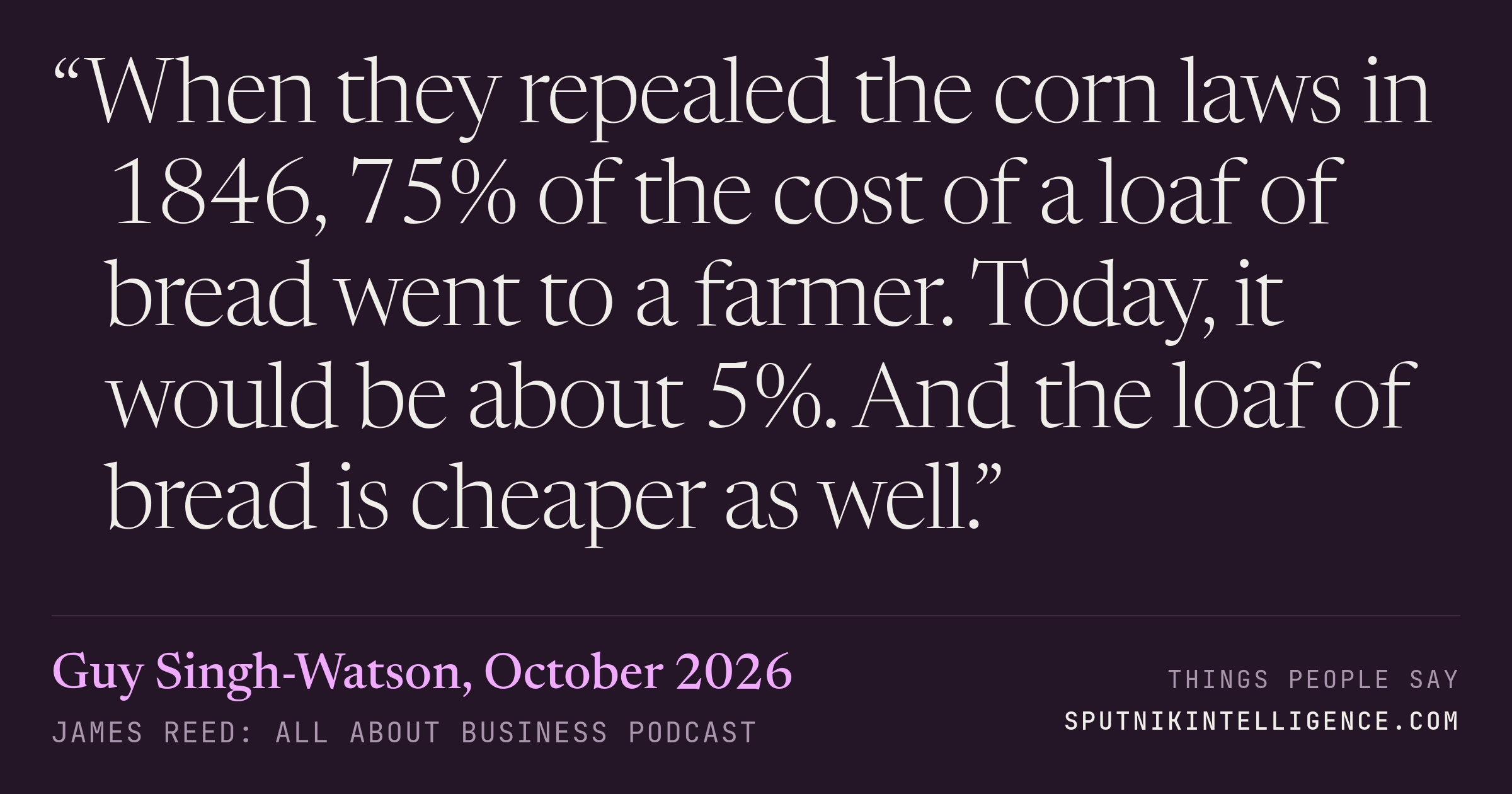
“When they repealed the corn laws in 1846, 75% of the cost of a loaf of bread went to a farmer. Today, it would be about 5%. And the loaf of bread is cheaper as well.”
James Reed: all about business · October 2026
The guest, a vegetable farmer and founder of the Riverford box scheme, was asked why he says cheap food is not really cheap. His answer was that food has become cheaper for shoppers while the farmer's share of what they spend has collapsed.
Transcript
It is. And there's no doubt that as you get older, you know, your appetite for stability increases. We just change, I think. And I do think I still have a lot to contribute, but I think it is time for other people to step into my shoes in a lot of areas.
Which you've done in a very interesting way, which we'll come to with the employee ownership. But you mentioned a moment ago about supermarkets. And you've said that cheap food is not really that cheap. So what's happening here? Well, it's mostly around food production and so on.
So we, I mean, farming is now down to 0.6% of GDP. I mean, we most of us spend, on average, around about 10% on food, but what actually goes of our income on food, but what actually goes to the farmer is about 0.6 of a percent. Food at the farm gate has just got cheaper and cheaper and cheaper. And what we spend on food, whether in a supermarket or a restaurant, particularly in a supermarket, has got relatively cheaper. But that's a double whammy for the farmer because the share that they get has just declined and declined and declined. When they repealed the corn laws in 1846, 75% of the cost of a loaf of bread went to a farmer. Today, it would be about 5%. And the loaf of bread is cheaper as well. So
5 or 6p in the pound is all the farmer gets when you spend money in the business.
For meat, it would be more. For vegetables, it might be 25 pence in the pound. Which begs the question, where's the other 95 pence going? It's gone into the retailers' pockets. It's gone into the food processing's pockets. And we have a completely dysfunctional food system where all that money has been spent on the middle. But we're getting, you know, we're getting certainly in the last 20 years, just worse and worse food. And we're seeing that at the doors of our hospitals and doctors' surgeries with obesity and type 2 diabetes. We have a completely dysfunctional food system, which is the result of a completely rational application of neoliberal economics. But the result of it is completely irrational if you look at how we are behaving. We all live in an obesogenic environment where we are tempted to eat the foods which are killing us.
Literally.
More from James Reed: all about business