GS

Guy Singh-Watson

Things Guy Says on Podcasts

Where to Find Them

Guy Singh-Watson has been a guest on James Reed: all about business and The Knepp Wilding Podcast .

Recently: “99. How to cash out without selling out | Guy Singh-Watson” on James Reed: all about business (October 2026); “Rebelling with Integrity: Geetie & Guy Singh-Watson on Food, Farming, and Fairness” on The Knepp Wilding Podcast (November 2025).

What They Said

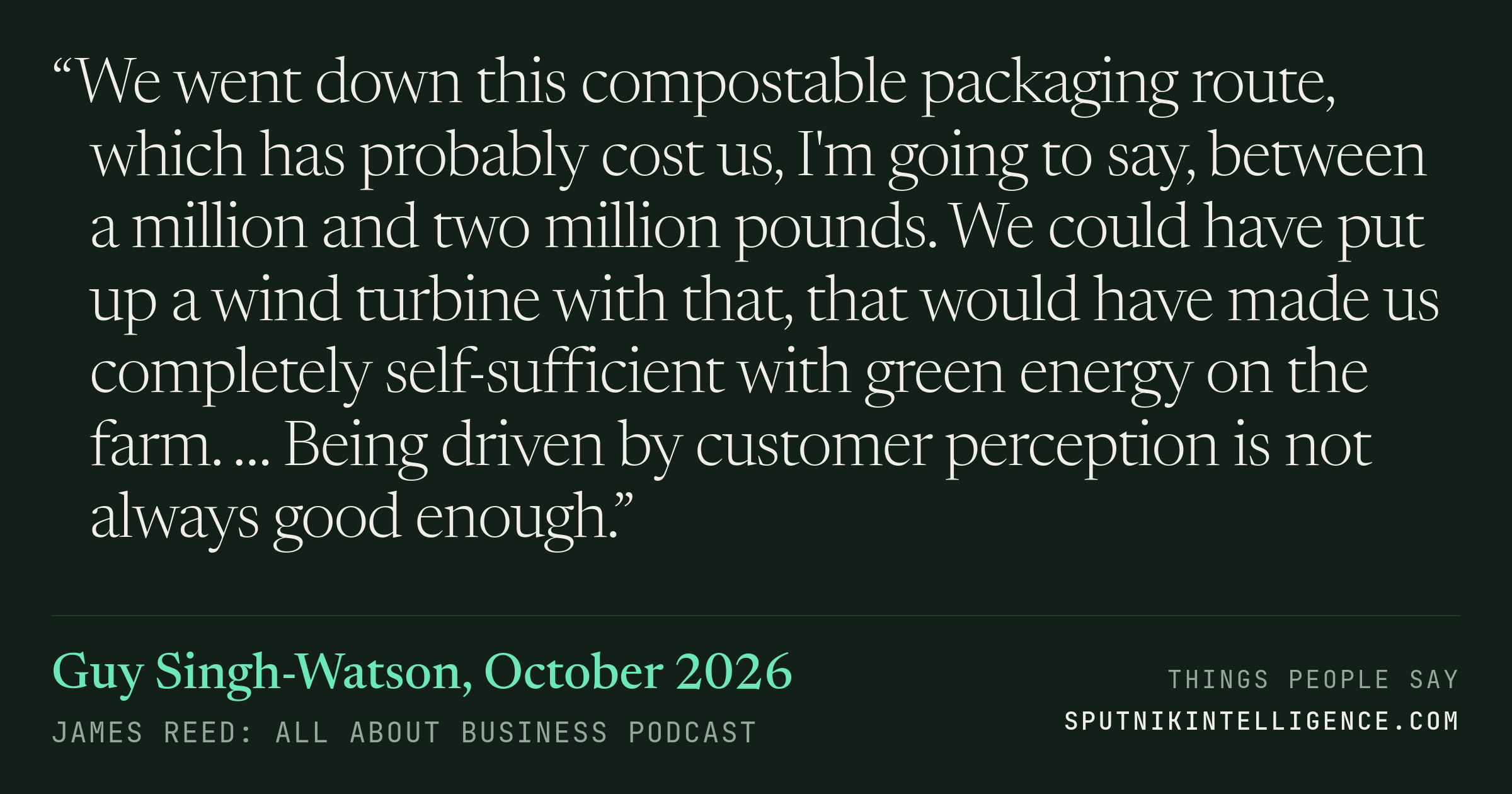
“We went down this compostable packaging route, which has probably cost us, I'm going to say, between a million and two million pounds. We could have put up a wind turbine with that, that would have made us completely self-sufficient with green energy on the farm. … Being driven by customer perception is not always good enough.” — Guy Singh-Watson, James Reed: all about business

Singh-Watson said his company switched from plastic to compostable packaging because customers found plastic unacceptable. Research had suggested most of it would be composted, and that turned out not to be the case, so the decision is under review.

James Reed: all about business · 2026-10-05 Permalink → Listen →
James Reed: all about business Around 42:24 into the episode
Speaker 2

moved, God, it must be six or seven years ago. I think after the Blue Planet came out or something, and there was a whole thing about marine pollution and plastics. And we already used about 15% of the amount of plastic the supermarket does per kilo of vegetable use. But we did take the decision to go to compostable packaging because all our customers were saying that this use of plastic was completely unacceptable. We are having to review that decision. We still haven't sort of finally. It's become compromised over the years. But mainly because, despite the fact we did our research and I think 85% of it looked like it was going to be composted, it's turned out it hasn't ended up like that. So you then, it's quite technical. I can go into it, James. I'd like

Speaker 1

to understand this. You tried to do that. So

Speaker 2

we were driven by customer perception. We did a bit of research and it seemed like the right thing to do. We didn't do enough research, I don't think. But we did more research than most people did. And we went down this compostable packaging route, which has... probably cost us I'm gonna say between a million and two million pounds I we could have put up a windmill wind turbine with that would have made us completely self-sufficient with green energy you know on the farm and that I think would have been a much better way of spending the money I'm just saying being driven by customer perception is not always good enough sometimes customer

Speaker 1

hypocrisy is you know that they're buying plastic in other supermarkets yeah and all they tell us

Speaker 2

they want all UK stuff or a lot of customers does we do have a UK only box and it is doing reasonably well now I think it's it's actually it's done a lot better in the last few years I think it's maybe four percent of our sales it never got above one percent

Speaker 1

uk only really uk

Speaker names from our own diarization · position estimated from where the line sits in the episode
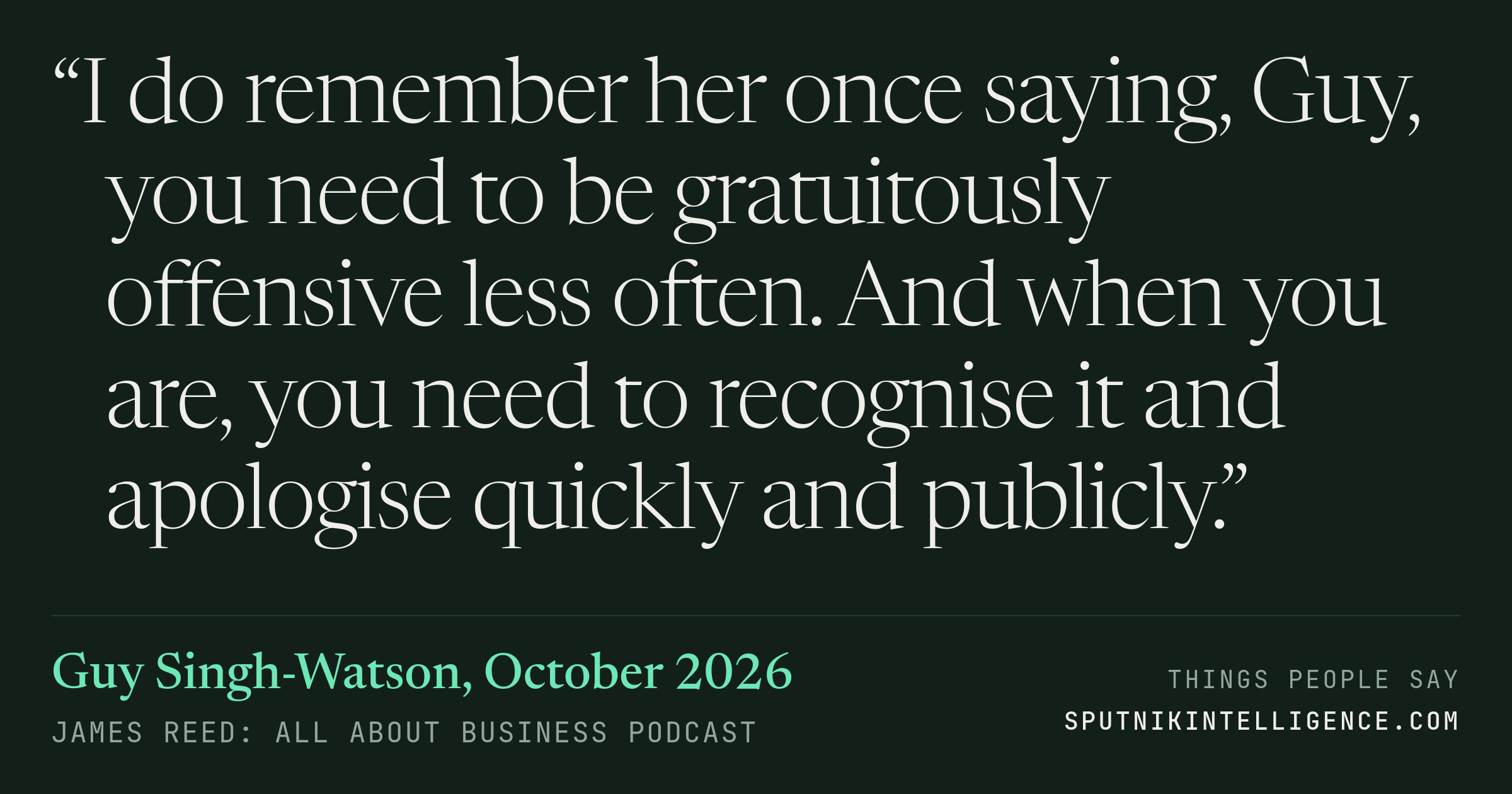
“I do remember her once saying, Guy, you need to be gratuitously offensive less often. And when you are, you need to recognise it and apologise quickly and publicly.” — Guy Singh-Watson, James Reed: all about business

Singh-Watson was recalling advice from a coach who had watched how he behaved at work. He said he had known his company had cultural problems without thinking they could be his, and that learning to apologise changed things.

James Reed: all about business · 2026-10-05 Permalink → Listen →
James Reed: all about business Around 28:22 into the episode
Speaker 2

I think she was, you know, takes a lot of credit. My wife gets a bit annoyed. I give her all the credit. My wife takes

Speaker 1

some as well. Get

Speaker 2

some of the credit as well. But I guess holding the mirror up to me, she would sometimes witness my behavior. And I do remember her once saying, Guy, you need to be gratuitously offensive less often. And when you are, you need to recognise it and apologise quickly and publicly. And I can't help noticing how I think I was quite poor at apologising. And actually, a genuine apology, you have to believe what you're saying, but it's actually a really easy thing to do when you learn how to do it. And it just changed the room. The fact that I could acknowledge that I'd got it wrong and I'd learned and I'd move forward meant that other people could. And it just really, it did really radically change. I knew that we had cultural problems at Riverford. I didn't think they could possibly be my. But they absolutely were. They started at the top. And I think she recognised that and says, you know, we've got to deal with you first, guy, and then we'll work on everyone else.

Speaker 1

So the culture of the company changed as a result of your behavior. And this was changing.

Speaker 2

This was whilst we were approaching employee ownership. Yes, I think so. They used to call it the Riverford crane. You know, someone would just pick you up and toss you out the window. You were collateral damage. You were gone. It was. I mean, there were good things as well. I'm painting quite a bleak picture. I mean, I think it was quite inspirational. I mean, as a lot of those Maverick entrepreneurs are, they tend to inspire people and lead people, but they often lead them in the wrong direction.

Speaker 1

What I'm thinking, this thing is that you said earlier that a lot of decision-making is actually emotional.

Speaker names from our own diarization · position estimated from where the line sits in the episode
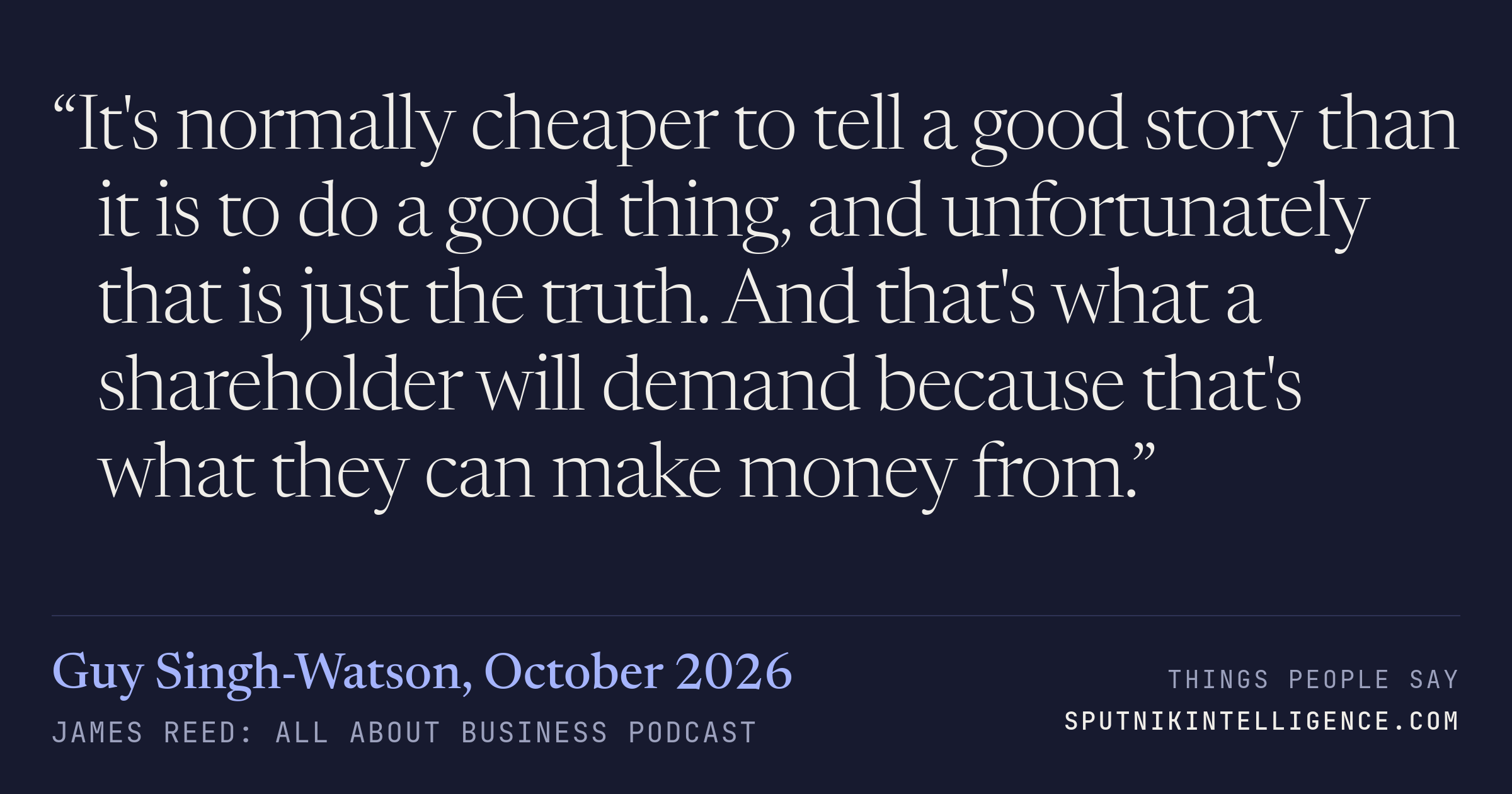
“It's normally cheaper to tell a good story than it is to do a good thing, and unfortunately that is just the truth. And that's what a shareholder will demand because that's what they can make money from.” — Guy Singh-Watson, James Reed: all about business

Singh-Watson was talking about greenwash in food retail, giving the example of supermarket own-brand labels named to sound like British family farms. He said most shoppers want to do the right thing but are too busy to be well informed.

James Reed: all about business · 2026-10-05 Permalink → Listen →
James Reed: all about business Around 46:04 into the episode
Speaker 3

yes there is what they actually

Speaker 1

want and this might be difficult yeah

Speaker 2

so i do i think we should be willing to push back against the customer is always um right uh you know it because it's just too i think most people want to do the right thing given the right information but they don't have the right information and and and it's really easy with a clever advertising company you know to to pretend you're doing the right thing when you're not there's you know a huge amount of green wash and uh you know and in my sector we have tesco's with eight brands which to all intents and purposes look they come from british family farms rosendale farms but i think peppers and vegetables they might come from egypt or whatever but or willow farm for their chicken sounds like a british family farm uh it's actually the brand is sort of administered effectively by global corporation uh and and and the chickens never go outside and it's hideous so you know you can it's because we have such busy lives and we can't possibly be that well informed on everything i'm afraid people have just got too used to the idea or business has got it's it's normally cheaper to tell a good story than it is to do a good thing and and uh unfortunately that is just the truth and that that's what a shareholder will demand because that's what they can make money from and and that's what that's what we get a lot of greenwash

Speaker 1

you've you've said that some of the farmers supplying riverford you know would no longer be in business without you um how how how do you decide what you know what is a fair price and to sort of be the other side of this equation

Speaker 2

okay well we are farmers ourselves so we still grow about 20 of what goes in the boxes so we kind of know what we can produce it for and uh expect other people to be able to produce it as at a somewhat similar but mostly we ask you know we we sit down in october with our suppliers and and say you know what would you like to grow next year what do you want to grow more of what do you want to grow less of you know what do you need to stay in business and to invest in your in your businesses in the future and and historically there hasn't been much pushback against that i don't think that's actually sustainable i i don't think that which is essentially a cost plus business the way you've

Speaker 1

been doing it kind of

Speaker names from our own diarization · position estimated from where the line sits in the episode
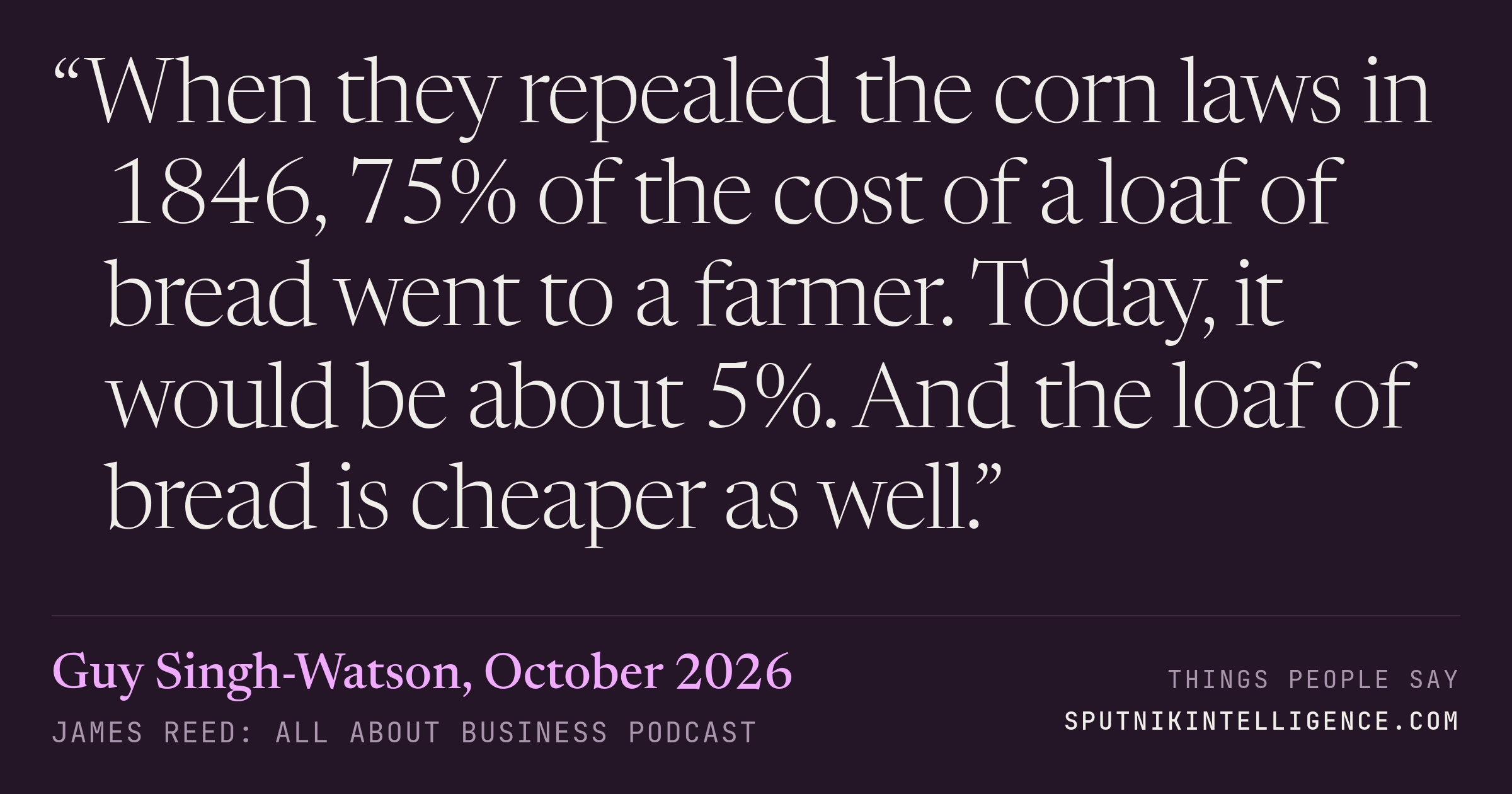
“When they repealed the corn laws in 1846, 75% of the cost of a loaf of bread went to a farmer. Today, it would be about 5%. And the loaf of bread is cheaper as well.” — Guy Singh-Watson, James Reed: all about business

The guest, a vegetable farmer and founder of the Riverford box scheme, was asked why he says cheap food is not really cheap. His answer was that food has become cheaper for shoppers while the farmer's share of what they spend has collapsed.

James Reed: all about business · 2026-10-05 Permalink → Listen →
James Reed: all about business Around 14:20 into the episode
Speaker 2

It is. And there's no doubt that as you get older, you know, your appetite for stability increases. We just change, I think. And I do think I still have a lot to contribute, but I think it is time for other people to step into my shoes in a lot of areas.

Speaker 1

Which you've done in a very interesting way, which we'll come to with the employee ownership. But you mentioned a moment ago about supermarkets. And you've said that cheap food is not really that cheap. So what's happening here? Well, it's mostly around food production and so on.

Speaker 2

So we, I mean, farming is now down to 0.6% of GDP. I mean, we most of us spend, on average, around about 10% on food, but what actually goes of our income on food, but what actually goes to the farmer is about 0.6 of a percent. Food at the farm gate has just got cheaper and cheaper and cheaper. And what we spend on food, whether in a supermarket or a restaurant, particularly in a supermarket, has got relatively cheaper. But that's a double whammy for the farmer because the share that they get has just declined and declined and declined. When they repealed the corn laws in 1846, 75% of the cost of a loaf of bread went to a farmer. Today, it would be about 5%. And the loaf of bread is cheaper as well. So

Speaker 1

5 or 6p in the pound is all the farmer gets when you spend money in the business.

Speaker 2

For meat, it would be more. For vegetables, it might be 25 pence in the pound. Which begs the question, where's the other 95 pence going? It's gone into the retailers' pockets. It's gone into the food processing's pockets. And we have a completely dysfunctional food system where all that money has been spent on the middle. But we're getting, you know, we're getting certainly in the last 20 years, just worse and worse food. And we're seeing that at the doors of our hospitals and doctors' surgeries with obesity and type 2 diabetes. We have a completely dysfunctional food system, which is the result of a completely rational application of neoliberal economics. But the result of it is completely irrational if you look at how we are behaving. We all live in an obesogenic environment where we are tempted to eat the foods which are killing us.

Speaker 1

Literally.

Speaker names from our own diarization · position estimated from where the line sits in the episode